 Back
BackStep-by-Step Study Guide for Photosynthesis and Cellular Energetics (AP Biology)
Study Guide - Smart Notes
 Tailored notes based on your materials, expanded with key definitions, examples, and context.
Q1. Define the terms autotroph and heterotroph. Give examples of each.
Background
Topic: Types of Organisms & Energy Acquisition
This question tests your understanding of how organisms obtain energy and the distinction between those that produce their own food and those that rely on others.
Key Terms:
Autotroph: An organism that produces its own food from inorganic substances (usually through photosynthesis).
Heterotroph: An organism that obtains energy by consuming other organisms.
Step-by-Step Guidance
Recall that autotrophs use light or chemical energy to synthesize organic molecules from inorganic sources.
Think of examples: plants (autotrophs), animals (heterotrophs), some bacteria (autotrophs or heterotrophs).
Consider the cellular structures involved: plants have both mitochondria and chloroplasts, enabling both cellular respiration and photosynthesis.
Try solving on your own before revealing the answer!
Final Answer:
Autotroph: An organism that makes its own food, such as plants and algae.
Heterotroph: An organism that consumes other organisms for energy, such as animals and fungi.
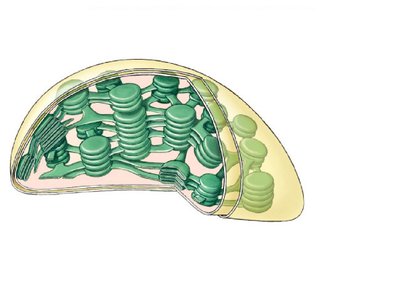
Q2. Label the following parts of the chloroplast: stroma, thylakoid, thylakoid space, inner membrane, and outer membrane.
Background
Topic: Chloroplast Structure
This question tests your knowledge of the anatomy of the chloroplast, which is essential for understanding where photosynthesis occurs.
Key Terms:
Stroma: The fluid-filled space inside the chloroplast, outside the thylakoids.
Thylakoid: Membranous sacs where the light reactions of photosynthesis take place.
Thylakoid Space: The internal space within a thylakoid.
Inner/Outer Membrane: The two membranes surrounding the chloroplast.
Step-by-Step Guidance
Identify the outermost layer as the outer membrane.
Locate the inner membrane just inside the outer membrane.
Find the stacks of green discs (thylakoids) and the space inside them (thylakoid space).
The stroma is the area surrounding the thylakoids within the inner membrane.
Try solving on your own before revealing the answer!
Final Answer:
Outer membrane: the outermost boundary; Inner membrane: just inside the outer membrane; Thylakoid: green disc structures; Thylakoid space: inside the thylakoid; Stroma: fluid area surrounding thylakoids.
Q3. Write out the formula for photosynthesis using both chemical symbols and words (net consumption of water).
Background
Topic: Photosynthesis Chemical Equation
This question tests your ability to recall and write the balanced equation for photosynthesis, which is fundamental to understanding the process.
Key Formula:
Where:
= carbon dioxide
= water
= glucose
= oxygen
Step-by-Step Guidance
Recall the reactants: carbon dioxide, water, and light energy.
Recall the products: glucose and oxygen.
Write the equation using chemical symbols.
Write the equation in words.
Try solving on your own before revealing the answer!
Final Answer:
Chemical:
Words: Six molecules of carbon dioxide and six molecules of water, using light energy, produce one molecule of glucose and six molecules of oxygen.
Q4. Briefly describe the functions of the two stages of photosynthesis: light-dependent reactions and light-independent reactions (Calvin cycle).
Background
Topic: Photosynthesis Stages
This question tests your understanding of the two main stages of photosynthesis and their roles in energy conversion and carbon fixation.
Key Terms:
Light-dependent reactions: Convert solar energy to chemical energy (ATP and NADPH).
Light-independent reactions (Calvin cycle): Use ATP and NADPH to fix carbon dioxide and produce glucose.
Step-by-Step Guidance
Recall that light-dependent reactions occur in the thylakoid membranes and require sunlight.
Understand that these reactions produce ATP and NADPH, which are used in the next stage.
Light-independent reactions (Calvin cycle) occur in the stroma and use ATP and NADPH to convert CO2 into glucose.
Try solving on your own before revealing the answer!
Final Answer:
Light-dependent: Capture energy from sunlight to produce ATP and NADPH.
Light-independent: Use ATP and NADPH to fix carbon dioxide and synthesize glucose.
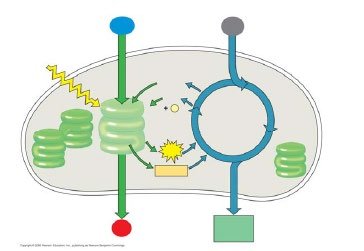
Q5. Label figure 8.5 and underline items cycled between the light reactions and the Calvin cycle.
Background
Topic: Photosynthesis Overview & Cyclic Components
This question tests your ability to visualize the flow of molecules and energy between the two stages of photosynthesis.
Key Terms:
ATP, NADPH: Cycled between light reactions and Calvin cycle.
CO2, O2, Glucose: Key molecules involved.
Step-by-Step Guidance
Identify the main components: thylakoid, stroma, ATP, NADPH, CO2, O2, glucose.
Label the diagram with these components.
Underline ATP and NADPH as they are cycled between the light reactions and the Calvin cycle.
Try solving on your own before revealing the answer!
Final Answer:
ATP and NADPH are cycled between the light reactions and the Calvin cycle. CO2 enters the Calvin cycle, O2 is released from the light reactions, and glucose is produced in the Calvin cycle.
Q6. Explain the correlation between an absorption spectra and an action spectrum.
Background
Topic: Light Absorption & Photosynthetic Activity
This question tests your understanding of how different wavelengths of light are absorbed by pigments and how this relates to photosynthetic activity.
Key Terms:
Absorption spectrum: Shows which wavelengths of light are absorbed by pigments.
Action spectrum: Shows the rate of photosynthesis at different wavelengths.
Step-by-Step Guidance
Recall that pigments absorb specific wavelengths of light.
Compare the absorption spectrum of chlorophyll to the action spectrum of photosynthesis.
Note that peaks in the absorption spectrum often correspond to peaks in the action spectrum.
Try solving on your own before revealing the answer!
Final Answer:
The action spectrum matches the absorption spectrum, showing that photosynthesis is most efficient at wavelengths absorbed by chlorophyll.
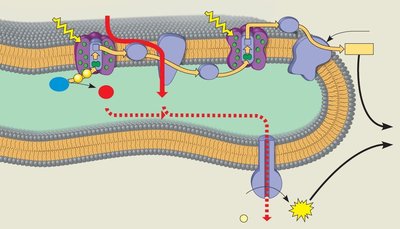
Q7. What is a photosystem? Explain its function.
Background
Topic: Photosystems in Photosynthesis
This question tests your understanding of the structure and function of photosystems, which are essential for capturing light energy.
Key Terms:
Photosystem: A complex of proteins and pigments that absorbs light and initiates electron transport.
Function: To capture light energy and transfer electrons through the electron transport chain.
Step-by-Step Guidance
Recall that photosystems are located in the thylakoid membrane.
Understand that they contain chlorophyll and other pigments.
Photosystems initiate the transfer of electrons when light is absorbed.
Try solving on your own before revealing the answer!
Final Answer:
A photosystem is a protein-pigment complex that absorbs light and transfers electrons, starting the process of photosynthesis.
