 Back
BackStructure and Function of Cells: Cell Theory, Types, and Organelles
Study Guide - Smart Notes
 Tailored notes based on your materials, expanded with key definitions, examples, and context.
Structure and Function of Cells
Cell Theory
The Cell Theory is a foundational concept in biology that describes the properties of cells, the basic unit of life. It consists of three main points:
All living things are composed of cells and cell products.
A single cell is the smallest unit that exhibits all the characteristics of life.
All cells come only from preexisting cells.
These principles remain central to modern biology and guide our understanding of life processes.
Classification of Cells
Cells are classified based on their internal organization into two main types: prokaryotic and eukaryotic cells.
Prokaryotic Cells: Simpler structure, lack membrane-bound organelles, DNA is located in a nucleoid region, surrounded by a plasma membrane and often a rigid cell wall. Examples include Bacteria and blue-green algae.
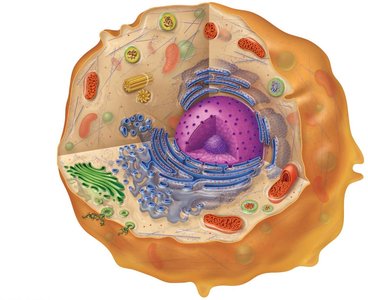
Eukaryotic Cells: More complex, contain a true nucleus (membrane-bound genetic material), cytoplasm with specialized organelles, and a plasma membrane. Examples include animal and plant cells.
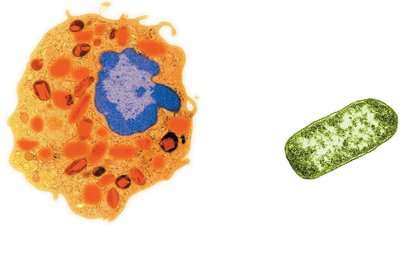
All cells are surrounded by a plasma membrane, which encloses the cell's contents and regulates the movement of substances in and out.
Structure Reflects Function
Although all cells share basic functions—such as gathering raw materials, excreting wastes, synthesizing macromolecules, and reproducing—they exhibit structural differences that reflect their specialized roles:
Muscle cells: Contain many organelles for energy production.
Nerve cells: Long and thin, specialized for transmitting signals.
Red blood cells: Round and flexible, allowing passage through capillaries.
Every eukaryotic cell is specialized to perform particular functions within an organism.
Cell Size and Efficiency
Cells remain small to maximize efficiency. Key principles include:
Metabolic activities are proportional to cell volume.
All materials must cross the plasma membrane; as cells grow, volume increases faster than surface area, limiting exchange efficiency.
Microvilli are microscopic projections that increase surface area, commonly found in the digestive tract and kidney tubules.
Smaller cells are more efficient at exchanging materials with their environment.
Microscopes in Cell Biology
Due to their small size, cells require magnification for observation. Three main types of microscopes are used:
Light Microscope: Magnifies up to 1000x, suitable for general cell structure.
Transmission Electron Microscope (TEM): Uses electrons to produce detailed 2D images of internal structures, up to 100,000x magnification.
Scanning Electron Microscope (SEM): Produces 3D images of cell surfaces, also up to 100,000x magnification.
Internal Cell Structures and Functions
The Nucleus
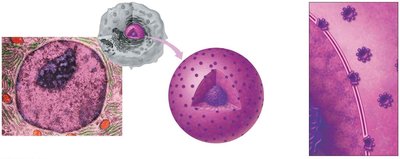
The nucleus is the control center of eukaryotic cells, containing most of the cell's genetic material (DNA). Key features include:
Nuclear membrane: Double phospholipid bilayer that encloses DNA.
Nucleolus: Dense region where ribosomal components are formed.
Nuclear pores: Allow selective movement of materials (e.g., ribosomes, proteins, RNA) in and out, but are too small for DNA to exit.
Ribosomes
Ribosomes are the sites of protein synthesis. They are composed of RNA and proteins, assembled in the nucleolus, and can be found:
Floating freely in the cytoplasm
Attached to the endoplasmic reticulum
Ribosomes link amino acids in the correct sequence to form proteins.
Endomembrane System
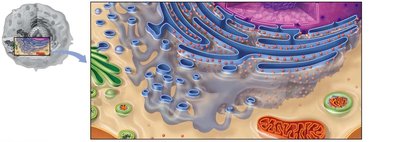
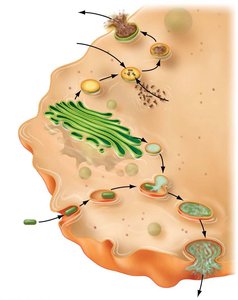
The endomembrane system includes several interconnected organelles responsible for the synthesis, modification, and transport of cellular materials:
Rough Endoplasmic Reticulum (RER): Studded with ribosomes, involved in protein synthesis and initial folding.
Smooth Endoplasmic Reticulum (SER): Lacks ribosomes, synthesizes lipids and some hormones, and packages proteins and lipids for transport.
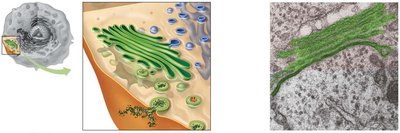
Golgi Apparatus: Receives vesicles from the ER, refines and sorts proteins and lipids, and packages them for delivery.
Specialized vesicles: Transport materials within the cell.
Vesicles and Their Types
Vesicles are small, membrane-bound sacs that transport and store substances within a cell. Major types include:
Secretory vesicles: Export products out of the cell.
Endocytotic vesicles: Bring external materials into the cell.
Peroxisomes: Contain enzymes to break down toxic wastes.
Lysosomes: Contain digestive enzymes to break down bacteria, large particles, and cellular debris.
Mitochondria
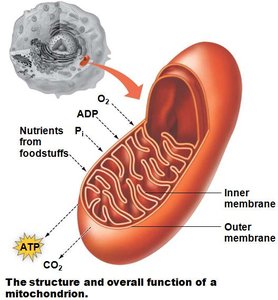
Mitochondria are the cell's powerhouses, converting nutrients into ATP through cellular respiration. Key features:
Double membrane structure: smooth outer membrane, highly folded inner membrane (cristae).
Contain their own DNA and ribosomes.
Number per cell depends on energy requirements (e.g., muscle cells have many mitochondria).
The main reaction is:
Cytoskeleton
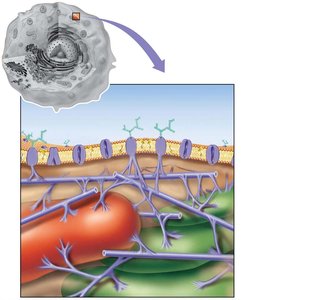
The cytoskeleton provides structural support, maintains cell shape, and anchors organelles. It consists of:
Microtubules: Hollow tubes for support and transport.
Microfilaments: Thin fibers for movement and shape changes.
Cilia and Flagella
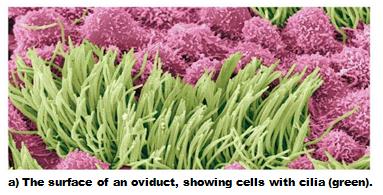
Both are structures made of microtubules that enable movement:
Cilia: Short, numerous, move materials along cell surfaces (e.g., in the respiratory tract, oviduct).
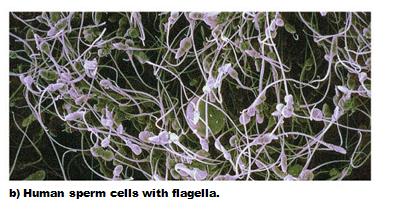
Flagella: Long, few in number, propel cells (e.g., sperm cells).
Centrioles
Centrioles are short, rod-like structures near the nucleus, essential for cell division. They help align and separate genetic material during mitosis and meiosis.
Summary Table: Major Eukaryotic Cell Structures and Functions
Structure | Main Function |
|---|---|
Plasma membrane | Controls movement of materials into and out of cell |
Nucleus | Information center; contains DNA |
Ribosomes | Site of protein synthesis |
Rough ER | Protein synthesis and processing |
Smooth ER | Lipid and hormone synthesis; packaging |
Golgi apparatus | Refines, packages, and ships macromolecules |
Lysosome | Digests damaged organelles and debris |
Peroxisome | Destroys toxic waste |
Mitochondrion | Produces energy (ATP) |
Cytoskeleton | Structural framework |
Centrioles | Involved in cell division |
Cilia/Flagella | Movement |
References: Johnson, M.D. (2017). Human biology: Concepts and current issues (8th ed). Pearson Education Inc.; Johnson, M.D. & Long, S (2021). Human biology: Concepts and current issues (9th ed). Pearson Education Inc.
