 Back
BackStructure and Organelles of Plant and Animal Cells
Study Guide - Smart Notes
 Tailored notes based on your materials, expanded with key definitions, examples, and context.
Plant and Animal Cells
Overview of Eukaryotic Cell Structure
Eukaryotic cells, including both plant and animal cells, contain a variety of membrane-bound organelles that perform specialized functions necessary for cellular life. Understanding the similarities and differences between plant and animal cells is fundamental to cell biology.
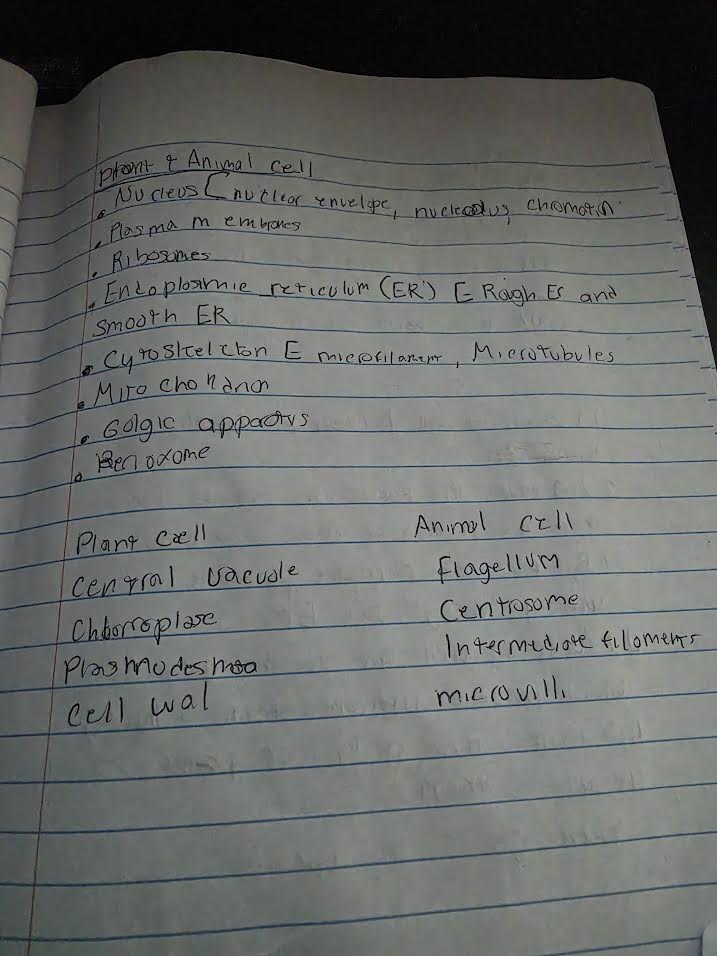
Nucleus: Contains the cell's genetic material (DNA) and is surrounded by the nuclear envelope. It includes the nucleolus (site of ribosome synthesis) and chromatin (DNA-protein complex).
Plasma Membrane: A selectively permeable barrier that controls the movement of substances into and out of the cell.
Ribosomes: Sites of protein synthesis, found either floating freely in the cytoplasm or attached to the rough endoplasmic reticulum.
Endoplasmic Reticulum (ER): A network of membranes involved in protein and lipid synthesis. The Rough ER is studded with ribosomes and synthesizes proteins, while the Smooth ER is involved in lipid synthesis and detoxification.
Cytoskeleton: Provides structural support and facilitates cell movement. Composed of microfilaments, microtubules, and (in animal cells) intermediate filaments.
Mitochondrion: The powerhouse of the cell, responsible for ATP production through cellular respiration.
Golgi Apparatus: Modifies, sorts, and packages proteins and lipids for secretion or delivery to other organelles.
Peroxisome: Contains enzymes that break down fatty acids and detoxify harmful substances.
Unique Features of Plant and Animal Cells
Comparison of Plant and Animal Cell Structures
While plant and animal cells share many common organelles, each type also has unique structures that reflect their specialized functions.
Plant Cell | Animal Cell |
|---|---|
Central Vacuole | Flagellum |
Chloroplast | Centrosome |
Plasmodesmata | Intermediate Filaments |
Cell Wall | Microvilli |
Central Vacuole (Plant): A large, membrane-bound sac that stores water, nutrients, and waste products, and helps maintain turgor pressure.
Chloroplast (Plant): Site of photosynthesis, containing the pigment chlorophyll.
Plasmodesmata (Plant): Channels between plant cell walls that allow for transport and communication.
Cell Wall (Plant): A rigid layer outside the plasma membrane, composed mainly of cellulose, providing structural support.
Flagellum (Animal): A whip-like structure used for cell movement (present in some animal cells, such as sperm).
Centrosome (Animal): The main microtubule organizing center, important for cell division.
Intermediate Filaments (Animal): Part of the cytoskeleton, providing mechanical support.
Microvilli (Animal): Extensions of the plasma membrane that increase surface area for absorption.
Summary Table: Key Differences
Feature | Plant Cell | Animal Cell |
|---|---|---|
Cell Wall | Present | Absent |
Chloroplasts | Present | Absent |
Central Vacuole | Large, single | Small or absent |
Centrosome | Absent | Present |
Flagella | Rare | Common (in some cells) |
Example: Photosynthesis vs. Cellular Respiration
Photosynthesis occurs in chloroplasts (plant cells), converting light energy into chemical energy.
Cellular respiration occurs in mitochondria (both plant and animal cells), converting glucose into ATP.
Additional info: The cytoskeleton is composed of three main types of fibers: microfilaments (actin), microtubules (tubulin), and intermediate filaments (various proteins). The presence of plasmodesmata in plant cells allows for direct cytoplasmic exchange between cells, while animal cells communicate via gap junctions.
