 Back
BackStudy Guide: Cell Division, Genetics, and Inheritance (Mitosis, Meiosis, Mendelian Genetics, Chromosomal Basis of Inheritance)
Study Guide - Smart Notes
 Tailored notes based on your materials, expanded with key definitions, examples, and context.
Cell Division: Mitosis and Meiosis
Key Concepts and Terminology
Cell division is a fundamental process in biology, essential for growth, repair, and reproduction. The two main types of cell division are mitosis and meiosis, each with distinct roles and outcomes. Understanding the terminology and mechanisms is crucial for mastering genetics and inheritance.
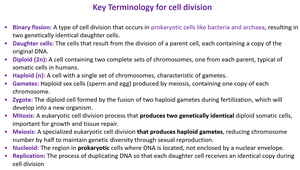
Binary fission: A type of cell division in prokaryotes (e.g., bacteria, archaea) resulting in two genetically identical daughter cells.
Daughter cells: The cells produced from the division of a parent cell, each containing a copy of the original DNA.
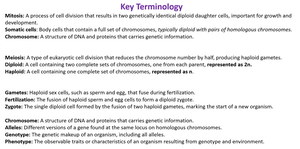
Diploid (2n): Cells with two complete sets of chromosomes, typical of somatic cells in animals.
Haploid (n): Cells with a single set of chromosomes, characteristic of gametes (sperm and egg).
Somatic cells: Body cells that are typically diploid and not involved in sexual reproduction.
Gametes: Haploid sex cells produced by meiosis, containing one copy of each chromosome.
Zygote: The diploid cell formed by the fusion of two haploid gametes during fertilization.
Mitosis: Eukaryotic cell division producing two genetically identical diploid somatic cells, important for growth and tissue repair.
Meiosis: Eukaryotic cell division that produces haploid gametes, reducing chromosome number by half for sexual reproduction.
Nucleoid: The region in prokaryotic cells where DNA is located, not enclosed by a nuclear envelope.
Replication: The process of duplicating DNA so that each daughter cell receives an identical copy during cell division.
Cellular Organization of Genetic Material
Genetic information is organized within the cell in a highly structured manner, allowing for accurate replication and segregation during cell division.
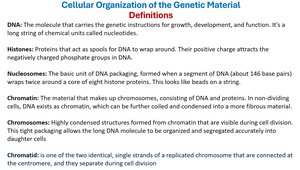
DNA: The molecule carrying genetic instructions for growth, development, and function.
Histones: Proteins that DNA wraps around, aiding in compaction and regulation.
Nucleosomes: The basic unit of DNA packaging, consisting of DNA wrapped around histone proteins.
Chromatin: The material making up chromosomes, consisting of DNA and proteins; loosely packed in non-dividing cells, condensed during cell division.
Chromosomes: Highly condensed structures formed from chromatin, visible during cell division.
Chromatid: One of two identical strands of a replicated chromosome, joined at the centromere.
Phases of the Cell Cycle and Mitosis
The cell cycle consists of interphase (G1, S, G2) and the mitotic phase (mitosis and cytokinesis). Mitosis is divided into several stages, each with distinct chromosomal movements and cellular events.
Interphase: Period of cell growth and DNA replication (G1, S, G2 phases).
Mitosis: Division of the nucleus, producing two identical daughter cells. Stages include:
Prophase
Prometaphase
Metaphase
Anaphase
Telophase
Cytokinesis: Division of the cytoplasm, forming two separate cells. In animal cells, a cleavage furrow forms; in plant cells, a cell plate forms.
Checkpoints: Control points (G1, S, G2, M) ensure proper cell cycle progression; malfunction can lead to cancer.
Proto-oncogenes and tumor suppressor genes: Regulate cell division; mutations can result in uncontrolled growth (cancer).
Comparison of Mitosis and Meiosis
Mitosis and meiosis are both forms of cell division but serve different purposes and have distinct outcomes.
Feature | Mitosis | Meiosis |
|---|---|---|
Chromosomal Duplications | 1 | 1 |
Cell Divisions | 1 | 2 |
Daughter Cells | 2 | 4 |
Chromosomes in Daughter Cells (humans) | 46 | 23 |
Metaphase Alignment | Individual chromosomes | Homologous pairs (Meiosis I), individual chromosomes (Meiosis II) |
Genetic Relationship | Identical to parent | Genetically unique |
Function in Humans | Growth, repair, asexual reproduction | Sexual reproduction (gametes) |
Meiosis and Sexual Life Cycles
Meiosis is essential for sexual reproduction, reducing chromosome number by half and generating genetic diversity through recombination and independent assortment.
Alternation of fertilization and meiosis: Fertilization restores diploid number; meiosis produces haploid gametes.
Stages of meiosis: Interphase, Meiosis I (reductional division), Meiosis II (equational division), and cytokinesis.
Genetic variation: Created by crossing over (recombination) during Prophase I and independent assortment during Metaphase I.
Karyotype: A picture of all chromosomes in a cell, used to identify chromosomal abnormalities (e.g., trisomy 21, Turner syndrome).
Nondisjunction: Failure of chromosomes to separate properly, leading to aneuploidy.
Mendelian Genetics and Patterns of Inheritance
Mendel's Experiments and Laws
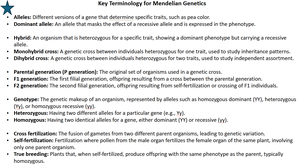
Gregor Mendel's experiments with pea plants established the foundational principles of inheritance, including the concepts of dominant and recessive traits, segregation, and independent assortment.
True-breeding plants: Plants that produce offspring identical to themselves when self-fertilized.
P generation: Parental generation in a genetic cross.
F1 and F2 generations: First and second filial generations, respectively.
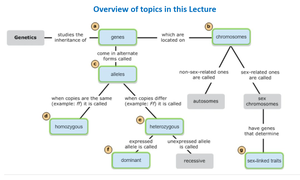
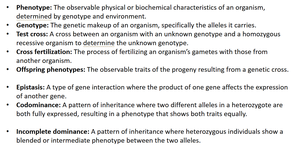
Gene: A heritable factor that determines a trait.
Allele: Different versions of a gene.
Dominant vs. recessive: Dominant alleles mask the effect of recessive alleles.
Genotype: Genetic makeup of an organism (e.g., YY, Yy, yy).
Phenotype: Observable traits of an organism.
Law of Segregation: Each individual has two alleles for each gene, which segregate during gamete formation.
Law of Independent Assortment: Genes for different traits assort independently during gamete formation.
Punnett Squares and Probability in Genetics
Punnett squares are used to predict the outcomes of genetic crosses, including monohybrid and dihybrid crosses. Probability laws help solve complex genetics problems.
Monohybrid cross: Cross between individuals heterozygous for one trait (e.g., Aa x Aa).
Dihybrid cross: Cross between individuals heterozygous for two traits (e.g., AaBb x AaBb), expected phenotypic ratio is 9:3:3:1.
Test cross: Cross between an individual with an unknown genotype and a homozygous recessive individual to determine the unknown genotype.
Probability: Used to predict the likelihood of specific genotypes and phenotypes in offspring.
Non-Mendelian Inheritance
Some inheritance patterns deviate from Mendel's laws, including incomplete dominance, codominance, multiple alleles, pleiotropy, epistasis, and polygenic inheritance.
Incomplete dominance: Heterozygotes show an intermediate phenotype.
Codominance: Both alleles are fully expressed in heterozygotes.
Multiple alleles: More than two alleles exist for a gene (e.g., ABO blood types).
Pleiotropy: One gene affects multiple traits.
Epistasis: One gene affects the expression of another gene.
Polygenic inheritance: Multiple genes influence a single trait.
Chromosomal Basis of Inheritance
Chromosome Structure and Alterations
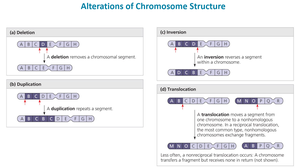
Chromosomes can undergo structural changes that affect gene expression and phenotype. These alterations can lead to genetic disorders and variation.
Deletion: Removal of a chromosomal segment.
Duplication: Repetition of a chromosomal segment.
Inversion: Reversal of a chromosomal segment within the chromosome.
Translocation: Movement of a chromosomal segment to a nonhomologous chromosome.
Karyotypes and Chromosome Classification
Karyotyping allows for the visualization and analysis of chromosome number and structure, aiding in the diagnosis of genetic disorders.
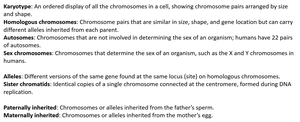
Karyotype: Ordered display of all chromosomes in a cell, arranged by size and shape.
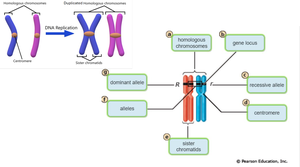
Homologous chromosomes: Chromosome pairs similar in size, shape, and gene location but may carry different alleles.
Autosomes: Non-sex chromosomes (22 pairs in humans).
Sex chromosomes: Chromosomes that determine sex (X and Y in humans).
Alleles: Different versions of the same gene at a locus on homologous chromosomes.
Sister chromatids: Identical copies of a chromosome connected at the centromere.
Paternally/maternally inherited: Chromosomes or alleles inherited from the father's sperm or mother's egg, respectively.
Patterns of Inheritance and Pedigrees
Inheritance patterns can be autosomal dominant, autosomal recessive, X-linked dominant, or X-linked recessive. Pedigrees are used to track inheritance of traits through generations.
Pedigree symbols: Squares (males), circles (females), shaded (affected), unshaded (unaffected).
Sex-linked disorders: Disorders associated with genes on sex chromosomes.
Autosomal disorders: Disorders associated with genes on autosomes.
Genetics: Overview and Key Terms
Genetics and Inheritance Patterns
Genetics is the study of inheritance, focusing on how genes and chromosomes determine traits. Key terms and concepts are foundational for understanding more complex genetic phenomena.
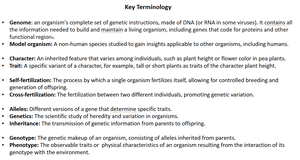
Genome: The complete set of genetic instructions in an organism.
Model organism: Non-human species used for genetic studies.
Character vs. trait: Character is an inherited feature; trait is a variant of a character.
Self-fertilization and cross-fertilization: Methods of fertilization affecting genetic variation.
Genotype vs. phenotype: Genotype is the genetic makeup; phenotype is the observable characteristics.
Chromosome Structure and Gene Mapping
Understanding chromosome structure and gene mapping is essential for studying inheritance and genetic disorders.
Gene locus: Specific location of a gene on a chromosome.
Dominant and recessive alleles: Affect trait expression.
Sister chromatids and centromere: Key structures during cell division.
 *Additional info: This guide integrates terminology, mechanisms, and visual aids to provide a comprehensive overview of cell division, genetics, and inheritance, suitable for exam preparation in a college-level biology course.*
