Back
BackStudy Guide: DNA, RNA, and Protein Synthesis Concepts for BIOL 110
Study Guide - Smart Notes
 Tailored notes based on your materials, expanded with key definitions, examples, and context.
Q1. What does semi-conservative DNA replication mean?
Background
Topic: DNA Replication
This question tests your understanding of how DNA is copied during cell division, specifically the mechanism by which new DNA molecules are formed.
Key Terms:
DNA Replication: The process by which a cell copies its DNA before cell division.
Semi-conservative: Each new DNA molecule contains one original (parental) strand and one newly synthesized strand.
Step-by-Step Guidance
Recall that DNA replication is essential for cell division and inheritance.
Understand that "semi-conservative" refers to the way the two strands of DNA are used as templates.
Each original strand serves as a template for a new complementary strand.
After replication, each DNA molecule consists of one old strand and one new strand.
Try solving on your own before revealing the answer!
Q2. Which is found in RNA but not in DNA?
Background
Topic: Nucleic Acids Structure
This question tests your knowledge of the differences between DNA and RNA, particularly their nitrogenous bases.
Key Terms:
DNA: Contains adenine, guanine, cytosine, and thymine.
RNA: Contains adenine, guanine, cytosine, and uracil (instead of thymine).
Step-by-Step Guidance
List the four bases found in DNA: adenine, guanine, cytosine, thymine.
List the four bases found in RNA: adenine, guanine, cytosine, uracil.
Identify which base is unique to RNA and not found in DNA.
Try solving on your own before revealing the answer!
Q3. Which process occurs in the nucleus?
Background
Topic: Cellular Processes
This question tests your understanding of where key processes like transcription and translation occur in eukaryotic cells.
Key Terms:
Transcription: The process of copying DNA into mRNA, occurs in the nucleus.
Translation: The process of synthesizing proteins from mRNA, occurs in the cytoplasm.
Step-by-Step Guidance
Recall the location of DNA in eukaryotic cells (nucleus).
Identify which process uses DNA as a template to make mRNA.
Consider where protein synthesis (translation) occurs (ribosomes in cytoplasm).
Try solving on your own before revealing the answer!
Q4. What is the process of copying genetic information from DNA to mRNA called?
Background
Topic: Gene Expression
This question tests your understanding of the first step in gene expression, where information in DNA is transferred to mRNA.
Key Terms:
Transcription: The process of making an mRNA copy from a DNA template.
Translation: The process of making a protein from an mRNA template.
Step-by-Step Guidance
Recall the two main steps in gene expression: transcription and translation.
Identify which step involves making an mRNA copy from DNA.
Distinguish this from translation, which uses mRNA to make protein.
Try solving on your own before revealing the answer!
Q5. In RNA, uracil pairs with which base?
Background
Topic: RNA Structure and Base Pairing
This question tests your knowledge of base pairing rules in RNA.
Key Terms:
Base Pairing: In RNA, uracil (U) pairs with adenine (A).
DNA: Thymine (T) pairs with adenine (A).
Step-by-Step Guidance
Recall that RNA uses uracil instead of thymine.
Identify which base uracil pairs with during transcription and translation.
Compare this to DNA base pairing rules.
Try solving on your own before revealing the answer!
Q6. Which type of RNA transports amino acids to the ribosome?
Background
Topic: Types of RNA
This question tests your understanding of the roles of different RNA molecules in protein synthesis.
Key Terms:
mRNA: Messenger RNA, carries genetic information from DNA to ribosome.
tRNA: Transfer RNA, brings amino acids to the ribosome.
rRNA: Ribosomal RNA, forms part of the ribosome structure.
Step-by-Step Guidance
Recall the three main types of RNA and their functions.
Identify which RNA is responsible for carrying amino acids.
Consider the role of tRNA during translation.
Try solving on your own before revealing the answer!
Q7. What is the site of protein synthesis in the cytoplasm?
Background
Topic: Protein Synthesis
This question tests your knowledge of cellular structures involved in making proteins.
Key Terms:
Ribosome: The cellular structure where proteins are synthesized.
Nucleus: Contains DNA, not the site of protein synthesis.
Step-by-Step Guidance
Recall where translation occurs in the cell.
Identify the organelle responsible for assembling amino acids into proteins.
Distinguish between nucleus and ribosome functions.
Try solving on your own before revealing the answer!
Q8. Which of the following represents a possible sequence of nucleotides on a strand of DNA?
Background
Topic: DNA Structure
This question tests your ability to recognize valid DNA nucleotide sequences.
Key Terms:
DNA Nucleotides: Adenine (A), Guanine (G), Cytosine (C), Thymine (T).
RNA Nucleotides: Adenine (A), Guanine (G), Cytosine (C), Uracil (U).
Step-by-Step Guidance
Review the four bases found in DNA.
Check each sequence for the presence of only DNA bases (A, G, C, T).
Identify any sequence containing uracil (U) as RNA, not DNA.
Try solving on your own before revealing the answer!
Q9. Which of the following is NOT a correct example of base-pairing in DNA?
Background
Topic: DNA Base Pairing
This question tests your knowledge of the specific pairing rules between DNA bases.
Key Terms:
Adenine (A) pairs with Thymine (T).
Guanine (G) pairs with Cytosine (C).
Step-by-Step Guidance
Recall the base pairing rules for DNA.
Identify which pairs are correct and which are incorrect.
Look for any pair that does not follow the A-T or G-C rule.
Try solving on your own before revealing the answer!
Q10. The Central Dogma states that one gene on DNA codes for one _________.
Background
Topic: Central Dogma of Molecular Biology
This question tests your understanding of the flow of genetic information from DNA to protein.
Key Terms:
Central Dogma: DNA → RNA → Protein.
Gene: A segment of DNA that codes for a specific protein.
Step-by-Step Guidance
Recall the Central Dogma pathway.
Identify what a gene codes for in this pathway.
Distinguish between proteins, carbohydrates, and other molecules.
Try solving on your own before revealing the answer!
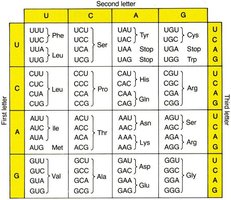
Q11. How many codons are in the genetic code?
Background
Topic: Genetic Code
This question tests your knowledge of the number of codons (three-letter sequences) that specify amino acids.
Key Terms:
Codon: A sequence of three nucleotides in mRNA that codes for an amino acid.
Genetic Code: The set of rules by which information encoded in mRNA is translated into proteins.
Step-by-Step Guidance
Recall that there are four possible nucleotides in RNA (A, U, G, C).
Calculate the number of possible three-letter combinations: $4 \times 4 \times 4$.
Determine the total number of codons.
Try solving on your own before revealing the answer!
Q12. What is the end product of translation?
Background
Topic: Translation
This question tests your understanding of the outcome of the translation process in protein synthesis.
Key Terms:
Translation: The process of synthesizing a protein from an mRNA template.
Protein: The final product of translation.
Step-by-Step Guidance
Recall the steps of gene expression: transcription and translation.
Identify what is produced at the end of translation.
Distinguish between mRNA, amino acids, and proteins.
Try solving on your own before revealing the answer!
Q13. If cytosine makes up 22% of the nucleotides in a DNA sample, what percent of the bases would be adenine?
Background
Topic: DNA Base Composition (Chargaff's Rules)
This question tests your ability to apply Chargaff's rules to determine the proportions of bases in DNA.
Key Terms:
Chargaff's Rules: In DNA, the amount of adenine equals thymine, and the amount of guanine equals cytosine.
Base Pairing: A-T and G-C.
Step-by-Step Guidance
Recall that cytosine pairs with guanine, so their percentages are equal.
Calculate the percentage of guanine (same as cytosine).
Subtract the combined percentage of C and G from 100% to find the percentage of A and T.
Divide the remaining percentage equally between adenine and thymine.
Try solving on your own before revealing the answer!
Q14. Which of the following represents a possible sequence of nucleotides on a strand of RNA?
Background
Topic: RNA Structure
This question tests your ability to recognize valid RNA nucleotide sequences.
Key Terms:
RNA Nucleotides: Adenine (A), Guanine (G), Cytosine (C), Uracil (U).
Step-by-Step Guidance
Review the four bases found in RNA.
Check each sequence for the presence of only RNA bases (A, G, C, U).
Identify any sequence containing thymine (T) as DNA, not RNA.
Try solving on your own before revealing the answer!
Q15. What are the components of a nucleotide?
Background
Topic: Nucleotide Structure
This question tests your knowledge of the basic building blocks of nucleic acids.
Key Terms:
Nucleotide: Composed of a sugar, a phosphate group, and a nitrogenous base.
Step-by-Step Guidance
Recall the three main components of a nucleotide.
Identify each component and its role in the structure of DNA/RNA.
Consider how these components connect to form nucleic acids.
Try solving on your own before revealing the answer!
Q16. During transcription, RNA polymerase unwinds and unzips the DNA molecule at the _____ for the protein that is about to be manufactured.
Background
Topic: Transcription Initiation
This question tests your understanding of how transcription begins and where RNA polymerase acts.
Key Terms:
RNA Polymerase: The enzyme that synthesizes RNA from a DNA template.
Locus: The specific location on DNA where transcription starts.
Step-by-Step Guidance
Recall the role of RNA polymerase in transcription.
Identify the region of DNA where transcription begins.
Distinguish between codon, anticodon, locus, and helix.
Try solving on your own before revealing the answer!
Q17. What is a sequence of three nucleotides on mRNA called?
Background
Topic: Genetic Code
This question tests your knowledge of the terminology used in translation.
Key Terms:
Codon: A sequence of three nucleotides on mRNA that codes for an amino acid.
Anticodon: A sequence of three nucleotides on tRNA that pairs with the codon.
Step-by-Step Guidance
Recall the definition of a codon.
Distinguish between codons, exons, introns, and anticodons.
Identify which term refers to the three-nucleotide sequence on mRNA.
Try solving on your own before revealing the answer!
Q18. What does tRNA shuttle to the mRNA/ribosome complex during protein synthesis?
Background
Topic: Translation
This question tests your understanding of the role of tRNA in protein synthesis.
Key Terms:
tRNA: Transfer RNA, brings amino acids to the ribosome.
mRNA: Messenger RNA, provides the template for protein synthesis.
Step-by-Step Guidance
Recall the function of tRNA during translation.
Identify what tRNA carries to the ribosome.
Distinguish between amino acids, enzymes, carbohydrates, and introns.
Try solving on your own before revealing the answer!
Q19. Which component is not directly involved in translation?
Background
Topic: Translation Machinery
This question tests your knowledge of the molecules involved in translation.
Key Terms:
mRNA: Provides the template.
tRNA: Brings amino acids.
Ribosome: Site of protein synthesis.
DNA: Not directly involved in translation.
Step-by-Step Guidance
List the components required for translation.
Identify which component is not part of the translation process.
Distinguish between transcription and translation roles.
Try solving on your own before revealing the answer!
Q20. Where is DNA stored in eukaryotic cells?
Background
Topic: Cell Structure
This question tests your knowledge of cellular compartments and the location of genetic material.
Key Terms:
Nucleus: The organelle where DNA is stored in eukaryotic cells.
Cytoplasm: Where translation occurs, not where DNA is stored.
Step-by-Step Guidance
Recall the structure of eukaryotic cells.
Identify the organelle that contains DNA.
Distinguish between nucleus, cytoplasm, Golgi bodies, and endoplasmic reticulum.
Try solving on your own before revealing the answer!
Q21. What is the correct sequence of events to get from DNA information to the actual making of a protein?
Background
Topic: Gene Expression Pathway
This question tests your understanding of the order of processes involved in gene expression.
Key Terms:
Transcription: DNA to mRNA.
RNA Editing: Modifying mRNA before translation.
Translation: mRNA to protein.
Replication: Copying DNA, not directly involved in protein synthesis.
Step-by-Step Guidance
Recall the steps involved in gene expression.
Identify the correct order: transcription, RNA editing, translation.
Distinguish between replication and gene expression.
Try solving on your own before revealing the answer!
Q22. What is transcription?
Background
Topic: Transcription
This question tests your understanding of the definition and purpose of transcription in gene expression.
Key Terms:
Transcription: The process of making an mRNA copy from a DNA template.
Translation: Making a protein from mRNA.
Replication: Making a copy of DNA.
Step-by-Step Guidance
Recall the definition of transcription.
Distinguish between transcription, translation, and replication.
Identify which process creates an mRNA copy of a gene.
Try solving on your own before revealing the answer!
Q23. After DNA replication, what does each new DNA double helix consist of?
Background
Topic: DNA Replication
This question tests your understanding of the outcome of semi-conservative DNA replication.
Key Terms:
Semi-conservative replication: Each new DNA molecule contains one old strand and one new strand.
Step-by-Step Guidance
Recall the mechanism of semi-conservative replication.
Identify the composition of each new DNA double helix.
Distinguish between old and new strands in the replicated DNA.
Try solving on your own before revealing the answer!