 Back
BackStudy Guide: DNA Technology, Replication, and Genetic Engineering
Study Guide - Smart Notes
 Tailored notes based on your materials, expanded with key definitions, examples, and context.
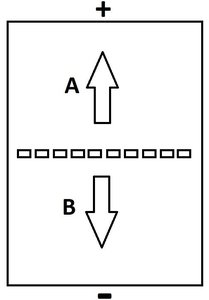
Q5. In gel electrophoresis, which direction will DNA move and why?
Background
Topic: Gel Electrophoresis
This question tests your understanding of how DNA fragments move in an electric field during gel electrophoresis, and the chemical basis for their movement.
Key Terms and Concepts:
Gel Electrophoresis: A technique used to separate DNA fragments by size using an electric field.
DNA Charge: DNA molecules are negatively charged due to their phosphate backbone.
Electrodes: The gel has a positive (+) and negative (-) end; DNA moves toward the positive electrode.
Step-by-Step Guidance
Examine the diagram: The gel has a positive (+) pole at the top and a negative (-) pole at the bottom.
Recall that DNA is negatively charged because of its phosphate groups.
In an electric field, negatively charged molecules move toward the positive pole.
Identify which arrow (A or B) points toward the positive pole.
Consider why DNA moves in that direction: The negative charge on DNA is repelled by the negative electrode and attracted to the positive electrode.
Try solving on your own before revealing the answer!
Final Answer: Arrow A shows the direction DNA will move, because DNA is negatively charged due to its phosphate group.
DNA migrates toward the positive electrode in gel electrophoresis, and the phosphate group is responsible for its negative charge.
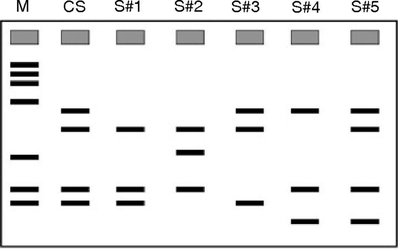
Q7. Which suspects could have been present at the crime scene based on the DNA bands in this gel?
Background
Topic: DNA Fingerprinting and Gel Electrophoresis
This question tests your ability to interpret DNA banding patterns from gel electrophoresis to match crime scene DNA with suspects.
Key Terms and Concepts:
Restriction Endonucleases: Enzymes that cut DNA at specific sequences, creating fragments.
Gel Electrophoresis: Separates DNA fragments by size; each band represents a fragment.
DNA Fingerprinting: Comparing band patterns to identify individuals.
Step-by-Step Guidance
Look at the lane labeled "CS" (crime scene) and compare its band pattern to each suspect lane (S#1–S#5).
For a suspect to be present, all their bands must be found in the crime scene sample.
Check each suspect: Does every band in their lane match a band in the CS lane?
Remember, more than one suspect's DNA could be present if all their bands are included in the CS lane.
Rule out suspects whose bands are missing from the CS lane, and identify those whose bands are all present.
Try solving on your own before revealing the answer!
Final Answer: Suspects 1 and 4 could have been present at the crime scene, as all their bands are included in the CS lane.
Matching all bands from a suspect to the crime scene sample is key to identifying possible contributors.
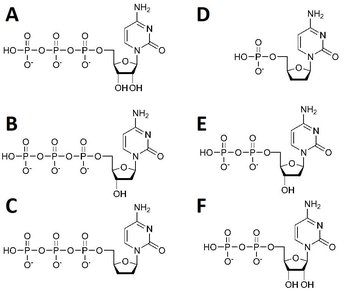
Q9. Identify the nucleotide types in the image: dNTP, ddNTP, NTP
Background
Topic: Nucleotide Structure and Function
This question tests your ability to distinguish between different nucleotide types used in DNA and RNA synthesis, and in sequencing reactions.
Key Terms and Concepts:
dNTP (deoxyribonucleoside triphosphate): Used in DNA synthesis; has a 3' -OH group.
ddNTP (dideoxynucleoside triphosphate): Used in Sanger sequencing; lacks both 2' and 3' -OH groups, causing chain termination.
NTP (ribonucleoside triphosphate): Used in RNA synthesis; has both 2' and 3' -OH groups.
Step-by-Step Guidance
Examine the chemical structures in the image for the presence or absence of hydroxyl (-OH) groups at the 2' and 3' positions of the sugar.
Identify which structure has both 2' and 3' -OH groups (NTP), which has only a 3' -OH (dNTP), and which lacks both (ddNTP).
Match the labels (A, B, C) to the correct nucleotide type based on their chemical features.
Recall: dNTP is used in DNA synthesis, ddNTP in Sanger sequencing, NTP in RNA synthesis.
Try solving on your own before revealing the answer!
Final Answer: B = dNTP, C = ddNTP, A = NTP
ddNTPs lack both 2' and 3' -OH groups, dNTPs have only a 3' -OH, and NTPs have both.
