 Back
BackStudy Guide: Meiosis, Genetic Diversity, and Chromosomal Disorders
Study Guide - Smart Notes
 Tailored notes based on your materials, expanded with key definitions, examples, and context.
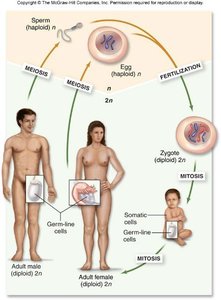
Q1. Describe the stages of the sexual life cycle. What are the roles of meiosis, gamete formation, and fertilization in this process?
Background
Topic: Sexual Life Cycle and Genetic Continuity
This question explores how organisms alternate between haploid and diploid stages, and the importance of meiosis, gamete formation, and fertilization in maintaining chromosome number across generations.
Key Terms and Concepts:
Meiosis: Cell division that reduces chromosome number by half, producing haploid gametes.
Gamete Formation: The process of forming sperm and egg cells (haploid).
Fertilization: Fusion of two gametes to form a diploid zygote.
Step-by-Step Guidance
Start by outlining the main stages: meiosis (in germ cells), gamete formation, fertilization, and growth by mitosis.
Explain how meiosis reduces the chromosome number from diploid (2n) to haploid (n), ensuring genetic diversity.
Describe how gametes (sperm and egg) are produced and why they are haploid.
Discuss how fertilization restores the diploid number, combining genetic material from both parents.
Try solving on your own before revealing the answer!
Q2. What are germ cells and how are they involved in the sexual life cycle?
Background
Topic: Germ Cells and Their Role in Reproduction
This question focuses on the specialized cells that give rise to gametes and their significance in heredity.
Key Terms:
Germ Cells: Cells in the reproductive organs that undergo meiosis to produce gametes.
Somatic Cells: All other body cells that do not participate in gamete formation.
Step-by-Step Guidance
Define germ cells and distinguish them from somatic cells.
Explain where germ cells are located (testes in males, ovaries in females).
Describe how germ cells undergo meiosis to produce haploid gametes.
Try solving on your own before revealing the answer!
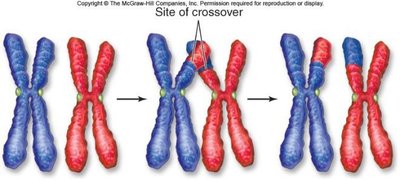
Q7a. Describe how crossing over occurs, and during which phase does it occur?
Background
Topic: Genetic Recombination in Meiosis
This question examines the process that increases genetic diversity by exchanging genetic material between homologous chromosomes.
Key Terms and Concepts:
Crossing Over: The exchange of genetic material between non-sister chromatids of homologous chromosomes.
Prophase I: The phase of meiosis where crossing over occurs.
Step-by-Step Guidance
Identify the stage of meiosis where homologous chromosomes pair up (synapsis).
Describe how non-sister chromatids physically exchange segments at points called chiasmata.
Explain the result: new combinations of alleles on each chromatid.
Try solving on your own before revealing the answer!
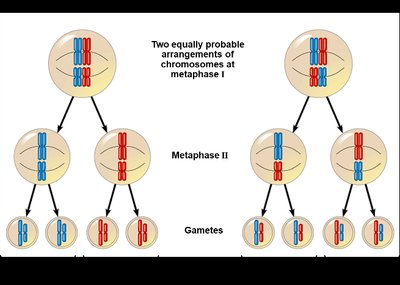
Q8c. Describe independent assortment and during which phase it occurs.
Background
Topic: Mechanisms of Genetic Variation
This question is about how chromosomes are distributed randomly into gametes, contributing to genetic diversity.
Key Terms and Concepts:
Independent Assortment: The random orientation of homologous chromosome pairs during metaphase I of meiosis.
Metaphase I: The phase where independent assortment occurs.
Step-by-Step Guidance
Explain how homologous chromosome pairs align independently at the metaphase plate during metaphase I.
Describe how this leads to different combinations of maternal and paternal chromosomes in gametes.
Relate this to the mathematical possibilities for chromosome combinations (2n).
Try solving on your own before revealing the answer!
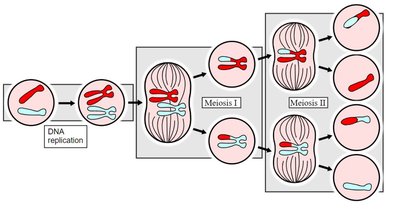
Q10. What happens to chromosome number after Meiosis I?
Background
Topic: Chromosome Reduction in Meiosis
This question tests your understanding of how meiosis reduces chromosome number and why this is important for sexual reproduction.
Key Terms:
Homologous Chromosomes: Chromosome pairs, one from each parent.
Reduction Division: The process by which chromosome number is halved during meiosis I.
Step-by-Step Guidance
Recall that meiosis I separates homologous chromosomes into two cells.
Determine how the chromosome number in each resulting cell compares to the original diploid cell.
Think about the difference between chromosome number and chromatid number at this stage.
Try solving on your own before revealing the answer!
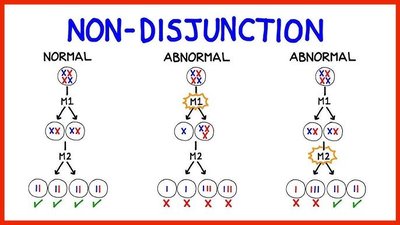
Q13. If homologous chromosomes fail to separate in anaphase I, what is the evaluative consequence for the resulting gametes?
Background
Topic: Nondisjunction and Chromosomal Disorders
This question addresses errors in meiosis and their impact on gamete chromosome number, which can lead to conditions like Down syndrome.
Key Terms:
Nondisjunction: Failure of homologous chromosomes (or sister chromatids) to separate properly during meiosis.
Aneuploidy: Abnormal number of chromosomes in a cell.
Step-by-Step Guidance
Recall what should happen during anaphase I (homologous chromosomes separate).
Describe what happens if this process fails (nondisjunction).
Predict the chromosome number in the resulting gametes—will some have extra or missing chromosomes?
Try solving on your own before revealing the answer!
