 Back
Study Guide: Structure and Function of Large Biological Molecules
Study Guide - Smart Notes
 Tailored notes based on your materials, expanded with key definitions, examples, and context.
Overview of Biological Molecules
Introduction to Biological Macromolecules
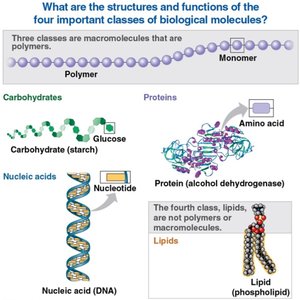
Biological macromolecules are essential for life, serving as the building blocks and functional molecules within cells. The four major classes are carbohydrates, proteins, nucleic acids, and lipids. Three of these classes (carbohydrates, proteins, nucleic acids) are polymers, composed of repeating monomer units, while lipids are not true polymers.
Polymer Formation and Breakdown
Dehydration Synthesis and Hydrolysis
Polymers are synthesized and broken down by specific chemical reactions:
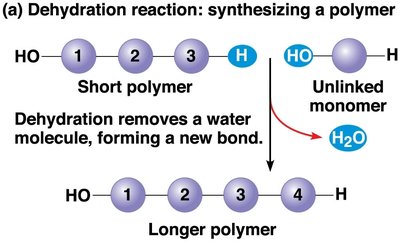
Dehydration Reaction (Condensation): Monomers are joined together by the removal of a water molecule, forming a covalent bond and creating a longer polymer.
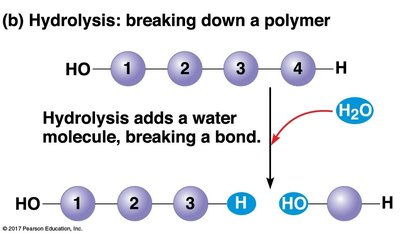
Hydrolysis: Polymers are broken down into monomers by the addition of a water molecule, breaking the covalent bond.
Carbohydrates
Structure and Function
Carbohydrates are composed of carbon, hydrogen, and oxygen (CH2O). They serve as energy sources and structural materials. Monosaccharides (simple sugars) are the monomers, which can be linked to form disaccharides and polysaccharides.
Monosaccharides: Glucose, fructose, galactose
Disaccharides: Sucrose, lactose, maltose
Polysaccharides: Starch (plants), glycogen (animals), cellulose (plants), chitin (fungi and arthropods)
Lipids
Structure and Function
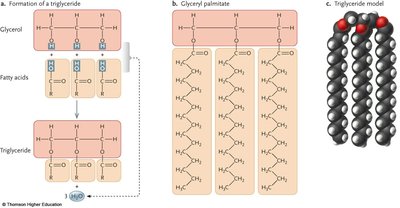
Lipids are hydrophobic molecules that include fats, phospholipids, and steroids. They are not true polymers but are assembled from smaller molecules by dehydration reactions.
Fats (Triglycerides): Composed of glycerol and three fatty acids. Serve as energy storage molecules.
Phospholipids: Major components of cell membranes, consisting of a glycerol, two fatty acids, and a phosphate group.
Steroids: Lipids with a carbon skeleton consisting of four fused rings (e.g., cholesterol).
Proteins
Amino Acids and Protein Structure
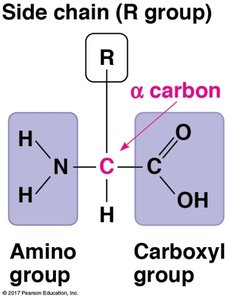
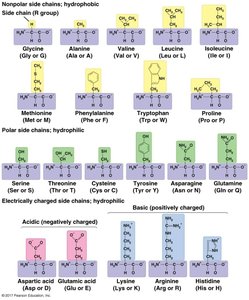
Proteins are polymers of amino acids, which contain an amino group, a carboxyl group, a hydrogen atom, and a variable side chain (R group) attached to a central alpha carbon. The sequence and properties of amino acids determine protein structure and function.
Levels of Protein Structure
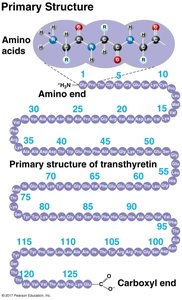
Primary Structure: Linear sequence of amino acids in a polypeptide, determined by genetic information.
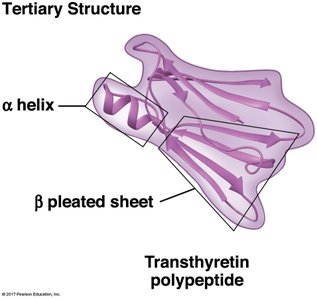
Secondary Structure: Local folding into alpha helices and beta sheets, stabilized by hydrogen bonds.
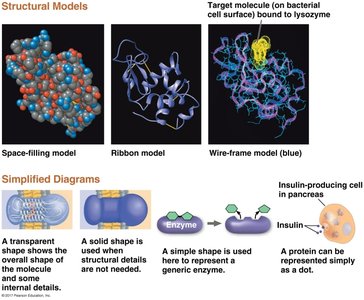
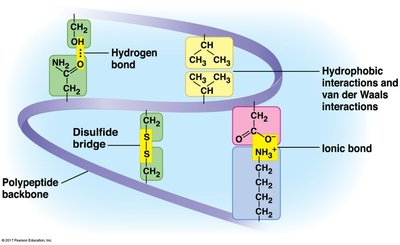
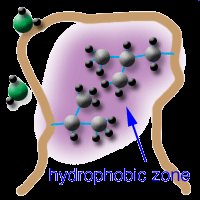
Tertiary Structure: Overall 3D shape of a polypeptide, stabilized by interactions among R groups (hydrogen bonds, ionic bonds, hydrophobic interactions, disulfide bridges).
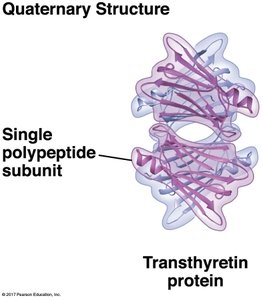
Quaternary Structure: Association of two or more polypeptide subunits to form a functional protein.
Protein Denaturation
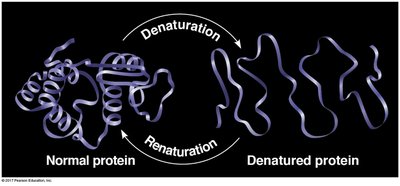
Denaturation is the loss of a protein's native structure due to environmental factors such as heat, pH, or chemicals, resulting in loss of function. Some proteins can renature if the denaturing agent is removed.
Protein Structure and Disease: Sickle Cell Anemia
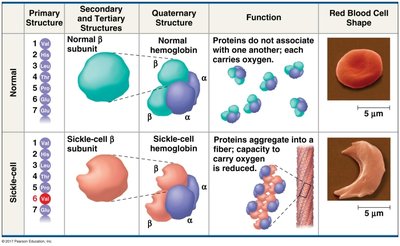
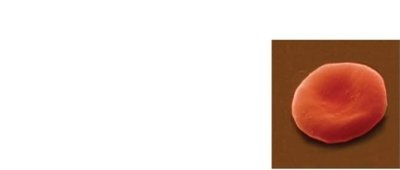
A single amino acid substitution in the primary structure of the beta chain of hemoglobin leads to sickle cell disease. This change alters the protein's secondary, tertiary, and quaternary structures, causing hemoglobin molecules to aggregate and deform red blood cells.
Nucleic Acids
Structure and Function
Nucleic acids (DNA and RNA) are polymers of nucleotides. Each nucleotide consists of a phosphate group, a five-carbon sugar (deoxyribose in DNA, ribose in RNA), and a nitrogenous base. DNA stores genetic information, while RNA is involved in protein synthesis and gene regulation.
Summary Table: Major Classes of Biological Molecules
Class | Monomer | Polymer | Bond Type | Function |
|---|---|---|---|---|
Carbohydrates | Monosaccharide | Polysaccharide | Glycosidic linkage | Energy storage, structure |
Proteins | Amino acid | Polypeptide | Peptide bond | Catalysis, structure, transport, signaling |
Nucleic Acids | Nucleotide | DNA/RNA | Phosphodiester bond | Genetic information storage and transfer |
Lipids | Fatty acids, glycerol | Not true polymers | Ester linkage | Energy storage, membranes, signaling |
Key Terms and Concepts
Monomer: Small molecule that can join with others to form a polymer.
Polymer: Large molecule made of repeating monomer units.
Dehydration Reaction: Chemical reaction that joins monomers by removing water.
Hydrolysis: Chemical reaction that breaks polymers into monomers by adding water.
Primary, Secondary, Tertiary, Quaternary Structure: Levels of protein organization, each contributing to the protein's final shape and function.
Denaturation: Loss of protein structure and function due to environmental changes.
Practice Question Example
Some regions of a polypeptide may coil or fold back on themselves. This folding is called secondary structure, and the coils or folds are held in place by hydrogen bonds.
