 Back
The Cell Cycle and Cellular Reproduction
Study Guide - Smart Notes
 Tailored notes based on your materials, expanded with key definitions, examples, and context.
The Cell Cycle and Cellular Reproduction
Overview of the Cell Cycle
The cell cycle is an orderly sequence of events that leads to cell division and the production of two genetically identical daughter cells. It is essential for growth, development, and tissue repair in multicellular organisms.
Interphase: The longest phase, where the cell grows, duplicates organelles, and replicates DNA. Subdivided into G1, S, and G2 phases.
Mitotic (M) Phase: Includes mitosis (nuclear division) and cytokinesis (cytoplasmic division).
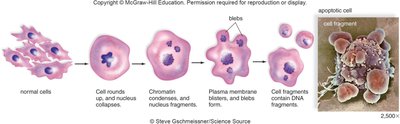
Checkpoints (G1, G2, M) regulate progression through the cycle, ensuring DNA integrity and proper cell division. If errors are detected, the cell may undergo apoptosis (programmed cell death).
Phases of Interphase
G1 Phase: Cell recovers from previous division, grows, and accumulates materials for DNA synthesis.
S Phase: DNA replication occurs, resulting in chromosomes with two identical sister chromatids.
G2 Phase: Final preparations for mitosis, including synthesis of proteins and microtubules.
Mitotic Stage: Mitosis and Cytokinesis
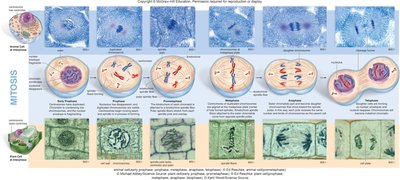
Mitosis is the process by which the nucleus divides, distributing identical chromosomes to daughter nuclei. Cytokinesis divides the cytoplasm, resulting in two separate cells.
Prophase: Chromatin condenses into visible chromosomes; spindle apparatus forms.
Prometaphase: Nuclear envelope fragments; kinetochores attach to spindle fibers.
Metaphase: Chromosomes align at the metaphase plate.
Anaphase: Sister chromatids separate and move to opposite poles.
Telophase: Nuclear envelopes reform; chromosomes decondense.
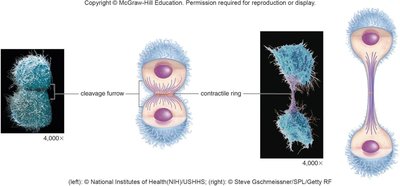
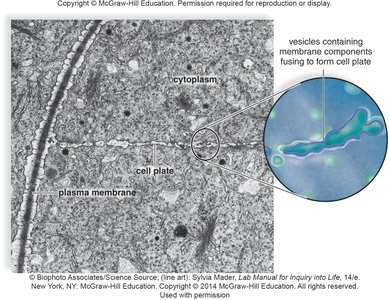
Cytokinesis differs in animal and plant cells:
Animal cells: Cleavage furrow forms via contractile ring of actin filaments.
Plant cells: Cell plate forms from vesicles, leading to new cell wall formation.
Control of the Cell Cycle
The cell cycle is regulated by internal and external signals:
External signals: Growth factors received at the plasma membrane.
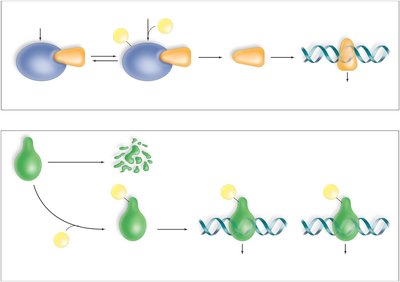
Internal signals: Cyclins and cyclin-dependent kinases (CDKs) regulate progression through checkpoints.
p53 protein: Halts the cycle at G1 if DNA is damaged, initiates repair, or triggers apoptosis if repair fails.
Apoptosis: Programmed Cell Death
Apoptosis is a controlled process that eliminates damaged or unnecessary cells. It is essential for development and homeostasis.
Triggered by internal or external signals.
Involves caspase enzymes that fragment the cell.
Balances cell proliferation (mitosis) to maintain tissue health.
The Eukaryotic Chromosome
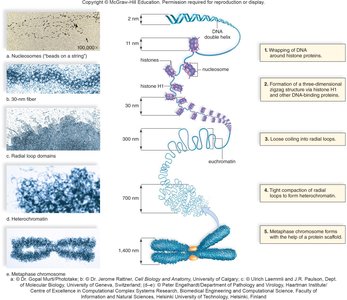
Eukaryotic chromosomes consist of DNA and associated proteins (histones), forming chromatin. Chromatin can be:
Euchromatin: Loosely packed, transcriptionally active.
Heterochromatin: Densely packed, transcriptionally inactive.
DNA wraps around histone proteins to form nucleosomes, which further coil and fold to fit within the nucleus.
Chromosome Number and Structure
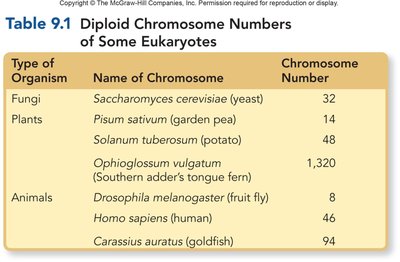
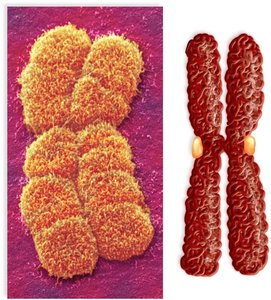
Each species has a characteristic diploid (2n) chromosome number. Humans have 46 chromosomes (23 pairs). Chromosomes duplicate during S phase, forming sister chromatids joined at the centromere.
Type of Organism | Name of Chromosome | Chromosome Number |
|---|---|---|
Fungi | Saccharomyces cerevisiae (yeast) | 32 |
Plants | Pisum sativum (garden pea) | 14 |
Plants | Solanum tuberosum (potato) | 48 |
Plants | Ophioglossum vulgatum (Southern adder's tongue fern) | 1,320 |
Animals | Drosophila melanogaster (fruit fly) | 8 |
Animals | Homo sapiens (human) | 46 |
Animals | Carassius auratus (goldfish) | 94 |
Functions of Mitosis
Permits growth and repair in multicellular organisms.
In plants, meristematic tissue divides throughout life.
In animals, stem cells retain the ability to divide and differentiate.
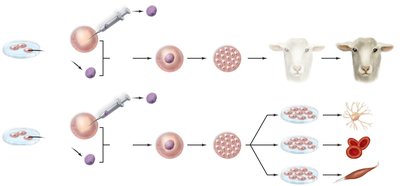
Therapeutic and reproductive cloning utilize mitosis and stem cells.
The Cell Cycle and Cancer
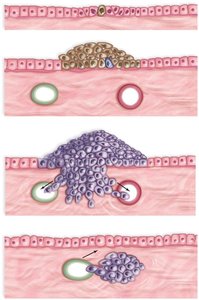
Cancer results from uncontrolled cell division due to mutations in genes regulating the cell cycle.
Benign tumors: Non-cancerous, encapsulated, do not invade tissues.
Malignant tumors: Cancerous, invade tissues, can metastasize (spread).
Key gene types involved:
Proto-oncogenes: Promote cell cycle; mutations convert them to oncogenes, causing uncontrolled division.
Tumor suppressor genes: Inhibit cell cycle and promote apoptosis; mutations inactivate them, removing growth inhibition.
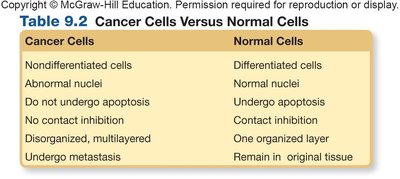
Cancer Cells | Normal Cells |
|---|---|
Nondifferentiated cells | Differentiated cells |
Abnormal nuclei | Normal nuclei |
Do not undergo apoptosis | Undergo apoptosis |
No contact inhibition | Contact inhibition |
Disorganized, multilayered | One organized layer |
Undergo metastasis | Remain in original tissue |
Causes of Cancer
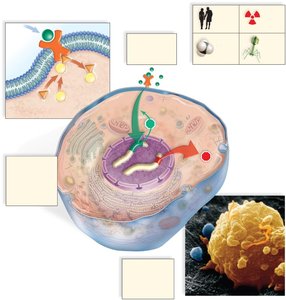
Mutations in proto-oncogenes and tumor suppressor genes.
Influences: heredity, radiation, chemicals (pesticides, herbicides), viruses.
Telomerase mutations allow cancer cells to divide indefinitely by maintaining telomere length.
Prokaryotic Cell Division: Binary Fission
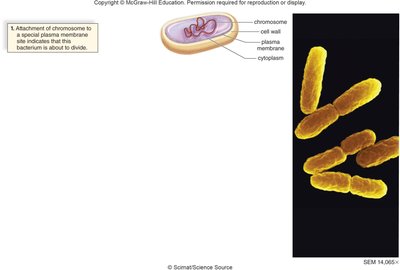
Prokaryotes (bacteria and archaea) divide by binary fission, a simpler process than mitosis:
Single, circular DNA molecule replicates.
Each copy attaches to the plasma membrane.
Cell elongates and divides, producing two genetically identical cells.
Binary fission is a form of asexual reproduction and ensures genetic consistency.
Comparison: Binary Fission vs. Mitosis
Both processes ensure daughter cells are genetically identical to the parent.
Binary fission occurs in prokaryotes; mitosis in eukaryotes.
No spindle apparatus in binary fission.
Summary Table: Key Differences Between Binary Fission and Mitosis
Feature | Binary Fission | Mitosis |
|---|---|---|
Organisms | Prokaryotes | Eukaryotes |
Chromosome Structure | Circular DNA | Linear chromosomes |
Spindle Apparatus | Absent | Present |
Purpose | Asexual reproduction | Growth, repair, asexual reproduction |
Additional info: Understanding the cell cycle and its regulation is fundamental for studying genetics, development, and cancer biology. Disruptions in these processes underlie many diseases, making this topic central to modern biology.
