Back
BackThe Cell Cycle and Regulation: Structure, Function, and Control of Chromosomes
Study Guide - Smart Notes
 Tailored notes based on your materials, expanded with key definitions, examples, and context.
Chapter 12: The Cell Cycle
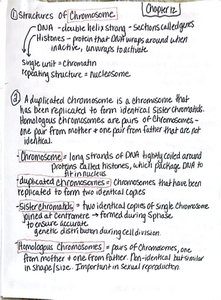
Structures of Chromosomes
Chromosomes are highly organized structures of DNA and proteins that ensure the accurate transmission of genetic information during cell division.
DNA: Double helix structure; contains genetic instructions.
Histones: Proteins around which DNA wraps, forming nucleosomes (the basic unit of chromatin).
Chromatin: The complex of DNA and proteins; condenses to form chromosomes during cell division.
Nucleosome: The repeating structural unit of chromatin.
Duplicated Chromosomes and Chromosome Terminology
During the cell cycle, chromosomes are duplicated to ensure each daughter cell receives identical genetic material.
Duplicated Chromosome: A chromosome that has been replicated to form two identical sister chromatids.
Homologous Chromosomes: Pairs of chromosomes (one from each parent) that are similar in shape and size but may carry different alleles.
Chromosome: Long strands of DNA tightly coiled around proteins (histones).
Sister Chromatids: Two identical copies of a single chromosome, joined at the centromere, formed during the S phase of the cell cycle.
Centromere and Kinetochore
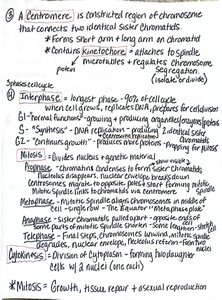
The centromere is a constricted region of the chromosome that connects two sister chromatids and is essential for proper chromosome segregation during cell division.
Centromere: Site where sister chromatids are joined; contains the kinetochore, a protein complex that attaches to spindle microtubules.
Kinetochore: Facilitates chromosome movement during segregation.
Phases of the Cell Cycle
The cell cycle consists of interphase (cell growth and DNA replication) and the mitotic phase (division of the nucleus and cytoplasm).
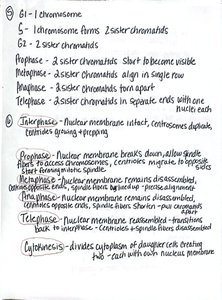
Interphase: Longest phase; includes G1 (growth), S (DNA synthesis), and G2 (preparation for division).
Mitosis: Division of the nucleus into two genetically identical nuclei.
Cytokinesis: Division of the cytoplasm, resulting in two daughter cells.
Stages of Mitosis
Prophase: Chromosomes condense, spindle forms, nuclear envelope breaks down.
Metaphase: Chromosomes align at the metaphase plate.
Anaphase: Sister chromatids separate and move to opposite poles.
Telophase: Nuclear envelopes reform, chromosomes decondense.
Cytokinesis
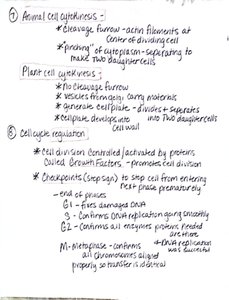
Animal Cells: Cleavage furrow forms via actin filaments, pinching the cell into two.
Plant Cells: Cell plate forms, dividing the cell into two daughter cells.
Cell Cycle Regulation
Cell division is tightly regulated by proteins and checkpoints to ensure proper replication and division.
Growth Factors: Proteins that promote cell division.
Checkpoints: Control mechanisms that ensure each phase is completed correctly before proceeding.
G1 Checkpoint: Checks for DNA damage.
G2 Checkpoint: Confirms DNA replication is complete.
M Checkpoint: Ensures chromosomes are properly attached to the spindle before division.
Genes Involved in Cell Cycle Regulation and Cancer
Mutations in genes that regulate the cell cycle can lead to uncontrolled cell growth and cancer.
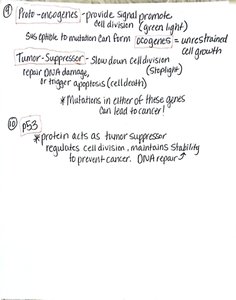
Proto-oncogenes: Provide signals that promote cell division; mutations can convert them to oncogenes, causing unrestrained cell growth.
Tumor Suppressor Genes: Slow down cell division, repair DNA, or trigger apoptosis; mutations can lead to cancer.
p53: A key tumor suppressor protein that regulates cell division, maintains genomic stability, and promotes DNA repair.
Summary Table: Key Terms in Chromosome Structure and Cell Cycle
Term | Definition |
|---|---|
Chromosome | Long DNA molecule with associated proteins, carrying genetic information |
Sister Chromatids | Identical copies of a chromosome, joined at the centromere |
Centromere | Region joining sister chromatids; site of kinetochore formation |
Homologous Chromosomes | Chromosome pairs, one from each parent, similar in size and shape |
Proto-oncogene | Gene that promotes cell division; mutation can lead to cancer |
Tumor Suppressor | Gene that inhibits cell division or induces apoptosis |
p53 | Protein that acts as a tumor suppressor, regulating cell cycle and DNA repair |
Equations and Key Concepts
DNA Replication: Each chromosome duplicates to form two sister chromatids before mitosis.
Cell Cycle:
Mitosis:
Applications
Mitosis: Essential for growth, tissue repair, and asexual reproduction in multicellular organisms.
Cell Cycle Regulation: Disruption can lead to diseases such as cancer.