 Back
BackThe Nervous System: Structure, Function, and Organization
Study Guide - Smart Notes
 Tailored notes based on your materials, expanded with key definitions, examples, and context.
Nervous System Overview
General Functions of the Nervous System
The nervous system is the primary communication and control system of the body, responsible for detecting stimuli, integrating information, and coordinating responses. It enables rapid and precise regulation of body functions, allowing organisms to interact with and adapt to their environment.
Sensory Input: Detection of changes in the internal and external environment by sensory receptors.
Integration: Processing and interpretation of sensory input, determining appropriate responses.
Motor Output: Activation of effector organs (muscles or glands) to carry out responses.
Organization of the Nervous System
Structural and Functional Divisions
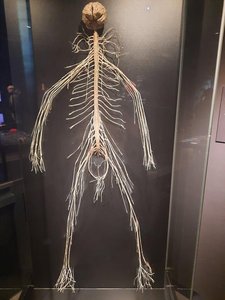
The nervous system is organized into two main structural divisions and several functional subdivisions, each with specialized roles in communication and control.
Central Nervous System (CNS): Consists of the brain and spinal cord; serves as the command center for processing information and issuing instructions.
Peripheral Nervous System (PNS): Composed of cranial and spinal nerves; connects the CNS to limbs and organs, facilitating communication throughout the body.
Functional Subdivisions of the PNS
Sensory (Afferent) Division: Transmits sensory information from receptors to the CNS.
Motor (Efferent) Division: Transmits commands from the CNS to effector organs.
Somatic Nervous System: Controls voluntary movements via skeletal muscles.
Autonomic Nervous System (ANS): Regulates involuntary functions (e.g., cardiac muscle, smooth muscle, glands).
Sympathetic Division: Prepares the body for 'fight or flight' responses.
Parasympathetic Division: Promotes 'rest and digest' activities.
Nervous Tissue: Structure and Function
Neurons (Nerve Cells)
Neurons are specialized cells designed to transmit electrical signals rapidly and efficiently. They are the fundamental units of the nervous system, responsible for communication within the body.
Cell Body (Soma): Contains the nucleus and organelles; site of neurotransmitter synthesis.
Dendrites: Short, branched extensions that receive signals from other neurons and transmit them to the cell body.
Axon: Long, singular extension that conducts impulses away from the cell body toward other neurons or effectors.
Axon Terminals: Release neurotransmitters to communicate with target cells.
Myelin Sheath and Nodes of Ranvier
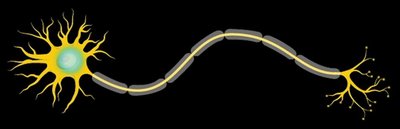
The myelin sheath is a fatty, insulating layer that surrounds axons, increasing the speed of nerve impulse conduction. Gaps in the myelin sheath, called nodes of Ranvier, allow impulses to "jump" rapidly from node to node, a process known as saltatory conduction.
Myelinated Neurons: Conduct impulses at speeds up to 120 m/s.
Unmyelinated Neurons: Conduct impulses much more slowly (0.5–10 m/s).
Classification of Neurons
Functional Classification:
Sensory (Afferent) Neurons: Carry information from sensory receptors to the CNS; mostly unipolar.
Motor (Efferent) Neurons: Carry commands from the CNS to muscles and glands; all are multipolar.
Interneurons: Connect sensory and motor neurons within the CNS; most numerous and multipolar.
Structural Classification:
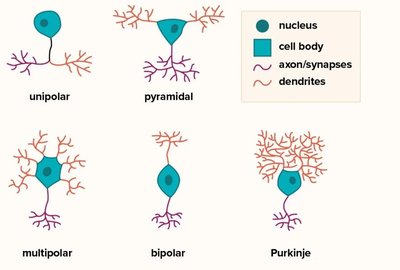
Multipolar Neurons: Many dendrites, one axon; most common type in the CNS.
Bipolar Neurons: One dendrite, one axon; found in special sense organs (e.g., retina, olfactory epithelium).
Unipolar Neurons: Single process that splits into two branches; primarily sensory neurons in the PNS.
Support Cells (Neuroglia/Glial Cells)
Types and Functions of Glial Cells
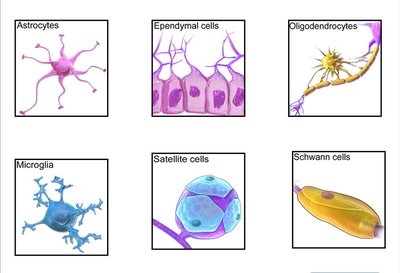
Glial cells are non-neuronal cells that provide structural, nutritional, and functional support to neurons. They outnumber neurons by about 10 to 1 and are essential for maintaining the health and efficiency of the nervous system.
Glial Cell Type | Location | Main Function |
|---|---|---|
Oligodendrocytes | CNS | Form myelin sheaths around axons |
Schwann Cells | PNS | Form myelin sheaths around axons |
Astrocytes | CNS | Support neurons, form blood-brain barrier, regulate nutrients |
Microglia | CNS | Immune surveillance, phagocytosis of debris |
Ependymal Cells | CNS | Produce and circulate cerebrospinal fluid (CSF) |
Satellite Cells | PNS | Support and regulate the environment around neuron cell bodies |
Central and Peripheral Nervous System
Central Nervous System (CNS)
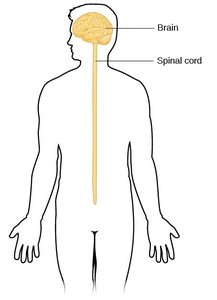
The CNS consists of the brain and spinal cord. It processes sensory information, coordinates voluntary and involuntary responses, and is protected by the skull and vertebral column.
Brain: Receives, processes, and interprets sensory information; initiates responses.
Spinal Cord: Conducts signals between the brain and PNS; mediates reflexes.
Peripheral Nervous System (PNS)
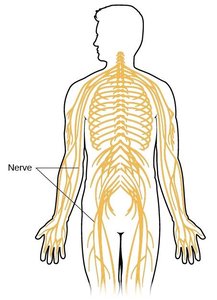
The PNS connects the CNS to the rest of the body through cranial and spinal nerves. It is responsible for relaying information to and from the CNS and executing motor commands.
Cranial Nerves: Carry signals to and from the brain.
Spinal Nerves: Carry signals to and from the spinal cord.
Summary Table: Structural and Functional Organization
Division | Components | Main Function |
|---|---|---|
Central Nervous System (CNS) | Brain, Spinal Cord | Integration, command center |
Peripheral Nervous System (PNS) | Cranial nerves, Spinal nerves | Communication between CNS and body |
Sensory (Afferent) Division | Sensory neurons | Transmit sensory input to CNS |
Motor (Efferent) Division | Motor neurons | Transmit commands from CNS to effectors |
Somatic Nervous System | Skeletal muscles | Voluntary control |
Autonomic Nervous System | Cardiac muscle, smooth muscle, glands | Involuntary control |
Sympathetic Division | Visceral organs | "Fight or flight" response |
Parasympathetic Division | Visceral organs | "Rest and digest" response |
Key Terms and Concepts
Neuron: The basic functional unit of the nervous system, specialized for signal transmission.
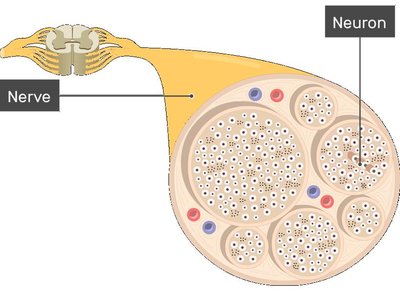
Nerve: A bundle of axons (nerve fibers) in the PNS.
Neuroglia (Glial Cells): Supportive cells in the nervous system.
Myelin Sheath: Insulating layer around axons that increases signal speed.
Nodes of Ranvier: Gaps in the myelin sheath that facilitate rapid signal conduction.
Reflex Arc: The neural pathway involved in a reflex action, typically involving a sensory neuron, interneuron, and motor neuron.
Example: Reflex Arc
A reflex arc is a simple neural pathway that mediates a rapid, involuntary response to a stimulus. For example, touching a hot object triggers a withdrawal reflex before the sensation is consciously perceived.
Stimulus: Heat detected by sensory receptors.
Sensory Neuron: Transmits signal to the spinal cord.
Interneuron: Processes information and relays it to a motor neuron.
Motor Neuron: Activates muscles to withdraw the hand.
Summary
The nervous system is a highly organized network that enables rapid communication and coordination throughout the body. Its structural and functional divisions allow for specialized processing, integration, and response to internal and external stimuli, ensuring survival and adaptation.
