 Back
BackBio 100 Lec Chapter 5 Study Guide
Study Guide - Smart Notes
 Tailored notes based on your materials, expanded with key definitions, examples, and context.
Bio 100 Lec Chapter 5 Study Guide
Chapter 5: The Structure and Function of Large Biological Molecules
Introduction
This chapter explores the four major classes of large biological molecules—carbohydrates, lipids, proteins, and nucleic acids. These molecules are essential for life, serving as structural components, energy sources, and carriers of genetic information. Understanding their structure and function is foundational for all biological sciences.
Macromolecules and Polymers
Concept: Macromolecules as Polymers
Many large biological molecules are polymers, which are long chains composed of repeating subunits called monomers. The diversity of macromolecules arises from the arrangement and types of monomers used.
Macromolecules: Large molecules formed by the polymerization of smaller subunits (monomers).
Examples: Carbohydrates, proteins, and nucleic acids are true macromolecules; lipids are large biological molecules but not true polymers.
Polymer Diversity: Polymers can be linear or branched, and their properties depend on the sequence and type of monomers.
Synthesis and Breakdown of Polymers
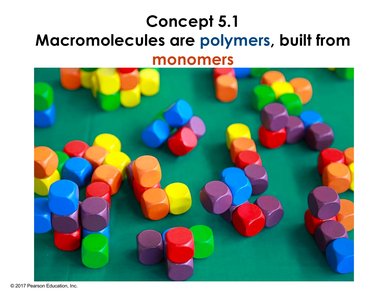
Dehydration Reaction (Condensation): Monomers are joined by covalent bonds through the removal of a water molecule. This process builds polymers.
Hydrolysis: Polymers are broken down into monomers by the addition of water, breaking covalent bonds.
Enzymes: Specialized proteins that catalyze both dehydration and hydrolysis reactions.
Diversity of Polymers in Living Organisms
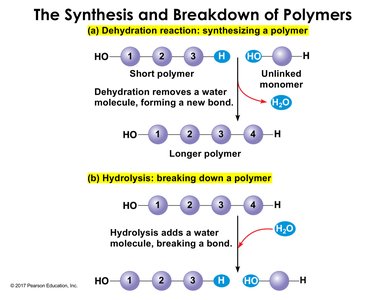
The types and abundance of large biological molecules vary among cells and species, reflecting their diverse functions such as energy storage, structural support, and information transfer.
Carbohydrates
Concept: Carbohydrates as Fuel and Building Material
Carbohydrates are sugars and their polymers. They serve as energy sources and structural materials in cells.
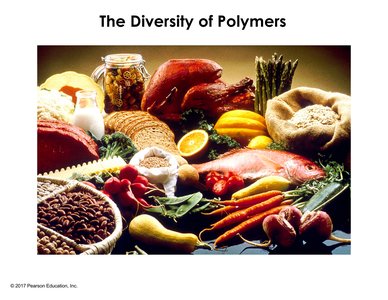
General Formula: (CH2O)n
Monosaccharides: Simple sugars (e.g., glucose, fructose) that are the monomers of carbohydrates.
Classification: Based on the location of the carbonyl group (aldose or ketose) and the number of carbons (triose, pentose, hexose).
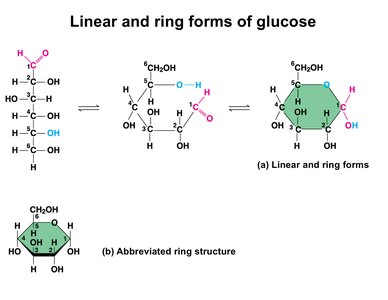
Linear and Ring Forms of Glucose
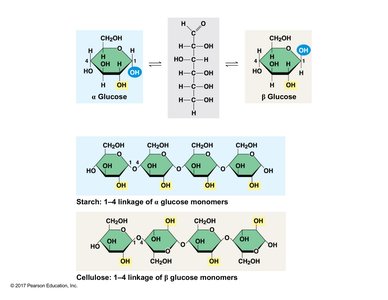
Glucose can exist in both linear and ring forms. In aqueous solutions, the ring form predominates. The orientation of the hydroxyl group at the anomeric carbon determines whether the glucose is in the alpha or beta form.
Disaccharides and Glycosidic Linkages
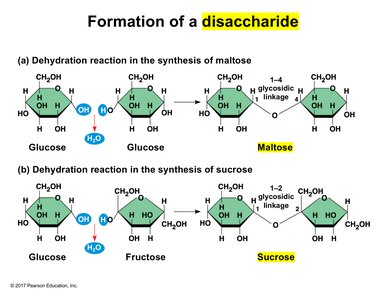
Disaccharides are formed by joining two monosaccharides via a dehydration reaction, resulting in a covalent bond called a glycosidic linkage.
Maltose: Two glucose units joined by a 1-4 glycosidic linkage.
Sucrose: Glucose and fructose joined by a 1-2 glycosidic linkage.
Polysaccharides: Storage and Structural Roles
Polysaccharides are polymers of monosaccharides linked by glycosidic bonds. Their structure and function depend on the type of monomer and the type of glycosidic linkage.
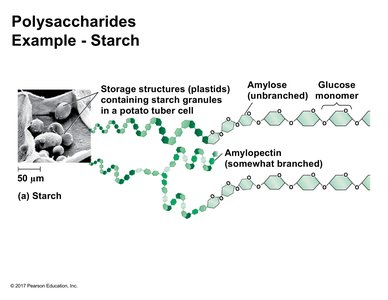
Starch: Storage polysaccharide in plants, composed of alpha-glucose monomers. Exists as amylose (unbranched) and amylopectin (branched).
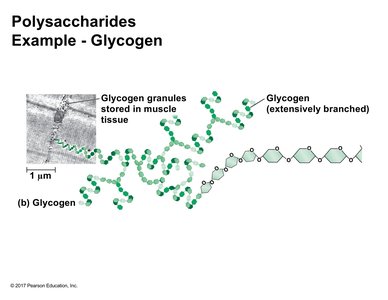
Glycogen: Storage polysaccharide in animals, highly branched and composed of alpha-glucose. Stored in liver and muscle cells.
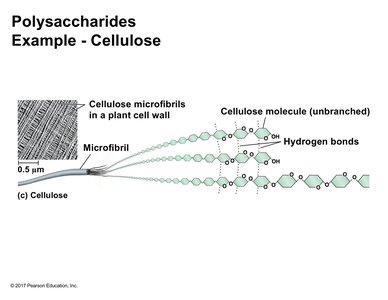
Cellulose: Structural polysaccharide in plant cell walls, composed of beta-glucose monomers. Forms straight, unbranched fibers that aggregate into microfibrils.
Alpha and Beta Glucose Linkages
The difference in the orientation of the glycosidic linkage (alpha or beta) leads to different properties and digestibility of polysaccharides.
Digestibility of Polysaccharides
Humans can digest starch (alpha linkages) but not cellulose (beta linkages). Some herbivores can digest cellulose due to symbiotic microbes.

Lipids
Concept: Lipids as Hydrophobic Molecules
Lipids are a diverse group of hydrophobic molecules that do not form true polymers. They include fats, phospholipids, and steroids.
Hydrophobicity: Lipids are insoluble in water due to their nonpolar hydrocarbon regions.
Functions: Energy storage, insulation, membrane structure, and signaling.
Fats (Triglycerides)
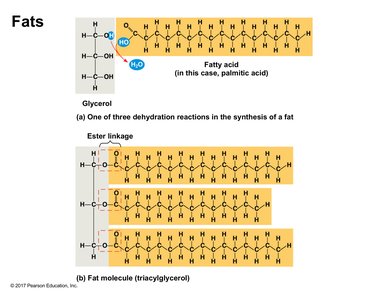
Fats are constructed from glycerol and three fatty acids, joined by ester linkages through dehydration reactions. They serve as long-term energy storage molecules.
Glycerol: A three-carbon alcohol with hydroxyl groups.
Fatty Acid: Long hydrocarbon chain with a carboxyl group.
Ester Linkage: Covalent bond formed between glycerol and fatty acid.
Saturated and Unsaturated Fats
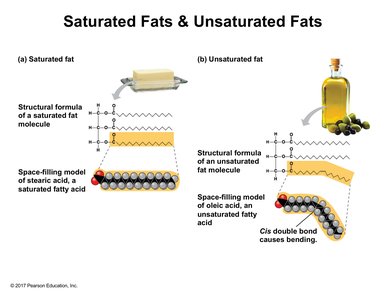
The presence or absence of double bonds in fatty acids determines whether a fat is saturated or unsaturated.
Saturated Fats: No double bonds; solid at room temperature (e.g., animal fats).
Unsaturated Fats: One or more cis double bonds; liquid at room temperature (e.g., plant oils).
Trans Fats
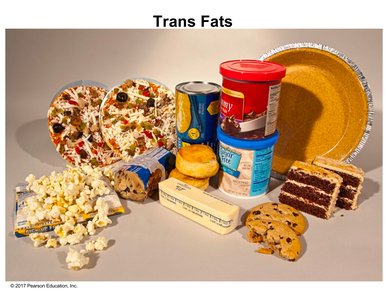
Trans fats are artificially created by hydrogenating unsaturated fats, resulting in trans double bonds. They are associated with negative health effects, including increased risk of cardiovascular disease.
Phospholipids
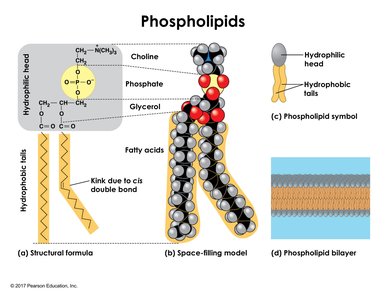
Phospholipids are major components of cell membranes. They have a hydrophilic head (glycerol, phosphate, and a small polar group) and two hydrophobic fatty acid tails. In water, they spontaneously form bilayers, creating a barrier between the cell and its environment.
Steroids
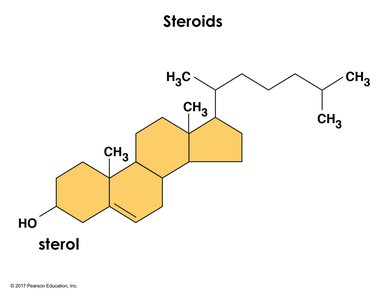
Steroids are lipids with a characteristic four-ring structure. Cholesterol is a key steroid in animal cell membranes and a precursor for other steroids, such as hormones.
Proteins
Concept: Proteins—Diversity of Structure and Function
Proteins are the most functionally diverse macromolecules, accounting for more than 50% of the dry mass of most cells. Their functions include catalysis (enzymes), defense, storage, transport, signaling, movement, and structure.
Enzymes: Catalyze biochemical reactions.
Defensive Proteins: Antibodies.
Storage Proteins: Store amino acids.
Transport Proteins: Move substances across membranes.
Hormonal Proteins: Coordinate organismal activities.
Receptor Proteins: Respond to chemical stimuli.
Motor Proteins: Movement.
Structural Proteins: Support and shape cells and tissues.
Amino Acids: The Building Blocks of Proteins
Amino acids are organic molecules with an amino group, a carboxyl group, a hydrogen atom, and a variable R group (side chain) attached to a central alpha carbon. The properties of the R group determine the characteristics of each amino acid.
Nonpolar (Hydrophobic) Side Chains: Tend to cluster in the interior of proteins.
Polar (Hydrophilic) Side Chains: Interact with water and other polar molecules.
Charged Side Chains: Acidic (negatively charged) or basic (positively charged); participate in ionic interactions.
Peptide Bond Formation
Amino acids are linked by peptide bonds through dehydration reactions, forming polypeptides. Polypeptides have directionality, with an N-terminus (amino end) and a C-terminus (carboxyl end).
Levels of Protein Structure
Primary Structure: Linear sequence of amino acids.
Secondary Structure: Coils (alpha helices) and folds (beta-pleated sheets) stabilized by hydrogen bonds between backbone atoms.
Tertiary Structure: Overall 3D shape stabilized by interactions among R groups (hydrogen bonds, ionic bonds, hydrophobic interactions, van der Waals forces, and disulfide bridges).
Quaternary Structure: Association of two or more polypeptide chains into a functional protein (e.g., hemoglobin).
Protein Denaturation and Renaturation
Proteins can lose their structure (denature) due to changes in pH, temperature, or salt concentration, resulting in loss of function. Some proteins can refold (renature) if optimal conditions are restored.
Nucleic Acids
Concept: Nucleic Acids Store and Transmit Hereditary Information
Nucleic acids are polymers of nucleotides and are responsible for the storage, transmission, and expression of genetic information. The two main types are DNA (deoxyribonucleic acid) and RNA (ribonucleic acid).
DNA: Stores genetic information; double-stranded helix.
RNA: Involved in gene expression; usually single-stranded.
Central Dogma: Information flows from DNA to RNA to protein (transcription and translation).
Nucleotide Structure
Nucleotide: Composed of a nitrogenous base, a five-carbon sugar (ribose or deoxyribose), and one or more phosphate groups.
Nitrogenous Bases: Pyrimidines (cytosine, thymine, uracil) and purines (adenine, guanine).
Phosphodiester Linkage: Covalent bond joining nucleotides in a nucleic acid strand.
DNA and RNA Structure
DNA: Double helix with complementary base pairing (A-T, C-G), antiparallel strands.
RNA: Single-stranded, but can form complex structures through internal base pairing (e.g., tRNA).
