 Back
BackTranscription and RNA Processing in Prokaryotes and Eukaryotes
Study Guide - Smart Notes
 Tailored notes based on your materials, expanded with key definitions, examples, and context.
Transcription and RNA Processing
Overview of Genetic Information Flow
The flow of genetic information in cells follows the central dogma: DNA is transcribed into RNA, which is then translated into protein. This process is fundamental to gene expression and is tightly regulated in both prokaryotic and eukaryotic cells.
Transcription: Synthesis of RNA from a DNA template.
Translation: Synthesis of proteins using the information in mRNA.
RNA Processing: Modifications of the primary RNA transcript, especially in eukaryotes.
Gene Structure and Transcription in Prokaryotes
Bacterial Protein Coding Genes
Bacterial genes contain specific sequences that regulate transcription:
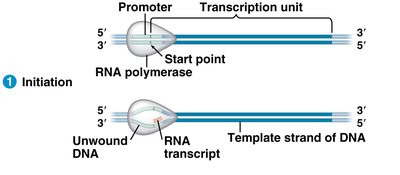
Promoter: DNA sequence where RNA polymerase binds to initiate transcription.
Terminator: Sequence signaling the end of transcription.
Stages of Bacterial Transcription
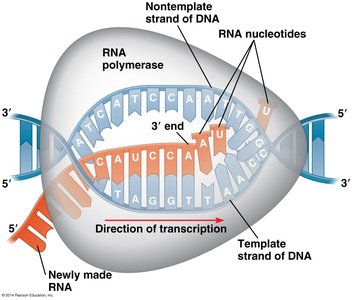
Transcription in bacteria occurs in three main stages:
Initiation: RNA polymerase binds to the promoter, unwinds DNA, and begins RNA synthesis (no primer required).
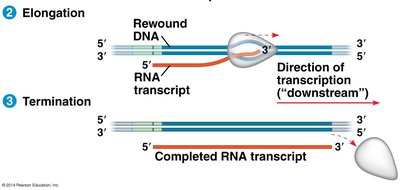
Elongation: RNA polymerase moves along the template strand (3' → 5'), synthesizing RNA in the 5' → 3' direction.
Termination: RNA polymerase reaches the terminator sequence, dissociates from DNA, and releases the RNA transcript.
Transcription in Eukaryotes
RNA Polymerases and Transcription Factors
Eukaryotic transcription is more complex, involving multiple RNA polymerases and regulatory proteins:
RNA Polymerase II: Synthesizes pre-mRNA (precursor to mRNA).
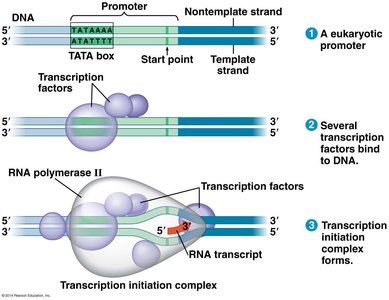
Transcription Factors: Proteins that help RNA polymerase bind to the promoter and initiate transcription.
TATA Box: A promoter element that recruits transcription factors (e.g., TFIID).
Stages of Eukaryotic Transcription
Initiation: Transcription factors bind to the promoter, recruiting RNA polymerase II to form the transcription initiation complex.
Elongation: RNA polymerase II synthesizes RNA, exposing 10–20 nucleotides at a time, at a rate of about 40 nucleotides per second.
Termination: A polyadenylation signal (AAUAAA) in the RNA leads to the release of the pre-mRNA transcript.
RNA Processing in Eukaryotes
Overview of RNA Processing
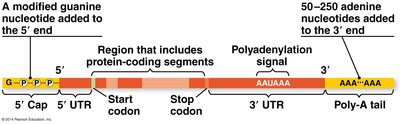
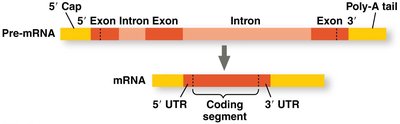
In eukaryotes, the primary RNA transcript (pre-mRNA) undergoes several modifications before becoming mature mRNA:
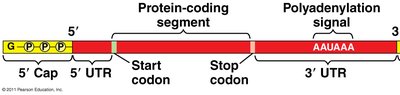
5' Capping: Addition of a modified guanine nucleotide to the 5' end.
3' Polyadenylation: Addition of a poly-A tail (50–250 adenine nucleotides) to the 3' end.
Splicing: Removal of noncoding introns and joining of coding exons.
5' Capping
The 5' cap protects mRNA from degradation, assists in export from the nucleus, and helps ribosomes recognize the mRNA for translation.
3' Polyadenylation
The poly-A tail stabilizes mRNA and aids in its export from the nucleus.

RNA Splicing
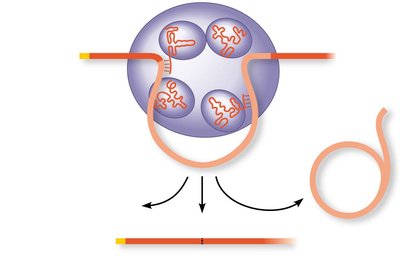
Most eukaryotic genes contain introns (noncoding regions) and exons (coding regions). Splicing removes introns and joins exons to produce a continuous coding sequence.
Spliceosome: A complex of proteins and small RNAs that catalyzes splicing. The RNA components (ribozymes) perform the catalytic activity.
Alternative Splicing
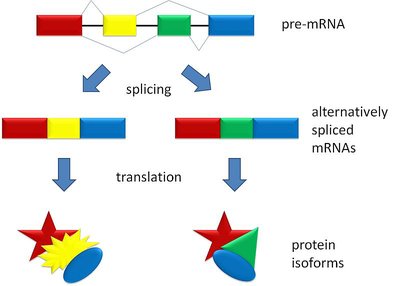
Alternative splicing allows a single gene to produce multiple protein isoforms by varying the combination of exons included in the final mRNA. This increases protein diversity without increasing the number of genes.
Example: The troponin gene can generate over 50 different muscle protein types through alternative splicing.

Summary Table: Key Differences in Transcription and RNA Processing
Feature | Prokaryotes | Eukaryotes |
|---|---|---|
Location | Cytoplasm | Nucleus |
RNA Polymerases | One | Three (I, II, III) |
RNA Processing | None | 5' capping, 3' polyadenylation, splicing |
Transcription Factors | Not required | Required |
Termination Signal | Terminator sequence | Polyadenylation signal (AAUAAA) |
Practice Questions
Which direction is RNA synthesized during transcription?
What is the function of the 5' cap and poly-A tail in eukaryotic mRNA?
How does alternative splicing contribute to protein diversity?
What is the role of the spliceosome in RNA processing?
