 Back
BackTranscription: DNA-Directed Synthesis of RNA
Study Guide - Smart Notes
 Tailored notes based on your materials, expanded with key definitions, examples, and context.
Transcription: DNA-Directed Synthesis of RNA
Overview of Transcription
Transcription is the process by which the information encoded in a DNA template is used to synthesize a complementary RNA molecule. This is the first stage of gene expression, ultimately leading to protein synthesis. The process is catalyzed by the enzyme RNA polymerase and involves three main stages: initiation, elongation, and termination.
Molecular Components of Transcription
Messenger RNA (mRNA): The RNA molecule that carries genetic information from DNA to the ribosome for protein synthesis.
RNA Polymerase: The enzyme that separates DNA strands and joins RNA nucleotides complementary to the DNA template strand, synthesizing RNA in the 5′ → 3′ direction.
Template Strand: The DNA strand used as a template for RNA synthesis.
Promoter: A specific DNA sequence where RNA polymerase binds to initiate transcription.
Terminator: In bacteria, a DNA sequence that signals the end of transcription.
Transcription Unit: The stretch of DNA that is transcribed into an RNA molecule.
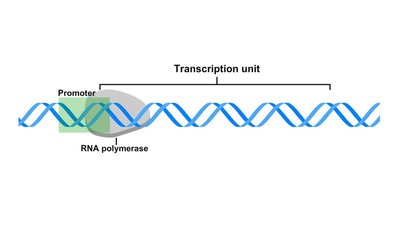
Stages of Transcription
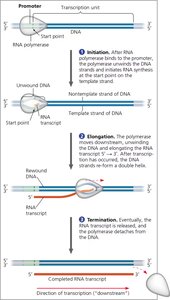
The process of transcription can be divided into three main stages: initiation, elongation, and termination.
1. Initiation
RNA polymerase binds to the promoter region of the gene, unwinding the DNA strands and beginning RNA synthesis at the start point.
In bacteria, RNA polymerase recognizes and binds directly to the promoter.
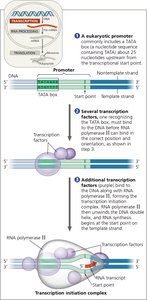
In eukaryotes, transcription factors help RNA polymerase II bind to the promoter, forming the transcription initiation complex. A key promoter element in many eukaryotic genes is the TATA box.
2. Elongation
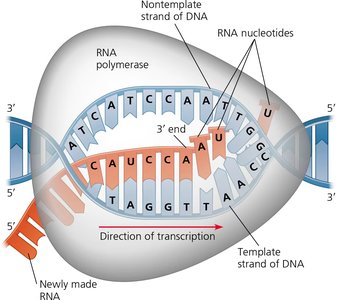
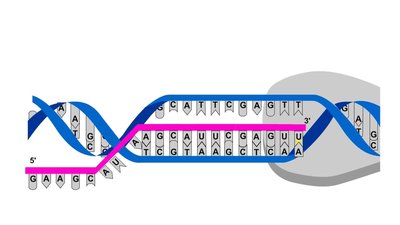
RNA polymerase moves along the DNA, unwinding the double helix and synthesizing RNA by adding nucleotides to the 3′ end of the growing RNA strand.
Only about 10–20 DNA nucleotides are exposed at a time for base pairing with RNA nucleotides.
The newly synthesized RNA strand peels away from the DNA template, and the DNA helix reforms behind the polymerase.
Multiple RNA polymerases can transcribe a single gene simultaneously, increasing mRNA production.
3. Termination
In bacteria, transcription ends when RNA polymerase reaches a terminator sequence, causing the enzyme to detach and release the RNA transcript.
In eukaryotes, RNA polymerase II transcribes a polyadenylation signal sequence (AAUAAA) in the pre-mRNA. Proteins recognize this signal and cut the RNA transcript free from the polymerase, releasing the pre-mRNA for further processing.
Key Differences: Bacterial vs. Eukaryotic Transcription
Feature | Bacteria | Eukaryotes |
|---|---|---|
RNA Polymerase Types | One type | At least three types (RNA polymerase II for mRNA) |
Promoter Recognition | RNA polymerase binds directly | Requires transcription factors |
Termination | Terminator sequence in DNA | Polyadenylation signal and RNA processing |
Important Terms and Concepts
Upstream/Downstream: "Upstream" refers to sequences before (5′ to) the start point; "downstream" refers to sequences after (3′ to) the start point.
Transcription Factors: Proteins in eukaryotes that help RNA polymerase bind to the promoter and initiate transcription.
TATA Box: A DNA sequence found in many eukaryotic promoters, crucial for forming the initiation complex.
Example: Effects of Mutations in the Promoter
A mutation in the TATA box can reduce or prevent the binding of transcription factors and RNA polymerase II, leading to decreased or abolished transcription of the gene.
Summary Table: Stages of Transcription
Stage | Main Events |
|---|---|
Initiation | RNA polymerase binds promoter, DNA unwinds, RNA synthesis begins |
Elongation | RNA polymerase moves along DNA, synthesizing RNA strand |
Termination | RNA transcript released, polymerase detaches (mechanism differs in bacteria and eukaryotes) |
Key Equations
Direction of RNA synthesis:
Base pairing during transcription:
Additional info: In eukaryotes, the pre-mRNA produced by transcription undergoes further processing (capping, polyadenylation, and splicing) before becoming mature mRNA ready for translation.
