 Back
BackTranscription, RNA Processing, and Translation: From Gene to Protein
Study Guide - Smart Notes
 Tailored notes based on your materials, expanded with key definitions, examples, and context.
Transcription, RNA Processing, and Translation
Introduction
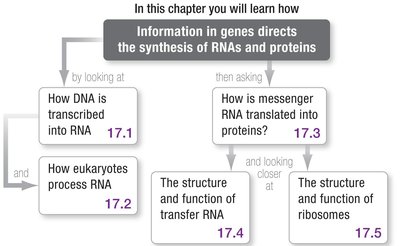
This chapter explores how genetic information encoded in DNA is used to synthesize proteins, the essential molecules responsible for most cellular functions. The process involves three main stages: transcription, RNA processing (in eukaryotes), and translation. Each stage is tightly regulated and involves a series of complex molecular interactions.
Transcription: Synthesis of RNA from DNA
Overview of Transcription
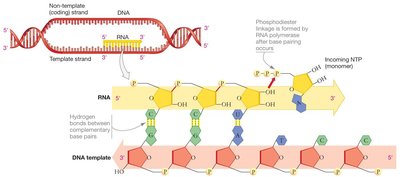
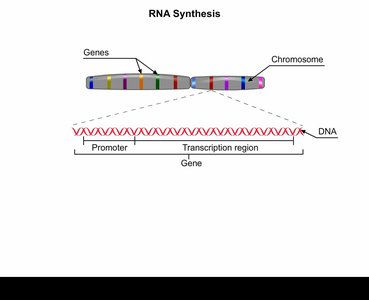
Transcription is the process by which RNA polymerases synthesize an RNA copy of a gene using DNA as a template. This RNA molecule carries the genetic instructions needed for protein synthesis.
RNA polymerases use ribonucleoside triphosphates (NTPs) to build RNA.
Only one DNA strand (the template strand) is used for transcription; the other is the coding strand, which matches the RNA sequence (except U replaces T).
RNA synthesis proceeds in the 5′ → 3′ direction.
Unlike DNA polymerases, RNA polymerases do not require a primer.
Bacteria have one RNA polymerase; eukaryotes have three (RNA polymerase I, II, III).
Initiation of Transcription in Bacteria
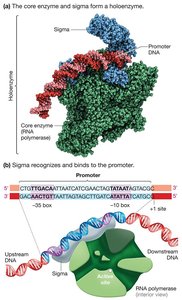
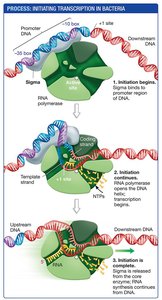
Transcription initiation requires the assembly of a holoenzyme composed of RNA polymerase and a sigma factor. The sigma factor recognizes specific DNA sequences called promoters, which signal the start of a gene.
Bacterial promoters are typically 40–50 base pairs long and contain conserved sequences:
-10 box: TATAAT sequence, ~10 bases upstream of the start site
-35 box: TTGACA sequence, ~35 bases upstream
Sigma binds to the promoter, orienting RNA polymerase and determining the template strand and direction of transcription.
Elongation and Termination in Bacteria
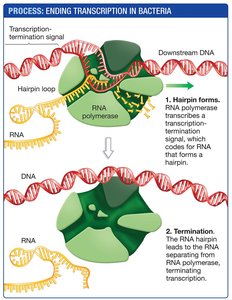
During elongation, RNA polymerase moves along the DNA template, adding nucleotides to the 3′ end of the growing RNA. Termination occurs when a specific sequence in the DNA is transcribed, causing the RNA to form a hairpin structure that destabilizes the transcription complex and releases the RNA transcript.
Elongation: Nucleotides are added to the 3′ end of RNA.
Termination: A transcription-termination signal codes for an RNA hairpin, causing RNA polymerase to dissociate from the DNA.
Transcription in Eukaryotes
Eukaryotic transcription is more complex than in bacteria, involving multiple RNA polymerases, larger and more variable promoters (including the TATA box), and general transcription factors instead of sigma proteins. Termination involves a poly(A) signal, and transcription occurs in the nucleus, separated from translation in the cytoplasm.
Three RNA polymerases (I, II, III), each transcribing different classes of RNA.
Promoters are more variable and often include a TATA box (~30 bases upstream).
General transcription factors are required for promoter recognition.
Termination involves cleavage of the RNA downstream of a poly(A) signal.
Transcription and translation are compartmentalized.
RNA Processing in Eukaryotes
Primary Transcripts and RNA Processing
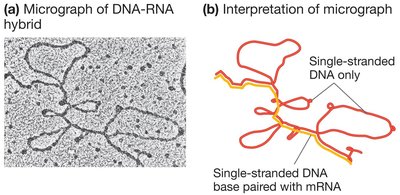
In eukaryotes, the initial RNA transcript (pre-mRNA) must be processed before it can be translated. This processing includes splicing, capping, and polyadenylation.
Primary transcripts contain both coding (exons) and noncoding (introns) regions.
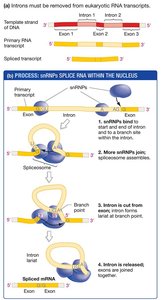
Introns are removed by splicing, catalyzed by the spliceosome (composed of snRNPs).
Exons are joined to form mature mRNA.
RNA Splicing
Splicing removes introns from pre-mRNA through a series of steps involving snRNPs and the formation of a lariat structure.
snRNPs bind to exon-intron boundaries and a branch point A.
Additional snRNPs assemble to form the spliceosome.
The intron forms a lariat and is excised.
Exons are ligated; the intron is degraded.
5′ Capping and 3′ Polyadenylation
Two additional modifications are made to eukaryotic mRNA:
5′ cap: A modified guanine nucleotide added to the 5′ end, facilitating ribosome binding and protecting mRNA from degradation.
Poly(A) tail: A stretch of 100–250 adenine nucleotides added to the 3′ end, enhancing stability and translation efficiency.
Mature mRNAs contain untranslated regions (UTRs) at both ends.

Translation: Protein Synthesis
Overview of Translation
Translation is the process by which the sequence of bases in mRNA is converted into an amino acid sequence, forming a polypeptide. This process requires ribosomes, mRNA, and tRNAs.
Ribosomes are the site of protein synthesis.
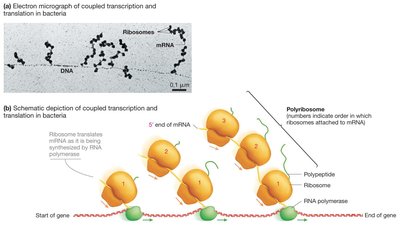
In bacteria, translation can begin before transcription is complete (coupled transcription and translation).
In eukaryotes, transcription and translation are separated by the nuclear envelope.
How Does mRNA Specify Amino Acids?
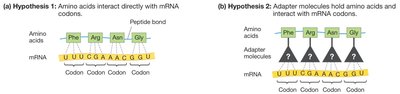
There are two main hypotheses for how mRNA codons specify amino acids:
Direct interaction between mRNA codons and amino acids.
Adaptor molecules (tRNAs) hold amino acids and interact with codons (Crick's hypothesis, which is correct).
Transfer RNA (tRNA): Structure and Function
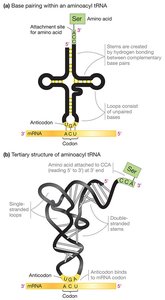
tRNAs serve as adaptor molecules in translation, linking specific amino acids to their corresponding mRNA codons via their anticodon loop.
tRNAs are 75–95 nucleotides long and fold into a stem-and-loop structure.
The 3′ end (CCA sequence) is the amino acid attachment site.
The anticodon loop base-pairs with the mRNA codon.
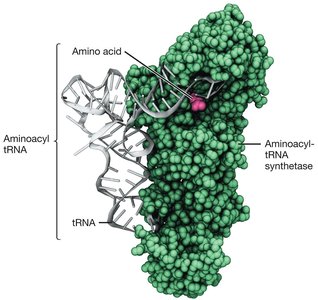
Aminoacyl-tRNA synthetases "charge" tRNAs with the correct amino acid, using ATP.
There are about 40 tRNAs for 61 codons; wobble pairing allows one tRNA to recognize multiple codons.
Ribosome Structure and Function in Translation
Ribosome Structure
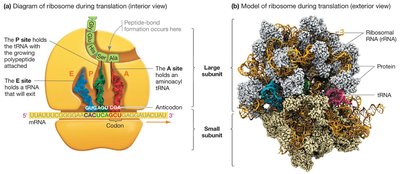
Ribosomes are composed of ribosomal RNA (rRNA) and proteins, and consist of two subunits (large and small). They contain three binding sites for tRNA:
A site (aminoacyl): Entry point for charged tRNA.
P site (peptidyl): Holds the tRNA with the growing polypeptide chain.
E site (exit): Where uncharged tRNAs exit the ribosome.
Mechanism of Translation
Translation proceeds in three phases: initiation, elongation, and termination.
Initiation
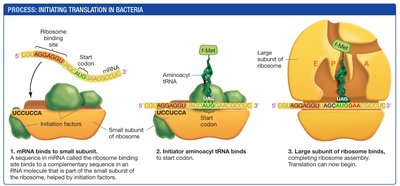
Begins near the AUG start codon.
In bacteria, the small ribosomal subunit binds to the Shine–Dalgarno sequence on mRNA, mediated by initiation factors.
The initiator tRNA (carrying f-Met in bacteria) binds to the start codon in the P site.
The large subunit joins, completing the initiation complex.
Elongation
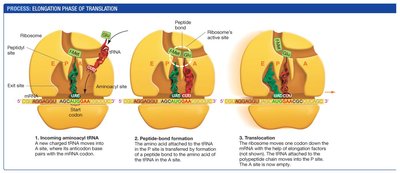
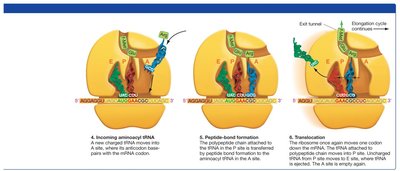
Aminoacyl tRNA enters the A site if its anticodon matches the codon.
A peptide bond forms between the amino acid in the A site and the polypeptide in the P site (catalyzed by rRNA, making the ribosome a ribozyme).
The ribosome translocates one codon, moving the tRNAs through the sites (A → P → E).
The cycle repeats, elongating the polypeptide chain.
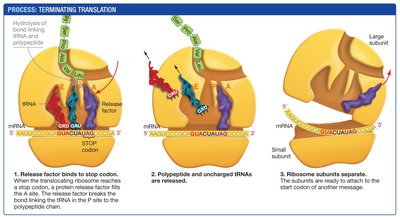
Termination
Occurs when a stop codon enters the A site.
A release factor protein binds, hydrolyzing the bond between the polypeptide and tRNA.
The ribosomal subunits, mRNA, and tRNAs dissociate.
Comparison of Transcription and Translation in Bacteria and Eukaryotes
Process | Bacteria | Eukaryotes |
|---|---|---|
Transcription | One RNA polymerase; promoters with -35 and -10 boxes; sigma factor required | Three RNA polymerases; variable promoters (often TATA box); general transcription factors required |
RNA Processing | Rare | Extensive: 5′ cap, splicing, 3′ poly(A) tail |
Translation | Initiation and termination less complex; elongation similar to eukaryotes | Initiation and termination more complex; elongation similar to bacteria |
Post-Translational Modification
Protein Folding and Chemical Modifications
After translation, most proteins undergo further processing to become functional. This includes folding (often assisted by molecular chaperones), and the addition of chemical groups such as sugars, lipids, or phosphates, which can alter protein activity and localization.
Folding determines protein shape and function.
Chaperones assist in proper folding.
Glycosylation and phosphorylation are common modifications.
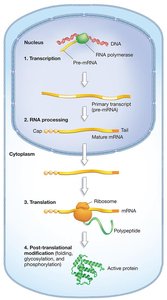
Additional info: The central dogma of molecular biology describes the flow of genetic information from DNA to RNA to protein. Regulation at each step ensures proper gene expression and cellular function.
