 Back
BackTranscription: The DNA-Directed Synthesis of RNA
Study Guide - Smart Notes
 Tailored notes based on your materials, expanded with key definitions, examples, and context.
Transcription: The DNA-Directed Synthesis of RNA
Overview of Transcription
Transcription is the first stage of gene expression, during which a segment of DNA is used as a template to synthesize a complementary RNA molecule. This process is essential for converting genetic information stored in DNA into messenger RNA (mRNA), which then directs protein synthesis in the cell.
Messenger RNA (mRNA): The RNA molecule that carries genetic information from DNA to the ribosome, where proteins are synthesized.
RNA Polymerase: The enzyme responsible for separating DNA strands and assembling RNA nucleotides complementary to the DNA template strand.
Directionality: RNA polymerase synthesizes RNA in the 5′ → 3′ direction, adding nucleotides to the 3′ end of the growing RNA chain.
Primer Requirement: Unlike DNA polymerase, RNA polymerase does not require a primer to initiate synthesis.
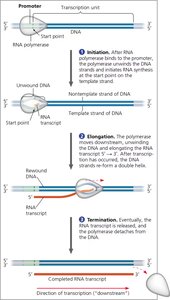
Molecular Components of Transcription
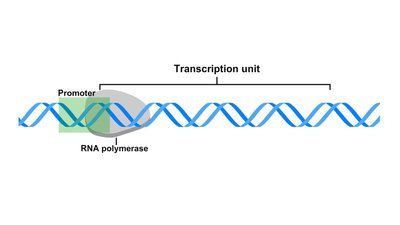
Specific DNA sequences mark the beginning and end of transcription. The promoter is the DNA sequence where RNA polymerase binds to initiate transcription, while the terminator signals the end of transcription (in bacteria).
Promoter: Located upstream of the transcription unit; includes the transcription start point.
Transcription Unit: The stretch of DNA downstream from the promoter that is transcribed into RNA.
RNA Polymerase Types: Bacteria have one RNA polymerase; eukaryotes have three, with RNA polymerase II synthesizing pre-mRNA.
Directionality Terms: "Upstream" refers to sequences before the start point; "downstream" refers to sequences after.
Stages of Transcription
1. Initiation
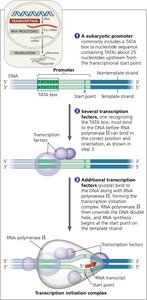
Transcription begins when RNA polymerase binds to the promoter. In bacteria, the polymerase recognizes and binds directly to the promoter. In eukaryotes, transcription factors are required to help RNA polymerase II bind to the promoter, forming the transcription initiation complex. A key promoter element in eukaryotes is the TATA box.
Transcription Factors: Proteins that assist RNA polymerase binding and initiation in eukaryotes.
TATA Box: A DNA sequence crucial for forming the initiation complex in eukaryotic promoters.
Transcription Initiation Complex: The assembly of transcription factors and RNA polymerase II at the promoter.
2. Elongation
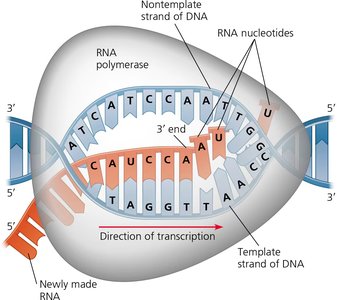
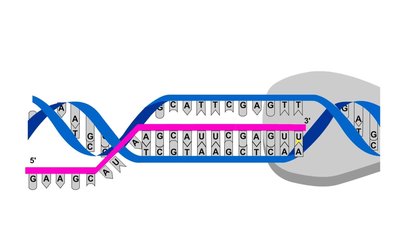
During elongation, RNA polymerase moves along the DNA, unwinding the double helix and synthesizing RNA by adding nucleotides complementary to the DNA template strand. The new RNA strand peels away from the DNA, and the DNA helix reforms behind the polymerase. Multiple RNA polymerases can transcribe a gene simultaneously, increasing mRNA output.
RNA Synthesis Rate: In eukaryotes, about 40 nucleotides per second.
Template Strand: The DNA strand used as a template for RNA synthesis.
Base Pairing: RNA nucleotides pair with complementary DNA bases (A-U, T-A, C-G, G-C).
3. Termination
The mechanism of transcription termination differs between bacteria and eukaryotes:
Bacteria: RNA polymerase transcribes a terminator sequence, causing the enzyme to detach and release the RNA transcript, which is ready for translation.
Eukaryotes: RNA polymerase II transcribes a polyadenylation signal sequence (AAUAAA). Proteins bind this sequence and cut the RNA transcript about 10–35 nucleotides downstream, releasing the pre-mRNA for further processing.
Key Definitions and Concepts
Promoter: DNA sequence where RNA polymerase binds to initiate transcription; located upstream of the transcription unit.
Transcription Factors: Proteins required for RNA polymerase binding and initiation in eukaryotes.
TATA Box: A conserved promoter sequence in eukaryotes, important for transcription initiation.
Polyadenylation Signal: Sequence (AAUAAA) in eukaryotic DNA that signals the end of transcription and triggers RNA processing.
Comparison Table: Bacterial vs. Eukaryotic Transcription
Feature | Bacteria | Eukaryotes |
|---|---|---|
RNA Polymerase Types | One | Three (I, II, III) |
Promoter Recognition | RNA polymerase binds directly | Requires transcription factors |
Termination Signal | Terminator sequence in DNA | Polyadenylation signal (AAUAAA) |
RNA Processing | Transcript ready for translation | Pre-mRNA processed before translation |
Example: Effects of Mutations in the TATA Box
If a mutation occurs in the TATA box of a gene's promoter, transcription initiation may be impaired because transcription factors and RNA polymerase II may not bind efficiently, reducing or abolishing gene expression.
Additional info: The TATA box is typically located about 25 nucleotides upstream from the transcription start point in eukaryotic genes. Its sequence is highly conserved due to its critical role in transcription initiation.
