 Back
Translation and the Genetic Code: From mRNA to Protein
Study Guide - Smart Notes
 Tailored notes based on your materials, expanded with key definitions, examples, and context.
Translation: Protein Synthesis from mRNA
Overview of Translation
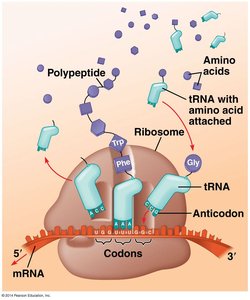
Translation is the biological process by which the sequence of nucleotides in messenger RNA (mRNA) is decoded to produce a specific sequence of amino acids, resulting in the synthesis of a polypeptide (protein). This process is fundamental to gene expression and is highly conserved across prokaryotes and eukaryotes.
Translation machinery includes mRNA, ribosomes, transfer RNA (tRNA), and various enzymes.
Ribosomes facilitate the decoding of mRNA and the formation of peptide bonds between amino acids.
tRNA molecules act as adaptors, matching mRNA codons with their corresponding amino acids.
The Genetic Code
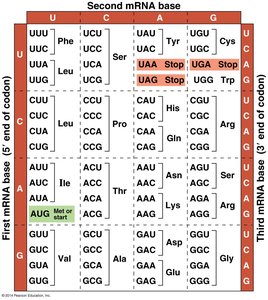
The genetic code is a set of rules by which information encoded in mRNA sequences is translated into proteins. Each three-nucleotide sequence (codon) in mRNA specifies a particular amino acid.
Redundancy: Multiple codons can code for the same amino acid, but each codon specifies only one amino acid (no ambiguity).
Universality: The genetic code is nearly universal among all organisms.
Start codon: AUG (methionine) signals the start of translation and sets the reading frame.
Stop codons: UAA, UAG, and UGA signal the termination of translation.
tRNA: Structure and Function
tRNA as the Decoder
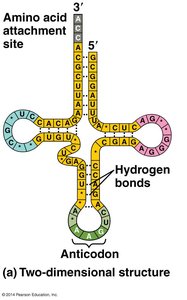
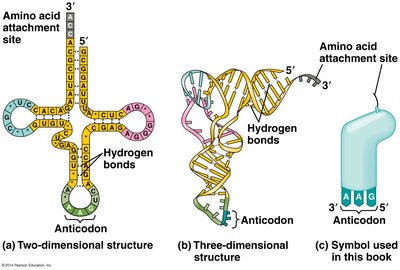
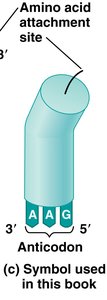
Transfer RNA (tRNA) molecules are essential for translating the nucleotide sequence of mRNA into the amino acid sequence of proteins. Each tRNA has a specific structure that allows it to recognize codons in mRNA and carry the corresponding amino acid.
Anticodon: A set of three nucleotides in tRNA that base-pairs with the complementary codon in mRNA.
Amino acid attachment site: The 3' end of the tRNA where a specific amino acid is covalently attached.
Structure: tRNA molecules are about 80 nucleotides long and fold into a characteristic cloverleaf structure due to complementary base pairing.
tRNA Charging: Aminoacyl-tRNA Synthetases
Before translation, each tRNA must be linked to its correct amino acid in a process called "charging." This reaction is catalyzed by a family of enzymes known as aminoacyl-tRNA synthetases.
Each aminoacyl-tRNA synthetase is specific for one amino acid and its corresponding tRNAs.
The reaction requires ATP and results in a "charged" tRNA ready for translation.
Decoding the Genetic Code: Codons and Anticodons
Codon-Anticodon Pairing
During translation, the ribosome moves along the mRNA, and tRNAs bring amino acids to the ribosome by matching their anticodons to the codons on the mRNA.
Base pairing between codon (mRNA) and anticodon (tRNA) is antiparallel and complementary.
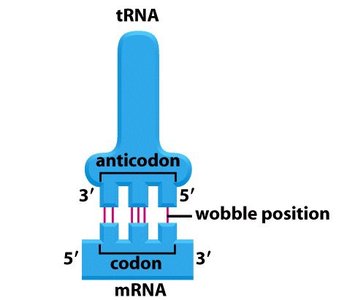
Directionality is important: codons are read 5' to 3' on the mRNA, and anticodons are oriented 3' to 5' on the tRNA.
Reading Frame and Start Codon
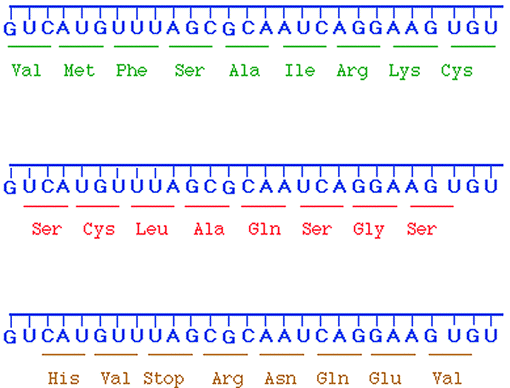
The reading frame is established by the start codon (AUG), which ensures that the mRNA is read in the correct groupings of three nucleotides. Shifting the reading frame changes the resulting amino acid sequence.
Incorrect reading frames result in nonfunctional proteins.
Wobble Hypothesis and tRNA Redundancy
Wobble Base Pairing
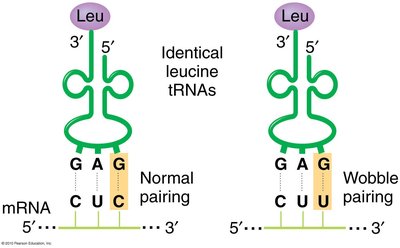
Although there are 64 possible codons, most organisms have fewer than 45 different tRNAs. This is possible because of "wobble" at the third position of the codon, allowing some tRNAs to pair with more than one codon.
The third base of the codon (5' end of the anticodon) can form non-standard base pairs, increasing the efficiency of translation.
Example: A tRNA with the anticodon UCU can pair with codons AGA and AGG.
Applications: Recombinant DNA Technology
Human Insulin Production in Bacteria
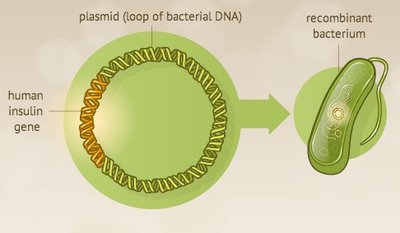
Recombinant DNA technology allows the insertion of human genes, such as the insulin gene, into bacterial plasmids. The bacteria then use their own translation machinery to produce human proteins.
This process is widely used in biotechnology and medicine for the production of therapeutic proteins.
Summary Table: Codons, Anticodons, and Amino Acids
The following table summarizes the relationship between mRNA codons, tRNA anticodons, and the amino acids they specify.
mRNA Codon | tRNA Anticodon | Amino Acid |
|---|---|---|
AUG | UAC | Methionine (Start) |
UUU | AAA | Phenylalanine |
UGA | ACU | Stop |
CCU | GGA | Proline |
ACG | CGU | Threonine |
Key Terms and Concepts
Translation: Synthesis of a polypeptide using the genetic information encoded in mRNA.
tRNA: Transfer RNA, adaptor molecule in protein synthesis.
Codon: Three-nucleotide sequence in mRNA specifying an amino acid.
Anticodon: Three-nucleotide sequence in tRNA complementary to the mRNA codon.
Aminoacyl-tRNA synthetase: Enzyme that attaches the correct amino acid to its tRNA.
Wobble: Flexibility in base pairing at the third position of the codon, allowing one tRNA to recognize multiple codons.
