 Back
BackWater, Carbon, and the Structure and Function of Large Biological Molecules
Study Guide - Smart Notes
 Tailored notes based on your materials, expanded with key definitions, examples, and context.
Water and Life
Polar Covalent Bonds and Hydrogen Bonding in Water
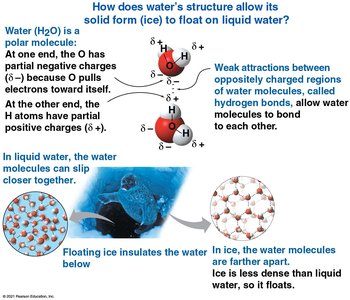
Water's unique properties arise from its molecular structure. The electrons in water's polar covalent bonds spend more time near the oxygen atom, making water a polar molecule with an uneven charge distribution. This polarity allows water molecules to form hydrogen bonds with each other, which are weak attractions between the partially positive hydrogen of one molecule and the partially negative oxygen of another.
Emergent Properties of Water
Water exhibits four key properties that make it essential for life:
Cohesion: Hydrogen bonds hold water molecules together, resulting in high surface tension.
Moderation of Temperature: Water absorbs and releases heat with minimal temperature change, stabilizing environments (e.g., coastal areas).
Expansion Upon Freezing: Ice is less dense than liquid water because hydrogen bonds keep molecules further apart in solid form, allowing ice to float and insulate aquatic life below.
Versatility as a Solvent: Water's polarity enables it to dissolve many substances, forming hydration shells around ions and polar molecules.
Hydrophilic and Hydrophobic Substances
Substances that interact well with water are termed hydrophilic, while those that do not (such as oils) are hydrophobic. Hydrophobic molecules are major components of cell membranes.
Acidic and Basic Conditions
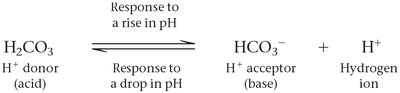
Water can dissociate into hydrogen ions (H+) and hydroxide ions (OH−). Acids increase the H+ concentration (pH < 7), while bases decrease it (pH > 7). Most biological fluids have pH values between 6 and 8. Buffers, such as the bicarbonate buffer system, help maintain stable pH in cells by reversibly binding H+ ions.
Carbon and the Molecular Diversity of Life
Organic Chemistry and the Importance of Carbon
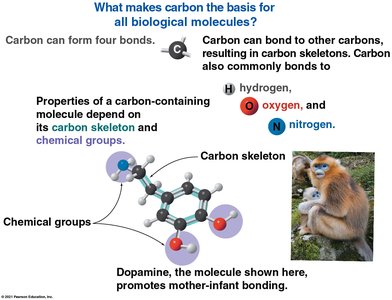
Organic chemistry studies carbon-containing compounds. Carbon's four valence electrons allow it to form four covalent bonds, enabling the construction of large, complex molecules. Carbon can bond to other carbons, forming chains and rings, and also bonds with hydrogen, oxygen, and nitrogen.
Formation of Bonds with Carbon
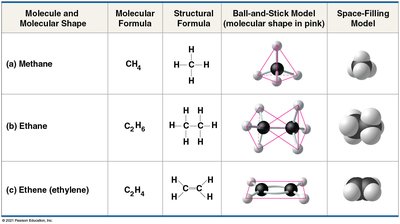
Carbon atoms can form single, double, or triple bonds. In molecules with multiple carbons, each carbon bonded to four other atoms has a tetrahedral shape, while double bonds create planar regions. This versatility leads to a wide variety of molecular shapes and functions.
Molecular Diversity from Carbon Skeletons
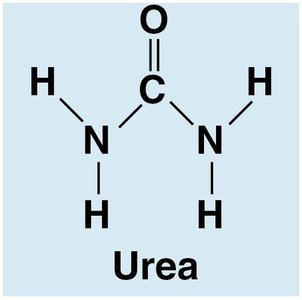
Carbon skeletons vary in length, branching, and ring formation, contributing to molecular diversity. For example, urea (CO(NH2)2) is a simple organic molecule with both carbon and nitrogen.
Hydrocarbons
Hydrocarbons are organic molecules consisting only of carbon and hydrogen. They are found in many biological molecules, such as fats, and can release large amounts of energy when oxidized.
Isomers
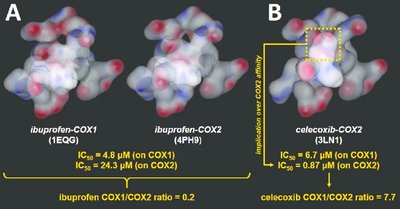
Isomers are compounds with the same molecular formula but different structures and properties:
Structural isomers: Differ in covalent arrangement of atoms.
Cis-trans (geometric) isomers: Same covalent bonds but different spatial arrangements.
Enantiomers: Mirror images of each other, often with different biological activities.
Chemical Groups and Functional Groups
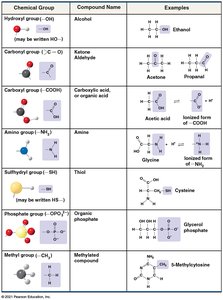
Functional groups are specific groups of atoms within molecules that are responsible for the characteristic chemical reactions of those molecules. The number and arrangement of functional groups determine the properties and functions of organic molecules. Seven functional groups are especially important in biological chemistry: hydroxyl, carbonyl, carboxyl, amino, sulfhydryl, phosphate, and methyl.
The Structure and Function of Large Biological Molecules
Macromolecules and Polymers
Large biological molecules, or macromolecules, include carbohydrates, proteins, and nucleic acids, which are polymers built from monomers. Lipids are large molecules but are not true polymers. The diversity of polymers arises from the arrangement of a small set of monomers in various sequences.

Polymerization: Dehydration and Hydrolysis Reactions
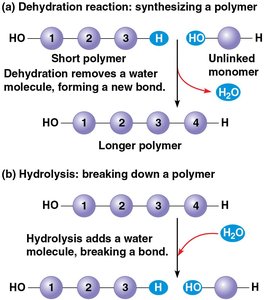
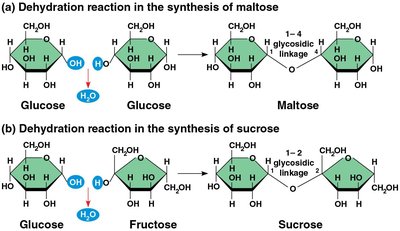
Polymers are synthesized by dehydration reactions, which remove a water molecule to form a new bond. They are broken down by hydrolysis, which adds a water molecule to break a bond.
Carbohydrates: Structure and Function
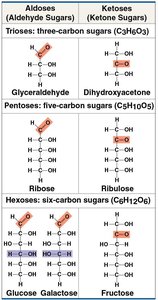
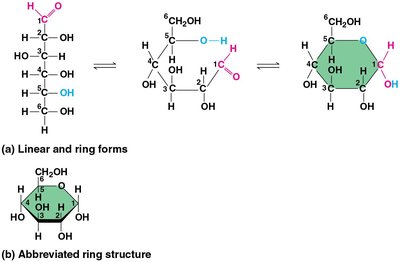
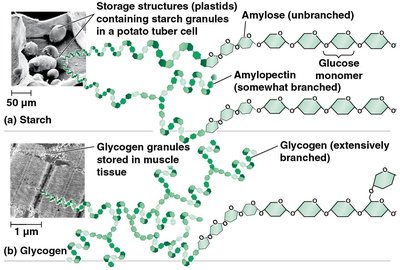
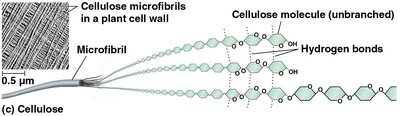
Carbohydrates include sugars and their polymers. The simplest are monosaccharides (e.g., glucose), which can be classified by the location of their carbonyl group (aldose or ketose) and the number of carbons. Disaccharides are formed by dehydration reactions between two monosaccharides, creating a glycosidic linkage. Polysaccharides serve storage (starch, glycogen) and structural (cellulose, chitin) roles.
Lipids: Structure and Function
Lipids are hydrophobic molecules that include fats, phospholipids, and steroids. Fats are constructed from glycerol and fatty acids, joined by ester linkages to form triacylglycerols. Fatty acids can be saturated (no double bonds) or unsaturated (one or more double bonds). Phospholipids have two fatty acids and a phosphate group attached to glycerol, forming bilayers in cell membranes. Steroids, such as cholesterol, have a structure of four fused rings.
