Pearson+ LogoPearson+ Logo
Ch. 35 Behavioral Adaptations to the Environment
Taylor - Campbell Biology: Concepts & Connections 10th Edition
Taylor, Simon, Dickey, Hogan10th EditionCampbell Biology: Concepts & ConnectionsISBN: 9780136538783Not the one you use?Change textbook
Chapter 35, Problem 9

Crows break the shells of certain molluscs before eating them by dropping them onto rocks. Hypothesizing that crows drop the molluscs from a height that gives the most food for the least effort (optimal foraging), a researcher dropped shells from different heights and counted the drops it took to break them. a. The researcher measured the average drop height for crows and found that it was 5.23 m. Does this support the researcher's hypothesis? Explain. b. Describe an experiment to determine whether dropping molluscs from an optimal height is learned or innate.
Table showing drop heights and average drops needed for crows to break mollusc shells.

Verified step by step guidance
1
Step 1: Analyze the data provided in the table. The table shows the height of drop (m), the average number of drops required to break the shell, and the total flight height (calculated as the number of drops multiplied by the height per drop). The goal is to determine if the average drop height of 5.23 m aligns with the hypothesis of optimal foraging.
Step 2: Compare the total flight height values in the table. Optimal foraging suggests that crows would choose a drop height that minimizes the total effort (total flight height). From the table, the drop height of 5 m has the lowest total flight height (30 m), indicating it requires the least effort to break the shell.
Step 3: Evaluate the average drop height of 5.23 m observed in crows. This value is close to the drop height of 5 m, which minimizes effort according to the data. This supports the hypothesis that crows drop molluscs from a height that optimizes foraging efficiency.
Step 4: To determine whether dropping molluscs from an optimal height is learned or innate, design an experiment. One approach is to observe juvenile crows that have not been exposed to adult crows. Provide them with molluscs and measure the drop heights they choose over time. Compare their behavior to adult crows to see if they naturally select optimal heights or if they learn this behavior through observation.
Step 5: Another experimental approach is to manipulate the environment. For example, raise crows in isolation without exposure to molluscs or other crows, then introduce molluscs and observe their drop height choices. If they consistently choose optimal heights, this suggests the behavior is innate. If their choices improve with experience or exposure to other crows, this suggests the behavior is learned.

Verified video answer for a similar problem:

This video solution was recommended by our tutors as helpful for the problem above.
Video duration:
2m
Was this helpful?

Key Concepts

Here are the essential concepts you must grasp in order to answer the question correctly.

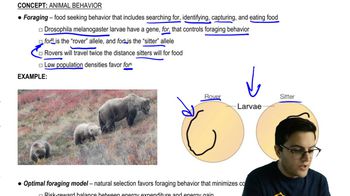
Optimal Foraging Theory

Optimal Foraging Theory posits that animals will maximize their energy intake per unit of foraging time. This means that crows, when dropping molluscs, would ideally choose a height that minimizes the effort required to break the shells while maximizing the food obtained. The researcher's hypothesis suggests that crows have evolved to drop shells from a height that reflects this balance.
Recommended video:

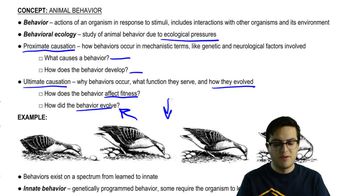
Innate vs. Learned Behavior

Innate behaviors are instinctual and do not require learning or experience, while learned behaviors are acquired through interaction with the environment. To determine if crows' dropping behavior is innate or learned, an experiment could involve observing young crows in isolation to see if they drop shells without prior exposure to the behavior, or if they need to observe other crows first.
Recommended video:

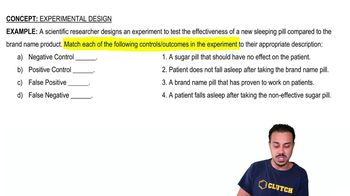
Experimental Design

Experimental design involves planning how to conduct an experiment to test a hypothesis effectively. In this case, the researcher must control variables such as the type of mollusc and the environment to ensure that the results accurately reflect the relationship between drop height and the number of drops needed to break the shells. This design is crucial for drawing valid conclusions from the data collected.
Recommended video:
Guided course
02:50
Experimental Design Example 1
Related Practice
Textbook Question
Almost all the behaviors of a housefly are innate. What are some advantages and disadvantages to the fly of innate behaviors compared with behaviors that are mainly learned?
833
views
Textbook Question
In Module 35.3, you learned that Norway rat offspring whose mothers don't interact much with them grow up to be fearful and anxious in new situations. Suggest a possible ultimate cause for this link between maternal behavior and stress response of offspring. (Hint: Under what circumstances might high reactivity to stress be more adaptive than being relaxed?)
1099
views
Textbook Question

A chorus of frogs fills the air on a spring evening. The frog calls are courtship signals.

What are the functions of courtship behaviors?

How might a behavioral ecologist explain the proximate cause of this behavior?

The ultimate cause?

881
views
Textbook Question
Scientists studying scrub jays found that it is common for 'helpers' to assist mated pairs of birds in raising their young. The helpers lack territories and mates of their own. Instead, they help the territory owners gather food for their offspring. Propose a hypothesis to explain what advantage there might be for the helpers to engage in this behavior instead of seeking their own territories and mates. How would you test your hypothesis? If your hypothesis is correct, what kind of results would you expect your tests to yield?
1171
views
Textbook Question

Researchers are very interested in studying identical twins who were raised apart. Among other things, they hope to answer questions about the roles of inheritance and upbringing in human behavior.

Why do identical twins make such good subjects for this kind of research?

What do the results of such studies suggest to you? What are the potential pitfalls of this research?

What abuses might occur in the use of these data if the studies are not evaluated critically?

943
views
Textbook Question
SCIENTIFIC THINKING Jane Goodall's work revealed that in areas of abundant food, chimpanzees may live in groups of several dozen individuals. State a hypothesis about the chimpanzee mating system that could be tested by observing one of these groups. What data would you collect to test your hypothesis? How would you interpret the results? (Note: A sexually mature female chimpanzee undergoes a hormonal cycle about 36 days long that is reflected in easily observed changes in the appearance of her genital area. Females are most sexually receptive, and males are most attracted to them, for about a week during the middle of the cycle.)
1038
views