
Pearson+ LogoPearson+ Logo
Ch. 33 Control Systems in Plants
Taylor - Campbell Biology: Concepts & Connections 10th Edition
Taylor, Simon, Dickey, Hogan10th EditionCampbell Biology: Concepts & ConnectionsISBN: 9780136538783Not the one you use?Change textbook
Chapter 33, Problem 3

Auxin causes a shoot to bend toward the light by
a. Causing cells to shrink on the dark side of the shoot
b. Stimulating growth on the dark side of the shoot
c. Causing cells to shrink on the lighted side of the shoot
d. Stimulating growth on the lighted side of the shoot

Verified step by step guidance
1
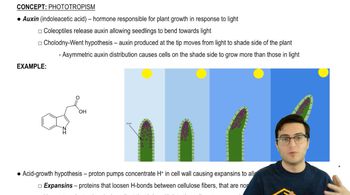
Understand the role of auxin: Auxin is a plant hormone that regulates growth by promoting cell elongation. It is distributed unevenly in response to light, which is key to phototropism (growth toward light).
Recall the mechanism of phototropism: When light shines on one side of a shoot, auxin redistributes to the shaded (dark) side of the shoot. This uneven distribution is crucial for the bending process.
Analyze the effect of auxin on cells: Auxin stimulates cell elongation by loosening the cell wall, allowing cells to expand. This effect occurs more prominently on the side of the shoot where auxin concentration is higher.
Determine which side grows more: Since auxin accumulates on the dark side of the shoot, the cells on the dark side elongate more than those on the lighted side. This differential growth causes the shoot to bend toward the light.
Match the correct option: Based on the above understanding, the correct answer is the option that describes auxin stimulating growth on the dark side of the shoot.

Verified video answer for a similar problem:

This video solution was recommended by our tutors as helpful for the problem above.
Video duration:
1m
Was this helpful?

Key Concepts

Here are the essential concepts you must grasp in order to answer the question correctly.

Phototropism

Phototropism is the growth response of a plant toward light. This phenomenon occurs because plant hormones, particularly auxins, redistribute unevenly in response to light, leading to differential growth rates on the sides of the plant. As a result, the plant bends toward the light source, optimizing its ability to capture sunlight for photosynthesis.
Recommended video:
Guided course
02:00
Energy Source: Phototrophs vs. Chemotrophs

Auxin

Auxin is a plant hormone that plays a crucial role in regulating growth and development. It promotes cell elongation, particularly on the side of the plant that is away from light, causing the plant to bend toward the light source. This hormone is essential for various growth processes, including phototropism and gravitropism.
Recommended video:

Cell Elongation

Cell elongation refers to the process by which plant cells increase in length, contributing to overall plant growth. Auxin stimulates this elongation by promoting the loosening of cell walls, allowing cells to expand. In the context of phototropism, greater elongation occurs on the shaded side of the plant, resulting in bending toward the light.
Recommended video:
Guided course
04:01
1) Elongation of Transcription