Pearson+ LogoPearson+ Logo
Ch. 16 Microbial Life: Prokaryotes and Protists
Taylor - Campbell Biology: Concepts & Connections 10th Edition
Taylor, Simon, Dickey, Hogan10th EditionCampbell Biology: Concepts & ConnectionsISBN: 9780136538783Not the one you use?Change textbook
Chapter 16, Problem 5

Which pair of protists has support structures composed of silica?
a. Dinoflagellates and diatoms
b. Diatoms and radiolarians
c. Radiolarians and forams
d. Forams and amoebozoans

Verified step by step guidance
1
Understand the question: The problem is asking which pair of protists has support structures composed of silica. Silica is a mineral commonly found in the cell walls or skeletons of certain protists.
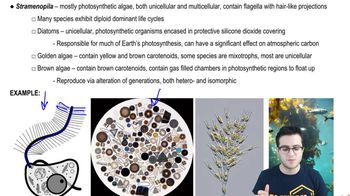
Recall the characteristics of diatoms: Diatoms are a type of protist that have cell walls made of silica, forming intricate and beautiful patterns. This is a key feature of diatoms.
Recall the characteristics of radiolarians: Radiolarians are another type of protist that have internal skeletons composed of silica. These skeletons are often elaborate and contribute to their structural support.
Eliminate incorrect options: Dinoflagellates do not have silica-based structures; they typically have cellulose plates. Forams have calcium carbonate shells, not silica. Amoebozoans lack silica-based support structures entirely.
Identify the correct pair: Based on the information above, the pair of protists with silica-based support structures is diatoms and radiolarians.

Verified video answer for a similar problem:

This video solution was recommended by our tutors as helpful for the problem above.
Video duration:
1m
Was this helpful?

Key Concepts

Here are the essential concepts you must grasp in order to answer the question correctly.

Diatoms

Diatoms are a group of microalgae characterized by their unique silica cell walls, which form intricate and beautiful patterns. These cell walls, known as frustules, provide structural support and protection, allowing diatoms to thrive in various aquatic environments. Their silica composition is crucial for their identification and ecological role in primary production.
Recommended video:
Guided course
10:24
Stramenopila and Alveolata

Radiolarians

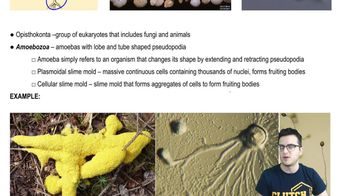
Radiolarians are single-celled protists that possess intricate silica skeletons, which can take on various geometric shapes. These skeletons not only provide structural support but also contribute to the formation of siliceous ooze on the ocean floor when they die. Radiolarians play a significant role in marine ecosystems and biogeochemical cycles.
Recommended video:
Guided course
06:26
Rhizarians and Amoebozoa

Silica as a Support Structure

Silica, a compound made of silicon and oxygen, is a key component in the support structures of certain protists, such as diatoms and radiolarians. This material provides rigidity and protection, allowing these organisms to maintain their shape and survive in diverse environments. The presence of silica in their structures is a defining characteristic that aids in their classification and ecological function.
Recommended video:
Guided course
03:18
What is Trophic Structure?