Pearson+ LogoPearson+ Logo
Ch. 17 The Evolution of Plant and Fungal Diversity
Taylor - Campbell Biology: Concepts & Connections 10th Edition
Taylor, Simon, Dickey, Hogan10th EditionCampbell Biology: Concepts & ConnectionsISBN: 9780136538783Not the one you use?Change textbook
Chapter 17, Problem 5

The eggs of seed plants are fertilized within ovules, and the ovules then develop into
a. Seeds.
b. Spores.
c. Fruit.
d. Sporophytes.

Verified step by step guidance
1
Understand the reproductive process in seed plants: Seed plants reproduce sexually, and fertilization occurs within the ovules, which are structures found inside the ovary of the flower.
Recognize the role of ovules: After fertilization, the ovules contain the zygote, which will develop into an embryo. The ovule itself transforms into another structure as part of the reproductive process.
Recall the transformation of ovules: In seed plants, the ovules develop into seeds after fertilization. Seeds contain the embryo, a food supply, and a protective coat.
Differentiate between seeds, spores, fruit, and sporophytes: Spores are reproductive cells in non-seed plants like ferns and mosses. Fruit is a structure that develops from the ovary and aids in seed dispersal. Sporophytes are the diploid phase of the plant life cycle, which includes the mature plant.
Conclude that the correct answer is based on the transformation of ovules into seeds after fertilization, as this is a key characteristic of seed plants.

Verified video answer for a similar problem:

This video solution was recommended by our tutors as helpful for the problem above.
Video duration:
2m
Was this helpful?

Key Concepts

Here are the essential concepts you must grasp in order to answer the question correctly.

Fertilization in Seed Plants

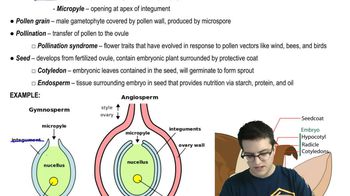
In seed plants, fertilization occurs when pollen grains, which contain male gametes, reach the ovule, where the female gamete resides. This process leads to the formation of a zygote, which eventually develops into a seed. Understanding this process is crucial for grasping how seed plants reproduce and propagate.
Recommended video:
Guided course
06:26
Seed Plants - 1

Ovules and Seeds

Ovules are structures within seed plants that contain the female gametes and develop into seeds after fertilization. A seed consists of an embryo, a food supply, and a protective seed coat. This transformation from ovule to seed is a key aspect of the reproductive cycle in seed plants, highlighting their evolutionary advantage.
Recommended video:
Guided course
06:26
Seed Plants - 1

Plant Life Cycle

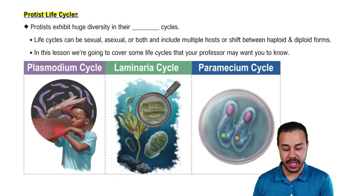
The plant life cycle includes alternating generations, specifically the sporophyte and gametophyte stages. In seed plants, the dominant sporophyte generation produces ovules and seeds, while the gametophyte is reduced and dependent on the sporophyte. Understanding this cycle is essential for comprehending how seed plants develop and reproduce.
Recommended video:
Guided course
01:04
Protist Life Cycles