Pearson+ LogoPearson+ Logo
Ch. 8 The Cellular Basis of Reproduction and Inheritance
Taylor - Campbell Biology: Concepts & Connections 10th Edition
Taylor, Simon, Dickey, Hogan10th EditionCampbell Biology: Concepts & ConnectionsISBN: 9780136538783Not the one you use?Change textbook
Chapter 8, Problem 3

Which of the following is not a function of mitosis in humans?
a. Repair of wounds
b. Growth
c. Production of gametes from diploid cells
d. Replacement of lost or damaged cells

Verified step by step guidance
1
Understand the purpose of mitosis: Mitosis is a type of cell division that results in two genetically identical daughter cells from a single parent cell. It is primarily involved in growth, repair, and maintenance of tissues in multicellular organisms.
Analyze each option: Review the functions listed in the question and determine whether they align with the known roles of mitosis.
Evaluate option (a): Repair of wounds involves the replacement of damaged cells, which is a function of mitosis as it helps regenerate tissues.
Evaluate option (b): Growth involves an increase in the number of cells, which is achieved through mitosis, making this a valid function.
Evaluate option (c): Production of gametes (sperm and egg cells) occurs through meiosis, not mitosis. This makes option (c) inconsistent with the functions of mitosis.

Verified video answer for a similar problem:

This video solution was recommended by our tutors as helpful for the problem above.
Video duration:
2m
Was this helpful?

Key Concepts

Here are the essential concepts you must grasp in order to answer the question correctly.

Mitosis

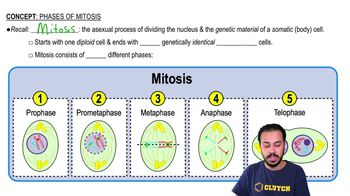
Mitosis is a type of cell division that results in two genetically identical daughter cells from a single parent cell. It is essential for growth, tissue repair, and asexual reproduction in multicellular organisms. Mitosis involves several stages: prophase, metaphase, anaphase, and telophase, followed by cytokinesis, which divides the cytoplasm.
Recommended video:
Guided course
03:21
Phases of Mitosis

Functions of Mitosis

The primary functions of mitosis include growth, repair of tissues, and replacement of lost or damaged cells. During these processes, cells divide to produce new cells that maintain the same genetic information as the original cell. However, mitosis does not produce gametes; this function is carried out by meiosis, a different type of cell division.
Recommended video:
Guided course
06:04
Functional Groups

Meiosis

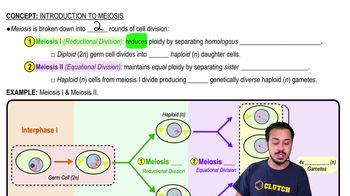
Meiosis is a specialized form of cell division that reduces the chromosome number by half, resulting in four genetically diverse gametes. It is crucial for sexual reproduction, as it produces sperm and egg cells in humans. Unlike mitosis, meiosis involves two rounds of division and introduces genetic variation through processes like crossing over and independent assortment.
Recommended video:
Guided course
04:49
Meiosis I & Meiosis II