Pearson+ LogoPearson+ Logo
Ch. 19 The Evolution of Vertebrate Diversity
Taylor - Campbell Biology: Concepts & Connections 10th Edition
Taylor, Simon, Dickey, Hogan10th EditionCampbell Biology: Concepts & ConnectionsISBN: 9780136538783Not the one you use?Change textbook
Chapter 19, Problem 4

Why were the Tiktaalik fossils an exciting discovery for scientists studying tetrapod evolution?
a. They are the earliest frog-like animal discovered to date.
b. They show that tetrapods successfully colonized land much earlier than previously thought.
c. They have a roughly equal combination of fishlike and tetrapod-like characteristics.
d. They demonstrate conclusively that limbs evolved as lobe-fins dragged themselves from pond to pond during droughts.

Verified step by step guidance
1
Understand the context of the Tiktaalik fossils: Tiktaalik is an extinct genus of fish that lived approximately 375 million years ago during the Devonian period. It is considered a transitional form between fish and tetrapods, providing key evidence for the evolution of vertebrates from aquatic to terrestrial environments.
Review the characteristics of Tiktaalik: Tiktaalik fossils exhibit a combination of fish-like traits (such as fins and scales) and tetrapod-like traits (such as a flat head, neck, and limb-like structures). This makes it a significant discovery for understanding the evolutionary transition.
Analyze the options provided in the question: Evaluate each answer choice based on the scientific evidence associated with Tiktaalik. For example, Tiktaalik is not frog-like (eliminating option a), and while it provides evidence for the transition to land, it does not conclusively show that tetrapods colonized land earlier than thought (eliminating option b).
Focus on the correct interpretation: Tiktaalik's combination of fish-like and tetrapod-like characteristics (option c) is the most scientifically accurate description of why the fossils are exciting. It bridges the gap between aquatic and terrestrial life forms, showing how limbs evolved for movement in shallow water and potentially on land.
Clarify misconceptions: Option d suggests a specific mechanism for limb evolution (dragging from pond to pond during droughts), but this is not conclusively demonstrated by Tiktaalik fossils. Scientists interpret Tiktaalik as evidence of gradual adaptation to shallow water environments, not necessarily drought-driven movement.

Verified video answer for a similar problem:

This video solution was recommended by our tutors as helpful for the problem above.
Video duration:
1m
Was this helpful?

Key Concepts

Here are the essential concepts you must grasp in order to answer the question correctly.

Tetrapod Evolution

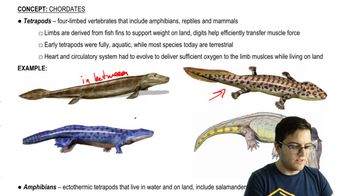
Tetrapod evolution refers to the transition of vertebrates from aquatic to terrestrial life, leading to the development of limbs and adaptations for living on land. This evolutionary milestone is crucial for understanding how modern amphibians, reptiles, birds, and mammals evolved from fish ancestors. The study of fossils like Tiktaalik provides insights into this significant shift in habitat and morphology.
Recommended video:

Tiktaalik Fossils

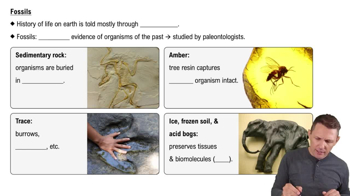
Tiktaalik is a genus of extinct lobe-finned fish that lived approximately 375 million years ago, showcasing a mix of fish and tetrapod features. Its fossils reveal characteristics such as a flat skull, neck, and robust fins that suggest an ability to support its body on land. This unique combination makes Tiktaalik a key specimen for understanding the evolutionary transition from water to land.
Recommended video:
03:54
Fossils

Morphological Characteristics

Morphological characteristics refer to the physical traits and structures of organisms, which can indicate evolutionary relationships. In the case of Tiktaalik, the presence of both fishlike features (such as gills and scales) and tetrapod-like features (such as limbs and a neck) illustrates the gradual changes that occurred during the evolution of tetrapods. Analyzing these traits helps scientists reconstruct the evolutionary history of vertebrates.
Recommended video:
Guided course
09:26
Characteristics of Life