
Pearson+ LogoPearson+ Logo
Ch. 11 - Cell-Cell Interactions
Freeman - Biological Science 7th Edition
Freeman7th EditionBiological ScienceISBN: 9783584863285Not the one you use?Change textbook
Chapter 11, Problem 9

Steroid hormones, like most lipid-soluble signaling molecules, are processed directly. How does the absence of a signal transduction cascade in the processing of steroid hormones affect (b) signal regulation?

Verified step by step guidance
1
Understand the nature of steroid hormones: Steroid hormones are lipid-soluble and can easily pass through the cell membrane to enter cells directly.
Recognize the typical pathway of steroid hormones: Once inside the cell, steroid hormones bind to specific receptor proteins in the cytoplasm or nucleus, forming a hormone-receptor complex.
Identify the absence of a signal transduction cascade: Unlike water-soluble hormones, steroid hormones do not require a second messenger system or a series of enzymatic reactions to relay their signal.
Consider the implications on signal regulation: The direct action of steroid hormones on gene expression means that the regulation of the signal is primarily at the level of hormone concentration and receptor availability.
Evaluate the effect on cellular response: The absence of a signal transduction cascade leads to a potentially quicker, but less amplified, cellular response compared to hormones that use cascades.

Verified video answer for a similar problem:

This video solution was recommended by our tutors as helpful for the problem above.
Video duration:
3m
Was this helpful?

Key Concepts

Here are the essential concepts you must grasp in order to answer the question correctly.

Steroid Hormones

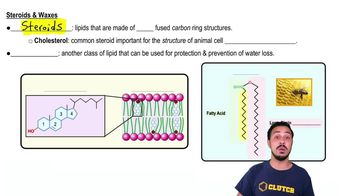
Steroid hormones are lipid-soluble molecules derived from cholesterol that can easily pass through cell membranes. Unlike peptide hormones, they bind to intracellular receptors, leading to direct modulation of gene expression. This characteristic allows them to exert effects on target cells without the need for a complex signaling cascade.
Recommended video:
Guided course
03:30
Steroids & Waxes

Signal Transduction Cascade

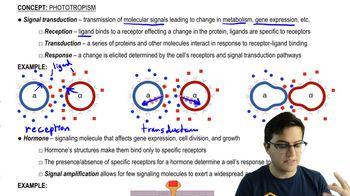
A signal transduction cascade is a series of biochemical events initiated by the binding of a signaling molecule to a receptor, leading to a cellular response. This process often involves multiple steps, including the activation of proteins and second messengers, amplifying the signal. In contrast, steroid hormones bypass this complexity, directly influencing cellular functions.
Recommended video:
Guided course
06:56
Signal Transduction and Response

Signal Regulation

Signal regulation refers to the mechanisms that control the intensity and duration of cellular responses to signaling molecules. In the absence of a signal transduction cascade, steroid hormones rely on the regulation of receptor availability and gene expression levels, which can lead to more sustained effects but may also limit the speed and flexibility of the cellular response compared to other signaling pathways.
Recommended video:
Guided course
06:10
Signal Amplification
Related Practice
Textbook Question

Suppose you were to model amplification by the phosphorylation cascade in Figure 11.16, using a penny for each kinase 1, a nickel for each kinase 2, and a dime for each kinase 3. Also suppose that Ras and each of the kinases can activate 10 proteins. How much money would you need to construct your model?

647
views
Textbook Question
Suppose you were to model amplification by the phosphorylation cascade in Figure 11.16, using a penny for each kinase 1, a nickel for each kinase 2, and a dime for each kinase 3. Also suppose that Ras and each of the kinases can activate 10 proteins. How much money would you need to construct your model?
1074
views
Textbook Question

What is the significance of the observation that many signal transduction pathways create a network, where they intersect or overlap?

966
views
Textbook Question

Steroid hormones, like most lipid-soluble signaling molecules, are processed directly. How does the absence of a signal transduction cascade in the processing of steroid hormones affect (a) signal amplification?

1064
views
Textbook Question

Steroid hormones, like most lipid-soluble signaling molecules, are processed directly. How does the absence of a signal transduction cascade in the processing of steroid hormones affect (b) signal regulation?

794
views
Textbook Question

Steroid hormones, like most lipid-soluble signaling molecules, are processed directly. How does the absence of a signal transduction cascade in the processing of steroid hormones affect (c) the cellular response that is possible?

861
views