
Pearson+ LogoPearson+ Logo
Ch. 11 - Cell-Cell Interactions
Freeman - Biological Science 7th Edition
Freeman7th EditionBiological ScienceISBN: 9783584863285Not the one you use?Change textbook
Chapter 11, Problem 7

Suppose you were to model amplification by the phosphorylation cascade in Figure 11.16, using a penny for each kinase 1, a nickel for each kinase 2, and a dime for each kinase 3. Also suppose that Ras and each of the kinases can activate 10 proteins. How much money would you need to construct your model?

Verified step by step guidance
1
Identify the number of each type of kinase at each step of the cascade. Since each kinase can activate 10 proteins, and each subsequent kinase is activated by the previous one, calculate the total number of kinases at each step. Start with 1 Ras activating 10 kinase 1 proteins.
Calculate the number of kinase 2 proteins activated by the 10 kinase 1 proteins. Since each kinase 1 can activate 10 kinase 2 proteins, multiply the number of kinase 1 proteins by 10.
Determine the number of kinase 3 proteins activated by the kinase 2 proteins. Multiply the total number of kinase 2 proteins by 10, as each kinase 2 can activate 10 kinase 3 proteins.
Assign monetary values to each type of kinase: a penny for each kinase 1, a nickel for each kinase 2, and a dime for each kinase 3. Calculate the total cost for each type of kinase by multiplying the number of kinases by their respective monetary values.
Sum the total costs for kinase 1, kinase 2, and kinase 3 to find out the total amount of money needed to construct the model.

Verified video answer for a similar problem:

This video solution was recommended by our tutors as helpful for the problem above.
Video duration:
2m
Was this helpful?

Key Concepts

Here are the essential concepts you must grasp in order to answer the question correctly.

Phosphorylation Cascade

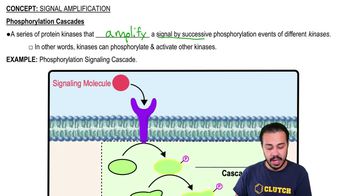
A phosphorylation cascade is a series of biochemical events where one enzyme activates another through the addition of phosphate groups. This process amplifies the signal within a cell, allowing a small initial signal to produce a large response. Each kinase in the cascade phosphorylates the next, leading to a rapid and extensive activation of downstream proteins.
Recommended video:
Guided course
02:35
Phosphorylation Cascades

Kinases

Kinases are enzymes that catalyze the transfer of phosphate groups from high-energy molecules, like ATP, to specific substrates, typically proteins. This phosphorylation can change the activity, localization, or interaction of the target proteins, playing a crucial role in regulating various cellular processes, including signal transduction and metabolism.
Recommended video:
Guided course
02:35
Phosphorylation Cascades

Signal Amplification

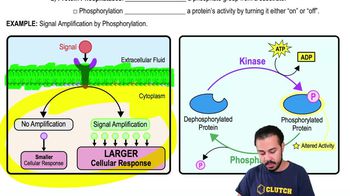
Signal amplification refers to the process by which a small initial signal is greatly increased through a series of biochemical reactions. In the context of a phosphorylation cascade, each activated kinase can trigger multiple downstream proteins, leading to a significant enhancement of the cellular response. This mechanism is vital for ensuring that cells can respond effectively to external stimuli.
Recommended video:
Guided course
06:10
Signal Amplification
Related Practice
Textbook Question

How do the extracellular filaments in plants differ from those in animals?

a. Plant filaments resist compression forces; animal filaments resist pulling forces.

b. Animal filaments consist of proteins; plant filaments consist of polysaccharides.

c. Plant extracellular filaments never move; animal filaments can slide past one another.

d. Plant filaments run parallel to one another; animal filaments crisscross.

1973
views
Textbook Question

Summarize the experimental evidence in sponges showing that animal cells adhere to each other selectively. Explain the molecular basis of selective adhesion.

902
views
Textbook Question

Suppose you were to model amplification by the phosphorylation cascade in Figure 11.16, using a penny for each kinase 1, a nickel for each kinase 2, and a dime for each kinase 3. Also suppose that Ras and each of the kinases can activate 10 proteins. How much money would you need to construct your model?

647
views
Textbook Question

What is the significance of the observation that many signal transduction pathways create a network, where they intersect or overlap?

966
views
Textbook Question
Steroid hormones, like most lipid-soluble signaling molecules, are processed directly. How does the absence of a signal transduction cascade in the processing of steroid hormones affect (b) signal regulation?
1047
views
Textbook Question

Steroid hormones, like most lipid-soluble signaling molecules, are processed directly. How does the absence of a signal transduction cascade in the processing of steroid hormones affect (a) signal amplification?

1064
views