Pearson+ LogoPearson+ Logo
Ch. 13 - Meiosis
Freeman - Biological Science 7th Edition
Freeman7th EditionBiological ScienceISBN: 9783584863285Not the one you use?Change textbook
Chapter 13, Problem 9

Meiosis results in independent assortment of maternal and paternal chromosomes. If 2n=6 for a given organism, and there is no crossing over, what is the chance that a gamete produced by this diploid organism will receive only paternal chromosomes?
a. 0
b. 1/16
c. 1/8
d. 1/3

Verified step by step guidance
1
Understand that meiosis involves the separation of homologous chromosomes into gametes, resulting in independent assortment. This means each gamete receives a random mix of maternal and paternal chromosomes.
Identify that the diploid number (2n) is 6, meaning there are 3 pairs of homologous chromosomes (n=3). Each pair consists of one maternal and one paternal chromosome.
Recognize that for a gamete to receive only paternal chromosomes, it must receive the paternal chromosome from each of the 3 pairs.
Calculate the probability of receiving the paternal chromosome from one pair, which is 1/2, since there are two equally likely outcomes (maternal or paternal).
Determine the overall probability by multiplying the probabilities for each pair: \( \left( \frac{1}{2} \right)^3 \). This represents the chance of receiving paternal chromosomes from all three pairs.

Verified video answer for a similar problem:

This video solution was recommended by our tutors as helpful for the problem above.
Video duration:
2m
Was this helpful?

Key Concepts

Here are the essential concepts you must grasp in order to answer the question correctly.

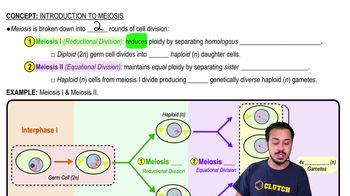
Meiosis

Meiosis is a type of cell division that reduces the chromosome number by half, resulting in four genetically distinct gametes. It consists of two stages: meiosis I and meiosis II. Meiosis I is where homologous chromosomes are separated, leading to independent assortment, which is crucial for genetic diversity.
Recommended video:
Guided course
04:49
Meiosis I & Meiosis II

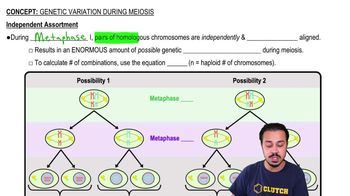
Independent Assortment

Independent assortment refers to the random distribution of maternal and paternal chromosomes into gametes during meiosis. This occurs during metaphase I when homologous chromosome pairs align independently at the cell's equator, allowing for various combinations of chromosomes in the resulting gametes.
Recommended video:
Guided course
08:49
Independent Assortment

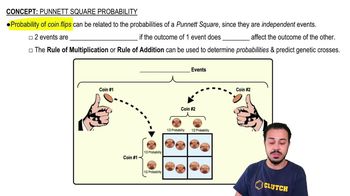
Probability in Genetics

Probability in genetics involves calculating the likelihood of specific genetic outcomes. For a diploid organism with 2n=6, there are three pairs of homologous chromosomes. Without crossing over, each pair can independently assort into gametes, leading to 2^3 (or 8) possible combinations. The chance of a gamete receiving only paternal chromosomes is 1/8.
Recommended video:
Guided course
03:38
Punnett Square Probability
Related Practice
Textbook Question

Norway rats have 42 chromosomes in their diploid cells. If such a cell enters meiosis, how many chromosomes and double-helical molecules of DNA will be present in each daughter cell at the end of meiosis II?

a. 21 chromosomes and 21 double-helical DNA molecules

b. 21 chromosomes and 42 double-helical DNA molecules

c. 42 chromosomes and 42 double-helical DNA molecules

d. 42 chromosomes and 84 double-helical DNA molecules

496
views
Textbook Question
Norway rats have 42 chromosomes in their diploid cells. If such a cell enters meiosis, how many chromosomes and double-helical molecules of DNA will be present in each daughter cell at the end of meiosis II?a. 21 chromosomes and 21 double-helical DNA moleculesb. 21 chromosomes and 42 double-helical DNA moleculesc. 42 chromosomes and 42 double-helical DNA moleculesd. 42 chromosomes and 84 double-helical DNA molecules
1308
views
Textbook Question

Triploid (3n) watermelons, which are seedless, are produced by crossing a tetraploid (4n) strain with a diploid (2n) plant. Explain why this mating produces a triploid individual.

1098
views
Textbook Question

A species of rotifer, a small freshwater invertebrate, lost the ability to reproduce sexually millions of years ago. A remarkable feature of its life cycle is the ability to withstand dry conditions. When the rotifer's environment dries out, so does the rotifer, and it can be blown to a new area. Rotifers that land in water will rehydrate and resume an active life. A major pathogen of these rotifers is a species of fungus that cannot survive drying. Some scientists hypothesize that drying rids the rotifers of this pathogen. Design an experimental study to test this hypothesis.

905
views
Textbook Question

A species of rotifer, a small freshwater invertebrate, lost the ability to reproduce sexually millions of years ago. A remarkable feature of its life cycle is the ability to withstand dry conditions. When the rotifer's environment dries out, so does the rotifer, and it can be blown to a new area. Rotifers that land in water will rehydrate and resume an active life. A major pathogen of these rotifers is a species of fungus that cannot survive drying. Some scientists hypothesize that drying rids the rotifers of this pathogen. Why might the ability to withstand drying reduce any potential advantage of sexual reproduction in this rotifer species?

1026
views
Textbook Question

Select True or False for each statement.

T/FLinked genes are always inherited together.

T/FGenetic map distances measure the number of nucleotides between a pair of genes.

T/FThe farther apart genes are on a chromosome, the more likely there is to be a crossover between these genes during meiosis.

T/FCrossing over occurs between genes on different homologs of a homologous chromosome pair.

1418
views