
Textbook Question
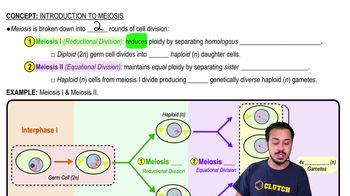
Nondisjunction that leads to problems in offspring can occur in:
a. Mitosis
b. Meiosis I only
c. Meiosis I and II
d. Mitosis, meiosis I, and meiosis II
1342
views


 Verified step by step guidance
 04:49
04:49
 08:09
08:09 07:44
07:44Nondisjunction that leads to problems in offspring can occur in:
a. Mitosis
b. Meiosis I only
c. Meiosis I and II
d. Mitosis, meiosis I, and meiosis II
Select True or False for each statement.
Sister chromatids are homologous chromosomes.
Non-sister chromatids are found on two different homologs.
Crossing over occurs between sister chromatids.
A chiasma forms between two of the four molecules of double-stranded DNA on duplicated homologous chromosomes.
If you followed a woman's cells through meiosis, at what stage of meiosis would the amount of DNA in one of these cells be equal to the amount of DNA in one of her G1 phase (before DNA replication) kidney cells?
Triploid (3n) watermelons, which are seedless, are produced by crossing a tetraploid (4n) strain with a diploid (2n) plant. Explain why this mating produces a triploid individual.
Meiosis results in independent assortment of maternal and paternal chromosomes. If 2n=6 for a given organism, and there is no crossing over, what is the chance that a gamete produced by this diploid organism will receive only paternal chromosomes?
a. 0
b. 1/16
c. 1/8
d. 1/3