As a genetic counselor, you advise couples about the possibility of genetic disease in their offspring. Today you met with an engaged couple, both of whom are phenotypically normal. The man, however, has a brother who died of Duchenne-type muscular dystrophy, an X-linked recessive condition. His fiancée, whose family has no history of the disease, is worried that the couple's sons or daughters might be afflicted. The sister of this man is planning to marry his fiancée's brother. How would you advise this second couple?
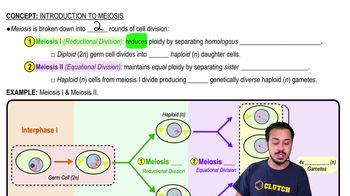
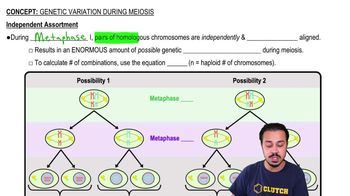
Suppose you are heterozygous for two genes that are located on different chromosomes. You carry alleles A and a for one gene and alleles B and b for the other. Draw a diagram illustrating what happens to these genes and alleles when meiosis occurs in your reproductive tissues.
Verified step by step guidance
Verified video answer for a similar problem:
Key Concepts
Meiosis
Independent Assortment
Heterozygosity
Suppose you are heterozygous for two genes that are located on different chromosomes. You carry alleles A and a for one gene and alleles B and b for the other. Label the stages of meiosis, the homologous chromosomes, sister chromatids, nonhomologous chromosomes, genes, and alleles.
Suppose you are heterozygous for two genes that are located on different chromosomes. You carry alleles A and a for one gene and alleles B and b for the other. Be sure to list all the genetically different gametes that could form and indicate how frequently each type should be observed.
Suppose you are heterozygous for two genes that are located on different chromosomes. You carry alleles A and a for one gene and alleles B and b for the other. On the diagram, identify the events responsible for the principle of segregation and the principle of independent assortment.
