
Pearson+ LogoPearson+ Logo
Ch. 18 - Control of Gene Expression in Bacteria
Freeman - Biological Science 7th Edition
Freeman7th EditionBiological ScienceISBN: 9783584863285Not the one you use?Change textbook
Chapter 18, Problem 1

Why are the genes involved in lactose metabolism considered to be an operon?a. They occupy adjacent locations on the E. coli chromosome.b. They have a similar function.c. They are all required for normal cell function.d. They are all controlled by the same promoter.

Verified step by step guidance
1
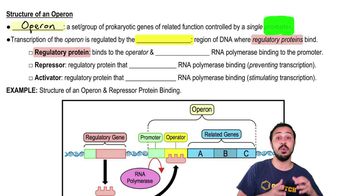
Identify the definition of an operon in the context of genetics. An operon is a functioning unit of genomic DNA containing a cluster of genes under the control of a single promoter. The genes are transcribed together into an mRNA strand and subsequently translated into proteins.
Consider the options given in the question and relate them to the definition of an operon. Look for the option that directly refers to the control mechanism of gene expression.
Understand that the key characteristic of an operon is that the genes it includes are regulated together and are usually involved in a common metabolic pathway.
Evaluate option 'd' which states that the genes are all controlled by the same promoter. This is a defining feature of an operon, as the presence of a single promoter for multiple genes allows for coordinated control of gene expression.
Conclude that the correct answer must be the one that aligns with the definition of an operon, where multiple genes are controlled by a single promoter, allowing for coordinated expression in response to environmental or cellular conditions.

Verified video answer for a similar problem:

This video solution was recommended by our tutors as helpful for the problem above.
Video duration:
4m
Was this helpful?

Key Concepts

Here are the essential concepts you must grasp in order to answer the question correctly.

Operon Structure

An operon is a cluster of genes that are transcribed together as a single mRNA molecule, typically under the control of a single promoter. This arrangement allows for coordinated regulation of genes that encode proteins with related functions, facilitating efficient gene expression in response to environmental changes.
Recommended video:
Guided course
04:23
Structure of an Operon

Promoter Function

A promoter is a specific DNA sequence where RNA polymerase binds to initiate transcription of a gene. In the context of an operon, a single promoter controls the transcription of multiple genes, ensuring that they are expressed simultaneously when needed, such as in the case of lactose metabolism in E. coli.
Recommended video:
Guided course
06:04
Functional Groups

Lactose Metabolism in E. coli

E. coli utilizes lactose as an energy source through a set of genes that encode enzymes for its metabolism, such as β-galactosidase. These genes are organized in an operon, allowing the bacterium to efficiently respond to the presence of lactose by expressing all necessary enzymes at once, optimizing resource use.
Recommended video:
Guided course
04:12
Mechanism of F Plasmid Conjugation in E. coli