Pearson+ LogoPearson+ Logo
Ch. 21 - Genes, Development, and Evolution
Freeman - Biological Science 7th Edition
Freeman7th EditionBiological ScienceISBN: 9783584863285Not the one you use?Change textbook
Chapter 21, Problem 5

A friend is interested in isolating genes that are expressed solely in liver cells but only has access to skin cells. She asks you for advice on whether to start her studies. What will you say?

Verified step by step guidance
1
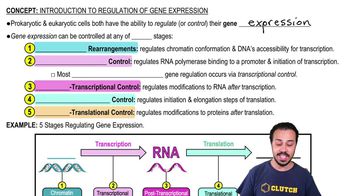
Explain the concept of gene expression: Gene expression refers to the process by which information from a gene is used to synthesize a functional gene product, usually a protein. Different cell types express different sets of genes, which is why liver cells and skin cells have different functions.
Discuss the importance of tissue-specific gene expression: Liver cells express certain genes that are not expressed in skin cells, and vice versa. This tissue-specific expression is crucial for the specialized functions of each cell type.
Introduce the concept of mRNA and its role in gene expression: mRNA (messenger RNA) is transcribed from DNA and carries the genetic information needed to produce proteins. By analyzing mRNA, researchers can determine which genes are actively expressed in a particular cell type.
Suggest the use of RNA sequencing or microarray analysis: These techniques can be used to compare the mRNA profiles of liver cells and skin cells, identifying genes that are uniquely expressed in liver cells.
Advise on the need for liver cell samples: Since the goal is to isolate genes expressed solely in liver cells, your friend will need access to liver cell samples to perform the necessary analyses. Skin cells alone will not provide the information needed to identify liver-specific genes.

Verified video answer for a similar problem:

This video solution was recommended by our tutors as helpful for the problem above.
Video duration:
1m
Was this helpful?

Key Concepts

Here are the essential concepts you must grasp in order to answer the question correctly.

Gene Expression

Gene expression is the process by which information from a gene is used to synthesize functional gene products, such as proteins. This process is regulated and can vary between different cell types, meaning that certain genes may be expressed in liver cells but not in skin cells. Understanding gene expression is crucial for isolating genes specific to liver cells.
Recommended video:
Guided course
06:40
Introduction to Regulation of Gene Expression

Cell Differentiation

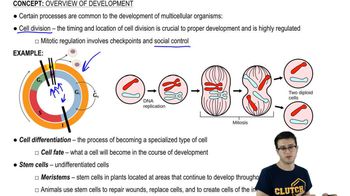
Cell differentiation is the process by which a less specialized cell becomes a more specialized cell type. Liver cells and skin cells have undergone differentiation to perform distinct functions, resulting in different gene expression profiles. This concept is essential for understanding why certain genes are expressed in liver cells but not in skin cells.
Recommended video:
Guided course
05:28
Cell Division and Differentiation

Tissue-Specific Gene Isolation

Tissue-specific gene isolation involves identifying and extracting genes that are uniquely expressed in a particular tissue, such as the liver. Techniques like RNA sequencing can be used to compare gene expression profiles between different tissues, helping to isolate genes specific to liver cells even if only skin cells are available initially.
Recommended video:
Guided course
06:58
Vascular Tissue
Related Practice
Textbook Question
What is a homeotic mutant?a. an individual with a structure located in the wrong placeb. an individual with an abnormal head-to-tail axisc. an individual that is missing segmentsd. an individual with double the normal number of structures
1222
views
Textbook Question

A tool-kit gene is               .

769
views
Textbook Question
A tool-kit gene is .
792
views
Textbook Question

The following predictions ask you to consider how genetic regulatory cascades provide positional information. Select True or False for each statement.

T/F Mutation of a gene at one level of a regulatory cascade will affect the expression of genes at all levels of the cascade.

T/F Mutation of a gene that is expressed later in a regulatory cascade will affect a smaller region of the body than mutation of gene that is expressed early in the cascade.

T/F In the regulatory cascade used by Drosophila, a gene at one level of the cascade will be controlled only by genes at the level immediately above it.

T/F Genes that control the largest regions of the Drosophila embryo are not transcribed in the embryo.

667
views
Textbook Question

What is the connection between genetic regulatory cascades and the observation that differentiation is a step-by-step process?

629
views
Textbook Question

Which of the following provides the strongest evidence for the conservation of tool-kit genes?

a. Bicoid moved from one fly embryo into the posterior of another fly embryo causes the formation of two head regions.

b. Mutation of an unrelated gene in another species of fly has a similar effect to mutation of bicoid in Drosophila.

c. A mouse Hox gene can be used to take over the function of a mutated Drosophila Hox gene.

d. Sheep can be cloned by fusing a differentiated adult cell with an enucleated egg.

567
views