Pearson+ LogoPearson+ Logo
Ch. 23 - Evolutionary Processes
Freeman - Biological Science 7th Edition
Freeman7th EditionBiological ScienceISBN: 9783584863285Not the one you use?Change textbook
Chapter 23, Problem 9

In humans, albinism is caused by loss-of-function mutations in genes involved in the synthesis of melanin, the dark pigment in skin. Only people homozygous for a loss-of-function allele (genotype aa) have the albino phenotype. In Americans of northern European ancestry, albino individuals are present at a frequency of about 1 in 10,000 (or 0.0001). Assuming that genotypes are in Hardy–Weinberg equilibrium, what is the predicted frequency of Caucasians in the United States who carry a single allele for albinism?

Verified step by step guidance
1
Identify the frequency of the albino phenotype (aa) in the population, which is given as 0.0001.
Use the Hardy-Weinberg principle to calculate the frequency of the recessive allele (a). The frequency of the homozygous recessive genotype (aa) is equal to the square of the frequency of the recessive allele (q^2). Solve for q by taking the square root of the frequency of the albino phenotype: q = \sqrt{0.0001}.
Calculate the frequency of the dominant allele (p) using the equation p + q = 1, where p is the frequency of the dominant allele and q is the frequency of the recessive allele.
Determine the frequency of heterozygous carriers (Aa) using the Hardy-Weinberg equation for heterozygotes: 2pq, where p is the frequency of the dominant allele and q is the frequency of the recessive allele.
The result from step 4 will give you the predicted frequency of Caucasians in the United States who carry a single allele for albinism.

Verified video answer for a similar problem:

This video solution was recommended by our tutors as helpful for the problem above.
Video duration:
5m
Was this helpful?

Key Concepts

Here are the essential concepts you must grasp in order to answer the question correctly.

Albinism and Melanin Synthesis

Albinism is a genetic condition characterized by a deficiency in melanin production, which is responsible for the pigmentation of skin, hair, and eyes. This condition arises from mutations in specific genes that are crucial for the synthesis of melanin. Individuals with albinism typically have a homozygous recessive genotype (aa), leading to the absence of melanin and resulting in lighter skin and hair.
Recommended video:
Guided course
04:19
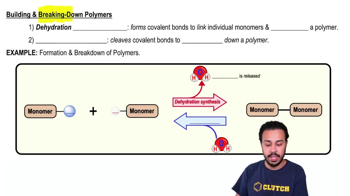
Building & Breaking-Down Polymers

Hardy-Weinberg Equilibrium

The Hardy-Weinberg equilibrium is a principle in population genetics that describes the genetic variation of a population under ideal conditions, where allele frequencies remain constant from generation to generation. It provides a mathematical framework to predict genotype frequencies based on allele frequencies, assuming no evolutionary influences such as mutation, selection, or genetic drift. This principle is essential for calculating the expected frequency of carriers in a population.
Recommended video:
08:26
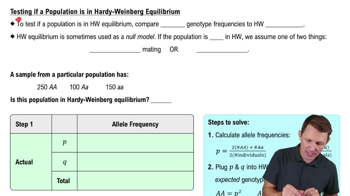
Testing if a Population is in Hardy-Weinberg Equilibrium

Carrier Frequency Calculation

Carrier frequency refers to the proportion of individuals in a population who carry one copy of a recessive allele for a particular trait, such as albinism. In the context of Hardy-Weinberg equilibrium, the frequency of carriers can be calculated using the formula 2pq, where p is the frequency of the dominant allele and q is the frequency of the recessive allele. Understanding this calculation is crucial for predicting how many individuals in a population are likely to be carriers of the albinism allele.
Recommended video:
03:30
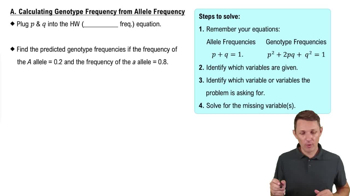
A. Calculating Genotype Frequency from Allele Frequency
Related Practice
Textbook Question
Determine what is incorrect in the following statement: Red deer mutated their genes so that they could have larger antlers to compete for mates.
1118
views
Textbook Question

Determine what is incorrect in the following statement: Deer mice living on beaches mutated their genes so that they could have white fur color, providing better camouflage to survive on beaches.

390
views
Textbook Question

Draw a small concept map showing how selection, genetic drift, gene flow, and mutation relate to genetic variation.

1059
views
Textbook Question
Suppose you were studying several species of monkeys. In one, males never helped females raise offspring. In another, males provided just as much parental care as females except for actually carrying the fetus during pregnancy. How does the fundamental asymmetry of sex compare in the two species? How would you expect sexual dimorphism to compare between the two species?
1102
views
Textbook Question

Human activities are causing the fragmentation of the Brazilian Atlantic rain forest. One result is that toucans have become extinct or nearly extinct in some of the forest fragments. Does the absence of toucans affect the forest?

Toucans disperse seeds of key forest species such as juçara palms by eating the fruit and defecating the seeds in new locations, sometimes more than a kilometer away. If there are no toucans, is the genetic diversity of palms likely to increase or decrease within forest fragments? Why?

a. Increase (due to increased genetic drift)

b. Decrease (due to decreased gene flow)

c. Decrease (due to decreased mutation rate)

d. Decrease (due to decreased natural selection)

740
views
Textbook Question

Human activities are causing the fragmentation of the Brazilian Atlantic rain forest. One result is that toucans have become extinct or nearly extinct in some of the forest fragments. Does the absence of toucans affect the forest? Toucans can eat fruits with large seeds because their large bills can open wide. Most other birds in the same forest can only eat small seeds. Ecologist Mauro Galetti and his colleagues measured the seed sizes of palms in forest fragments with and without toucans. The graphs show two of the forest populations they studied. What is the take-home message of the data?

735
views