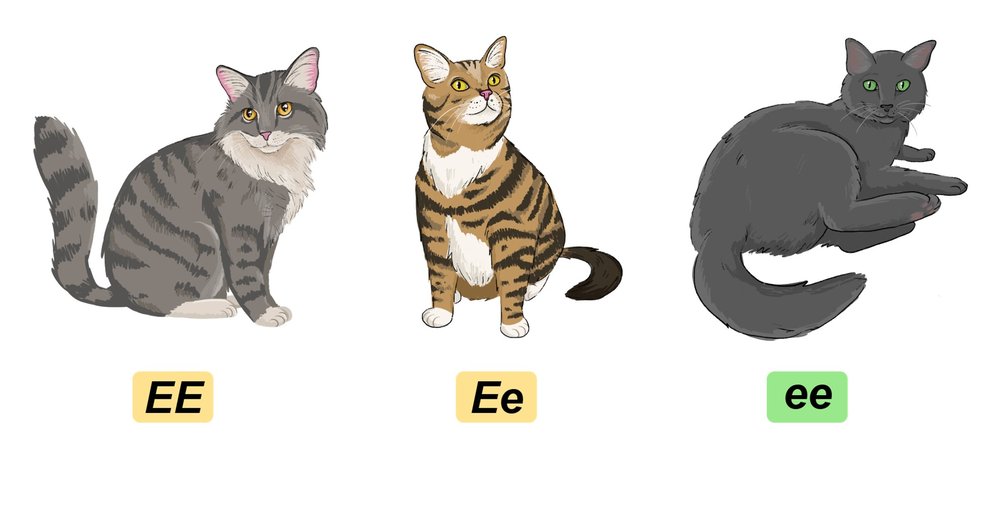
Understanding the Hardy-Weinberg equation is essential for predicting genotype frequencies in a diploid population with two alleles. This equation allows scientists to estimate how common different genotypes will be, based solely on allele frequencies, without needing to track individual mating events. The equation is grounded in two key assumptions: random mating and no changes in allele frequency, which means the population is not evolving.
The Hardy-Weinberg principle states that if a population is in equilibrium, the frequencies of the genotypes can be expressed as follows:
Let p represent the frequency of the dominant allele (A) and q represent the frequency of the recessive allele (a). The relationship between these frequencies is:
p + q = 1
From these allele frequencies, we can derive the expected genotype frequencies:
1. The frequency of homozygous dominant individuals (AA) is given by:
p²
2. The frequency of heterozygous individuals (Aa) is:
2pq
3. The frequency of homozygous recessive individuals (aa) is:
q²
These frequencies must sum to 1, leading to the equation:
p² + 2pq + q² = 1
To apply the Hardy-Weinberg equation, one can use the allele frequencies to calculate the expected genotype frequencies in a population. For example, if the frequency of allele A (p) is known, one can easily find the frequency of allele a (q) using the first equation, and then use these values to determine the expected proportions of each genotype.
This mathematical framework not only provides insights into population genetics but also serves as a foundational concept for understanding evolutionary processes. By practicing various problems involving these equations, students can enhance their proficiency in applying the Hardy-Weinberg principle to real-world scenarios.