Pearson+ LogoPearson+ Logo
Ch. 26 - Bacteria and Archaea
Freeman - Biological Science 7th Edition
Freeman7th EditionBiological ScienceISBN: 9783584863285Not the one you use?Change textbook
Chapter 26, Problem 1

What do some photosynthetic bacteria use as a source of electrons instead of water?
a. Oxygen (O2)
b. Hydrogen sulfide (H2S)
c. Organic compounds (e.g., CH3COO)
d. Nitrate (NO3-)

Verified step by step guidance
1
Understand that photosynthesis involves the transfer of electrons to convert light energy into chemical energy. In plants, water (H2O) is typically the electron donor.
Recognize that some photosynthetic bacteria do not use water as their electron source. Instead, they use other compounds to fulfill this role.
Consider the options given: oxygen (O2), hydrogen sulfide (H2S), organic compounds (e.g., CH3COO−), and nitrate (NO3-).
Recall that certain photosynthetic bacteria, such as purple sulfur bacteria, use hydrogen sulfide (H2S) as an electron donor instead of water.
Conclude that hydrogen sulfide (H2S) is the correct answer, as it is commonly used by some photosynthetic bacteria as a source of electrons.

Verified video answer for a similar problem:

This video solution was recommended by our tutors as helpful for the problem above.
Video duration:
2m
Was this helpful?

Key Concepts

Here are the essential concepts you must grasp in order to answer the question correctly.

Photosynthesis in Bacteria

Photosynthesis in bacteria differs from that in plants, as some bacteria do not use water as an electron source. Instead, they utilize other compounds, allowing them to thrive in environments where water is scarce or where other electron donors are more abundant. This adaptation is crucial for their survival and ecological role.
Recommended video:
Guided course
05:58
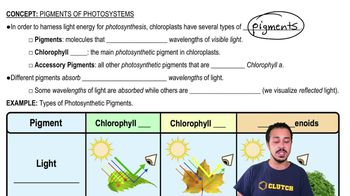
Pigments of Photosynthesis

Electron Donors in Photosynthesis

Electron donors are substances that provide electrons for the photosynthetic process. In some photosynthetic bacteria, compounds like hydrogen sulfide (H2S) or organic compounds are used instead of water. These alternative electron donors are essential for the bacteria's energy production and influence their habitat preferences.
Recommended video:
Guided course
05:58
Pigments of Photosynthesis

Hydrogen Sulfide as an Electron Source

Hydrogen sulfide (H2S) is a common electron donor for certain photosynthetic bacteria, particularly those found in sulfur-rich environments. These bacteria oxidize H2S to obtain electrons, which are then used in their photosynthetic processes. This ability allows them to occupy ecological niches where other organisms might not survive.
Recommended video:
Guided course
05:03
Hydrogen Bonding