Pearson+ LogoPearson+ Logo
Ch. 28 - Green Algae and Land Plants
Freeman - Biological Science 7th Edition
Freeman7th EditionBiological ScienceISBN: 9783584863285Not the one you use?Change textbook
Chapter 28, Problem 8

Explain the difference between homosporous and heterosporous plants. Where are the microsporangium and megasporangium found in a tulip? What happens to the spores that are produced by these structures?

Verified step by step guidance
1
Understand the terms: Homosporous plants produce only one type of spore that typically develops into a bisexual gametophyte, which means it contains both male and female reproductive organs. Heterosporous plants produce two distinct types of spores: microspores (which develop into male gametophytes) and megaspores (which develop into female gametophytes).
Identify the location of sporangia in tulips: In tulips, which are angiosperms (flowering plants), the microsporangium and megasporangium are located within the flower. The microsporangium is found in the anthers, which are part of the stamen (the male reproductive organ), while the megasporangium is located in the ovules, which are part of the carpel (the female reproductive organ).
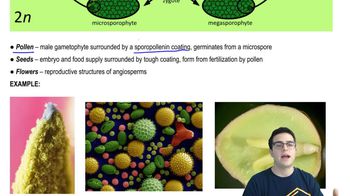
Describe the development process of spores in tulips: In the microsporangium of the tulip, microspores are produced through meiosis. These microspores develop into pollen grains, which are the male gametophytes. In the megasporangium, megaspores are also produced through meiosis and one of these megaspores will develop into the female gametophyte.
Explain the fertilization process: After the pollen grains (male gametophytes) are released from the anthers, they are transferred to the stigma of a carpel (often through wind or pollinators). The pollen grain germinates on the stigma, growing a pollen tube down through the style to reach the ovule in the ovary. The sperm cells from the pollen grain then fertilize the egg cell in the female gametophyte within the ovule.
Discuss the outcome of fertilization: Following fertilization, the fertilized egg (zygote) develops into an embryo, and the ovule matures into a seed. The surrounding ovary develops into a fruit, which helps in the dispersal of the seeds.

Verified video answer for a similar problem:

This video solution was recommended by our tutors as helpful for the problem above.
Video duration:
2m
Was this helpful?

Key Concepts

Here are the essential concepts you must grasp in order to answer the question correctly.

Homosporous vs. Heterosporous Plants

Homosporous plants produce a single type of spore that develops into a gametophyte capable of producing both male and female gametes. In contrast, heterosporous plants generate two distinct types of spores: microspores, which develop into male gametophytes, and megaspores, which develop into female gametophytes. This differentiation allows for more complex reproductive strategies and greater genetic diversity.
Recommended video:
Guided course
06:17
Land Plants - 4

Microsporangium and Megasporangium

In flowering plants like tulips, the microsporangium is located within the anthers of the stamen, where it produces microspores that develop into pollen grains. The megasporangium is found within the ovule, located in the ovary of the pistil, and it produces megaspores that develop into the female gametophyte. These structures are essential for sexual reproduction in angiosperms.
Recommended video:
Guided course
05:18
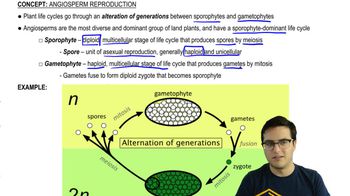
Alteration of Generations

Fate of Spores

The spores produced by the microsporangium and megasporangium serve different roles in plant reproduction. Microspores develop into pollen grains, which facilitate fertilization by transferring male gametes to the female ovule. Megaspores, on the other hand, typically undergo mitosis to form the female gametophyte, which will produce eggs for fertilization, ultimately leading to seed development.
Recommended video:
Guided course
05:28
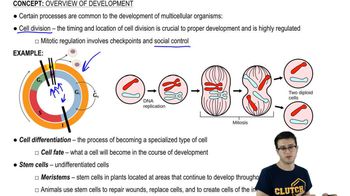
Cell Division and Differentiation
Related Practice
Textbook Question

Soils, water, and the atmosphere are major components of the abiotic (nonliving) environment. Describe how green plants affect the abiotic environment in ways that are advantageous to humans.

538
views
Textbook Question

The evolution of cuticle presented plants with a challenge that threatened their ability to live on land. Describe this challenge, and explain why stomata represent a solution. Compare and contrast stomata with the pores found in liverworts.

896
views
Textbook Question

Explain the difference between homosporous and heterosporous plants. Where are the microsporangium and megasporangium found in a tulip? What happens to the spores that are produced by these structures?

860
views
Textbook Question

Angiosperms such as grasses, oaks, and maples are wind pollinated. The ancestors of these subgroups were probably pollinated by insects, however. As an adaptive advantage, why might a species 'revert' to wind pollination? (Hint: Think about the costs and benefits of being pollinated by insects versus wind.) Why is it logical to observe that wind-pollinated species usually grow in dense stands containing many individuals of the same species? Why is it logical to observe that in wind-pollinated deciduous trees, flowers form very early in spring—before leaves form?

866
views
Textbook Question

You have been hired as a field assistant for a researcher interested in the evolution of flower characteristics in orchids. Design an experiment to determine whether color, size, shape, scent, or amount of nectar is the most important factor in attracting pollinators to a particular species. Assume that you can change any flower's color with a dye and that you can remove petals or nectar stores, add particular scents, add nectar by injection, or switch parts among species by cutting and gluing.

694
views
Textbook Question

<Image>

Moss sperm are motile and capable of swimming short distances to fertilize an egg. However, it was unknown until recently how sperm make their way from male to female gametophytes that may be separated by a distance of several centimeters or more.

Researchers hypothesized that small animals called springtails (a type of arthropod) facilitate sperm transfer in mosses. To test this hypothesis, the researchers grew patches of male and female mosses at varying distances from each other and in the presence or absence of springtails. They later checked to see how many sporophytes were found in each female patch (as an indicator that fertilization had occurred). Their results are shown in the graph here (** means P<0.01, * means P>0.05. What conclusions can be drawn about the role of the springtails during the reproductive cycle of the mosses?

525
views