
Pearson+ LogoPearson+ Logo
Ch. 29 - Fungi
Freeman - Biological Science 7th Edition
Freeman7th EditionBiological ScienceISBN: 9783584863285Not the one you use?Change textbook
Chapter 29, Problem 10

Many mushrooms are extremely colorful. One hypothesis is that the colors serve as a warning to prevent animals from eating mushrooms, much like the bright yellow and black stripes on wasps help to deter potential predators. Design an experiment to test this hypothesis.

Verified step by step guidance
1
Identify a variety of mushroom species with different colors, including some that are known to be toxic and some that are known to be non-toxic.
Set up an experimental area in a controlled environment where interactions between mushrooms and potential animal predators (such as insects, small mammals) can be observed.
Divide the mushrooms into two groups: one group where the natural colors are visible, and another group where the mushrooms are painted with a neutral color to mask their original coloration.
Place equal numbers of colored and neutral-colored mushrooms in the experimental area and observe the interactions over a specified period. Record the number of times animals approach, touch, or eat mushrooms from each group.
Analyze the data to determine if there is a significant difference in the interaction rates between the brightly colored mushrooms and the neutral-colored ones. This will help to assess if coloration plays a role in deterring predators.

Verified video answer for a similar problem:

This video solution was recommended by our tutors as helpful for the problem above.
Video duration:
1m
Was this helpful?

Key Concepts

Here are the essential concepts you must grasp in order to answer the question correctly.

Aposematism

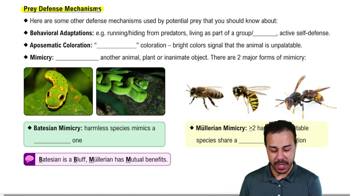
Aposematism is a biological phenomenon where bright coloration in organisms serves as a warning signal to potential predators about their toxicity or unpalatability. This strategy helps deter animals from consuming these organisms, as seen in species like poison dart frogs and certain wasps. Understanding this concept is crucial for designing experiments that test whether colorful mushrooms are indeed using their colors as a warning signal.
Recommended video:
Guided course
03:04
Prey Defense Mechanisms

Experimental Design

Experimental design refers to the process of planning an experiment to ensure that it effectively tests a hypothesis. Key components include selecting appropriate control and experimental groups, determining variables, and establishing methods for data collection and analysis. A well-structured experimental design is essential for testing the hypothesis about mushroom coloration and its effects on predator behavior.
Recommended video:
Guided course
02:50
Experimental Design Example 1

Predator-Prey Interactions

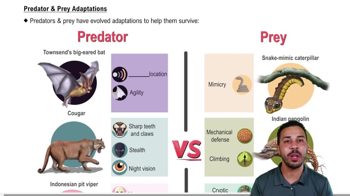
Predator-prey interactions are ecological relationships where one organism (the predator) hunts and consumes another (the prey). These interactions can influence the evolution of traits such as coloration in prey species. Understanding these dynamics is important for interpreting the results of experiments aimed at assessing whether colorful mushrooms deter predators based on their appearance.
Recommended video:
Guided course
03:01
Predator & Prey Adaptations
Related Practice
Textbook Question

Lawns are sometimes fertilized with nitrate that can be washed into neighboring woodlots by rain. If the trees in that woodlot are associated with EMF, what effect might the excess nitrate have on the fungi and/or trees?

a. Fungal growth may be stimulated, causing the trees to transport more nitrogen to the fungi.

b. The fungi may secrete more peptidases to break down the nitrate.

c. The trees may take up the nitrate directly into their roots and rely less on the fungi.

d. The excess nitrate may stimulate the fungi to transport more sugar to the trees.

593
views
Textbook Question

Table 29.1 mentions that chytrids are responsible for massive die-offs currently occurring in amphibians. Review Koch's postulates; then design a study showing how you would use Koch's postulates to test the hypothesis that chytrid infections are responsible for frog deaths.

635
views
Textbook Question

Many mushrooms are extremely colorful. One hypothesis is that the colors serve as a warning to prevent animals from eating mushrooms, much like the bright yellow and black stripes on wasps help to deter potential predators. Design an experiment to test this hypothesis.

691
views
Textbook Question

Some fungi have elaborate mechanisms for dispersing spores. For example, the 'squirt gun' fungus Pilobolus, which grows in cow dung, forcibly shoots off tiny black sporangia filled with spores. Any sporangia that are flung onto fresh grass are likely to be eaten by a grazing cow, passed through its digestive system unharmed, and deposited in a new batch of dung. The spores carried within the sporangia are perfectly positioned to grow into a new mycelium.

Pilobolus is a zygomycete, and the sporangia just described produce asexual spores. In contrast, which of the following best describes what happens during the sexual phase of its life cycle?

a. It produces eight ascospores in each ascus.

b. It produces basidiospores that grow into mushrooms.

c. It produces motile sperm and eggs.

d. Hyphae from two compatible mating types fuse and form a zygosporangium.

956
views
Textbook Question

Some fungi have elaborate mechanisms for dispersing spores. For example, the “squirt gun” fungus Pilobolus, which grows in cow dung, forcibly shoots off tiny black sporangia filled with spores. Any sporangia that are flung onto fresh grass are likely to be eaten by a grazing cow, passed through its digestive system unharmed, and deposited in a new batch of dung. The spores carried within the sporangia are perfectly positioned to grow into a new mycelium.

Both asexual sporangia (shown in the photo) and zygosporangia can be found in cow dung. Make a simplified drawing that illustrates the events of plasmogamy, karyogamy, and meiosis that occur during sexual reproduction in Pilobolus. Be sure to indicate and label the zygosporangium.

695
views
Textbook Question

Some fungi have elaborate mechanisms for dispersing spores. For example, the “squirt gun” fungus Pilobolus, which grows in cow dung, forcibly shoots off tiny black sporangia filled with spores. Any sporangia that are flung onto fresh grass are likely to be eaten by a grazing cow, passed through its digestive system unharmed, and deposited in a new batch of dung. The spores carried within the sporangia are perfectly positioned to grow into a new mycelium.

Would you describe the association between Pilobolus and cows as a symbiotic relationship? Explain your answer.

687
views