
Pearson+ LogoPearson+ Logo
Ch.3 - Protein Structure and Function
Freeman - Biological Science 7th Edition
Freeman7th EditionBiological ScienceISBN: 9783584863285Not the one you use?Change textbook
Chapter 3, Problem 2

What are the defining characteristics of a condensation reaction?a. Two monomers are covalently bonded together and a water molecule is produced.b. Two monomers are covalently bonded together and a water molecule is used up.c. A polymer is broken down into monomers and a water molecule is produced.d. A polymer is broken down into monomers and a water molecule is used up.

Verified step by step guidance
1
Identify the process described in each option and relate it to the definition of a condensation reaction.
Understand that a condensation reaction, also known as dehydration synthesis, involves the joining of two molecules with the loss of a small molecule, typically water.
Analyze option a: Determine if the formation of a covalent bond between two monomers with the production of water fits the definition of a condensation reaction.
Analyze option b: Consider whether the use of a water molecule aligns with the concept of a condensation reaction.
Compare options c and d: Evaluate if the breakdown of a polymer into monomers and the role of water in these options correspond to a condensation reaction.

Verified video answer for a similar problem:

This video solution was recommended by our tutors as helpful for the problem above.
Video duration:
2m
Was this helpful?

Key Concepts

Here are the essential concepts you must grasp in order to answer the question correctly.

Condensation Reaction

A condensation reaction, also known as a dehydration synthesis, is a chemical process where two molecules combine to form a larger molecule, releasing a small molecule, typically water, as a byproduct. This reaction is fundamental in the formation of polymers from monomers, such as in the synthesis of proteins from amino acids.
Recommended video:
Guided course
01:56
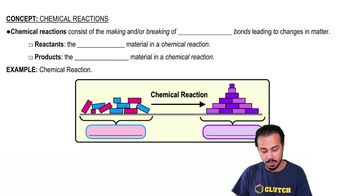
Chemical Reactions

Covalent Bonding

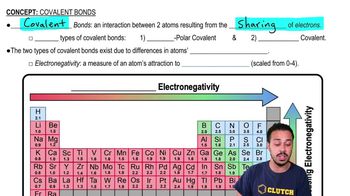
Covalent bonding involves the sharing of electron pairs between atoms, which creates a strong connection. In the context of condensation reactions, covalent bonds are formed between monomers, resulting in the creation of larger macromolecules like carbohydrates, proteins, and nucleic acids, essential for biological functions.
Recommended video:
Guided course
04:28
Covalent Bonds

Monomers and Polymers

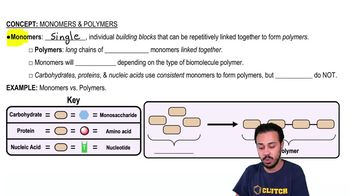
Monomers are the basic building blocks of larger molecules known as polymers. In biological systems, monomers such as amino acids, nucleotides, and simple sugars can link together through condensation reactions to form complex structures like proteins, DNA, and polysaccharides, which are crucial for life.
Recommended video:
Guided course
03:42
Monomers & Polymers