
Pearson+ LogoPearson+ Logo
Ch.3 - Protein Structure and Function
Freeman - Biological Science 7th Edition
Freeman7th EditionBiological ScienceISBN: 9783584863285Not the one you use?Change textbook
Chapter 3, Problem 2a

What type of bond is directly involved in the formation of an α-helix?
a. Peptide bonds between amino acid residues
b. Hydrogen bonds between amino acid residues
c. Van der Waals interactions between nonpolar residues
d. Disulfide bonds between cysteine residues

Verified step by step guidance
1
Understand the structure of an α-helix: It is a common secondary structure in proteins, characterized by a coiled shape stabilized by specific interactions between amino acid residues.
Recall the types of bonds involved in protein structures: Peptide bonds form the primary structure, while secondary structures like α-helices are stabilized by non-covalent interactions such as hydrogen bonds.
Focus on hydrogen bonds: In an α-helix, hydrogen bonds occur between the backbone atoms of amino acids. Specifically, the hydrogen atom of the amide group (-NH) in one amino acid forms a bond with the oxygen atom of the carbonyl group (-C=O) in another amino acid located four residues earlier in the sequence.
Eliminate incorrect options: Peptide bonds are part of the primary structure, not directly involved in stabilizing the α-helix. Van der Waals interactions and disulfide bonds are not the primary stabilizing forces for α-helices.
Conclude that hydrogen bonds between amino acid residues are the key interactions directly involved in the formation and stabilization of an α-helix.

Verified video answer for a similar problem:

This video solution was recommended by our tutors as helpful for the problem above.
Video duration:
1m
Was this helpful?

Key Concepts

Here are the essential concepts you must grasp in order to answer the question correctly.

Peptide Bonds

Peptide bonds are covalent bonds that link amino acids together in a protein. They form through a dehydration reaction between the carboxyl group of one amino acid and the amino group of another, resulting in a chain of amino acids known as a polypeptide. While essential for protein structure, peptide bonds do not directly stabilize secondary structures like the α-helix.
Recommended video:
Guided course
05:03
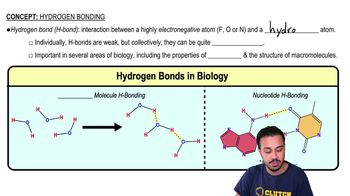
Hydrogen Bonding

Hydrogen Bonds

Hydrogen bonds are weak attractions that occur between a hydrogen atom covalently bonded to an electronegative atom and another electronegative atom. In the context of an α-helix, hydrogen bonds form between the carbonyl oxygen of one amino acid and the amide hydrogen of another, stabilizing the helical structure. This interaction is crucial for maintaining the secondary structure of proteins.
Recommended video:
Guided course
05:03
Hydrogen Bonding

Secondary Structure

Secondary structure refers to the local folded structures that form within a protein due to interactions between the backbone of the polypeptide chain. Common types include α-helices and β-pleated sheets, which are stabilized by hydrogen bonds. Understanding secondary structure is vital for grasping how proteins achieve their functional shapes and roles in biological processes.
Recommended video:
Guided course
03:18
What is Trophic Structure?
Related Practice
Textbook Question

What two functional groups are bound to the central carbon of every free amino acid monomer?

a. An R-group and a hydroxyl group

b. An N—H group and a (C═O) group

c. An amino group and a hydroxyl group

d. An amino group and a carboxyl group

2405
views
Textbook Question
What are the defining characteristics of a condensation reaction?a. Two monomers are covalently bonded together and a water molecule is produced.b. Two monomers are covalently bonded together and a water molecule is used up.c. A polymer is broken down into monomers and a water molecule is produced.d. A polymer is broken down into monomers and a water molecule is used up.
2771
views
Textbook Question

What type of information is used to direct different polypeptides to fold into different shapes?

1701
views
Textbook Question

Which of the following correctly describe an active site? Select True or False for each statement.

T/F It is the location in an enzyme where substrates bind.

T/F It is the place where a molecule or ion binds to an inactive enzyme to induce a shape change to make it active.

T/F It is the portion of an enzyme where chaperones bind to help enzymes fold.

T/F It is the site on an enzyme where catalysis occurs.

1903
views
Textbook Question

If a cell were to use only 10 of the 20 possible amino acids, how much effect would you expect this to have on protein diversity? Calculate and compare the number of different sequences that can be generated by randomly assembling either 10 or 20 amino acids into peptides that are five residues long.

1653
views