

Pearson+ LogoPearson+ Logo
Ch. 31 - Protostome Animals
Freeman - Biological Science 7th Edition
Freeman7th EditionBiological ScienceISBN: 9783584863285Not the one you use?Change textbook
Chapter 31, Problem 4

Which of these characteristics does not apply to cnidarians?a. are diploblasticb. possess a gastrovascular cavity with one openingc. undergo metamorphosisd. have a central nervous system

Verified step by step guidance
1
Identify the characteristics of cnidarians: Cnidarians, including jellyfish, corals, and sea anemones, are known for certain key characteristics.
Understand the term 'diploblastic': This term refers to organisms that develop from two embryonic layers - ectoderm and endoderm. Cnidarians are diploblastic.
Review the gastrovascular cavity function: Cnidarians have a gastrovascular cavity that serves both digestive and circulatory functions, and it typically has only one opening that acts as both mouth and anus.
Examine the concept of metamorphosis in cnidarians: Many cnidarians undergo metamorphosis during their life cycle, transitioning from larval to adult forms.
Analyze the nervous system structure: Cnidarians possess a nerve net, which is a simple type of nervous system, but they do not have a centralized nervous system as seen in more complex animals.

Verified video answer for a similar problem:

This video solution was recommended by our tutors as helpful for the problem above.
Video duration:
1m
Was this helpful?

Key Concepts

Here are the essential concepts you must grasp in order to answer the question correctly.

Cnidarian Characteristics

Cnidarians are a group of animals that include jellyfish, corals, and sea anemones. They are characterized by their radial symmetry, presence of specialized cells called cnidocytes for capturing prey, and a body plan that includes a gastrovascular cavity with a single opening serving as both mouth and anus.
Recommended video:
Guided course
09:26
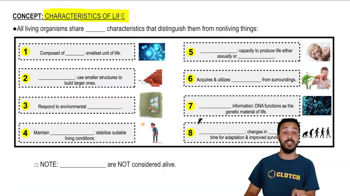
Characteristics of Life

Diploblastic Organization

Diploblastic organisms, like cnidarians, have two primary germ layers: the ectoderm and the endoderm. This contrasts with triploblastic organisms, which have a third layer called mesoderm. The diploblastic structure contributes to the simpler body organization and functions of cnidarians.
Recommended video:
Guided course
06:52
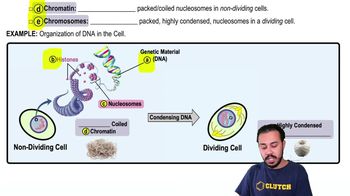
Organization of DNA in the Cell

Metamorphosis in Animals

Metamorphosis is a biological process involving significant physical changes in an organism's form during its life cycle, commonly seen in insects and amphibians. Cnidarians do not undergo metamorphosis; instead, they typically have a life cycle that includes polyp and medusa stages, but these do not involve the drastic transformations characteristic of metamorphosis.
Recommended video:
Guided course
05:58
Overview of Animals - 1