

Pearson+ LogoPearson+ Logo
Ch. 32 - Deuterostome Animals
Freeman - Biological Science 7th Edition
Freeman7th EditionBiological ScienceISBN: 9783584863285Not the one you use?Change textbook
Chapter 32, Problem 17a

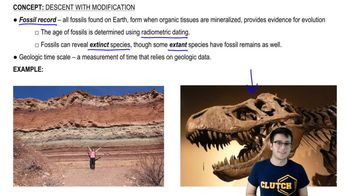
The size and shape of the vertebrate skull can reveal a great deal about an animal's lifestyle and evolutionary relationships. Consider your own skull. If you put your finger in your ear and move your jaw up and down, you can feel the space near the hinge of your jaw. Nestled in this space are the tiny bones that make your hearing possible: the malleus, incus, and stapes. All mammals have these three ear bones, but reptiles such as this T. rex don't.
Where did ear bones come from?

Verified step by step guidance
1
Understand the evolutionary significance of the mammalian ear bones: The malleus, incus, and stapes are crucial for hearing in mammals. These bones evolved from structures that were originally part of the jaw in ancestral species.
Explore the concept of homologous structures: Homologous structures are anatomical features that share a common ancestry but may serve different functions in modern species. The mammalian ear bones are homologous to certain jaw bones found in reptiles.
Investigate the evolutionary transition from jaw bones to ear bones: In early vertebrates, the jaw was composed of several bones. Over time, some of these bones were repurposed to improve hearing capabilities, leading to the development of the middle ear bones in mammals.
Examine fossil evidence: Fossils of transitional species, such as therapsids, provide evidence of the gradual shift from jaw bones to ear bones. These fossils show intermediate stages where the bones served dual functions in both the jaw and hearing.
Consider the role of natural selection: Natural selection favored individuals with improved hearing abilities, leading to the gradual refinement of the ear bones. This adaptation allowed mammals to better detect sounds, enhancing their survival and reproductive success.

Verified video answer for a similar problem:

This video solution was recommended by our tutors as helpful for the problem above.
Video duration:
2m
Was this helpful?

Key Concepts

Here are the essential concepts you must grasp in order to answer the question correctly.

Evolution of Ear Bones

The evolution of ear bones in mammals is a fascinating example of anatomical adaptation. The malleus, incus, and stapes are derived from jaw bones of ancestral reptiles, showcasing a transition from jaw function to auditory function. This evolutionary change highlights the complex modifications that occur over time to enhance survival and sensory capabilities in mammals.
Recommended video:
Guided course
05:22
Convergent and Divergent Evolution

Comparative Anatomy

Comparative anatomy involves studying the similarities and differences in the anatomy of different species. By examining the vertebrate skulls, scientists can infer lifestyle adaptations and evolutionary relationships. The presence of specific structures, like ear bones in mammals, provides insights into how species have evolved differently to adapt to their environments.
Recommended video:
Guided course
08:18
Leaf & Chloroplast Anatomy

Mammalian Auditory System

The mammalian auditory system is characterized by the presence of three middle ear bones: the malleus, incus, and stapes. These bones play a crucial role in transmitting sound vibrations from the eardrum to the inner ear, allowing for enhanced hearing capabilities. This system is a key adaptation that distinguishes mammals from other vertebrates, such as reptiles, which lack these specialized structures.
Recommended video:
Guided course
09:19
Immune System
Related Practice
Textbook Question

The size and shape of the vertebrate skull can reveal a great deal about an animal's lifestyle and evolutionary relationships. Consider your own skull. If you put your finger in your ear and move your jaw up and down, you can feel the space near the hinge of your jaw. Nestled in this space are the tiny bones that make your hearing possible: the malleus, incus, and stapes. All mammals have these three ear bones, but reptiles such as this T. rex don't. Where did ear bones come from? Gene expression patterns can be used to test hypotheses based on morphology. For example, the regulatory gene Bapx1 is expressed in the hinge of the developing lower jaw in fishes and reptiles.

Where would you predict Bapx1 expression to occur in mammals?

469
views
Textbook Question

The size and shape of the vertebrate skull can reveal a great deal about an animal's lifestyle and evolutionary relationships. Consider your own skull. If you put your finger in your ear and move your jaw up and down, you can feel the space near the hinge of your jaw. Nestled in this space are the tiny bones that make your hearing possible: the malleus, incus, and stapes. All mammals have these three ear bones, but reptiles such as this T. rex don't. Where did ear bones come from? Researchers studied mice embryos as a model organism to determine whether the cells of the ear bones originated from the same embryonic cells as the cells that form the jaw in other vertebrates.

Why would the researchers use mice instead of humans?

Do the results from mice tell you something about your own ears? Why or why not?

624
views
Textbook Question

The size and shape of the vertebrate skull can reveal a great deal about an animal's lifestyle and evolutionary relationships. Consider your own skull. If you put your finger in your ear and move your jaw up and down, you can feel the space near the hinge of your jaw. Nestled in this space are the tiny bones that make your hearing possible: the malleus, incus, and stapes. All mammals have these three ear bones, but reptiles such as this T. rex don't.

Where did ear bones come from?

Evolution often results in the co-option of a preexisting structure for a new use. Cite three examples from this chapter to support this statement.

Evolution can also result in the loss of a trait. Cite three examples from this chapter.

609
views