Pearson+ LogoPearson+ Logo
Ch. 39 - Animal Form and Function
Freeman - Biological Science 7th Edition
Freeman7th EditionBiological ScienceISBN: 9783584863285Not the one you use?Change textbook
Chapter 39, Problem 15

Many species of animals on islands are larger than related species on the mainland. Scientists hypothesize that this phenomenon, called island gigantism, evolved in response to the scarcity of competitors and predators on islands. Reduced competition and predation allow species to exploit more resources and free them from the need to hide in small refuges. Suppose that a small mainland tortoise and a large island tortoise are placed in the same pen at a zoo.
Which tortoise will be more poikilothermic, the small or large tortoise? Why?

Verified step by step guidance
1
Understand the concept of poikilothermy: Poikilothermic animals, also known as ectotherms, have body temperatures that vary with the environment. They rely on external sources of heat to regulate their body temperature.
Consider the size of the tortoises: Larger animals generally have a lower surface area-to-volume ratio compared to smaller animals. This means they lose heat more slowly and can maintain a more stable internal temperature.
Analyze the environmental conditions: In the zoo pen, both tortoises are exposed to the same environmental conditions. However, the larger tortoise, due to its size, may be able to retain heat better than the smaller tortoise.
Evaluate the implications of island gigantism: Island gigantism may result in larger body sizes that are advantageous for thermoregulation, allowing the tortoise to be less affected by external temperature fluctuations.
Conclude which tortoise is more poikilothermic: Based on the understanding of poikilothermy and the effects of body size on heat retention, the smaller tortoise is likely to be more poikilothermic, as it would be more susceptible to changes in environmental temperature.

Verified video answer for a similar problem:

This video solution was recommended by our tutors as helpful for the problem above.
Video duration:
26s
Was this helpful?

Key Concepts

Here are the essential concepts you must grasp in order to answer the question correctly.

Island Gigantism

Island gigantism refers to the phenomenon where species on islands evolve to be larger than their mainland counterparts. This is often due to reduced competition and predation, allowing species to exploit available resources more freely. The lack of predators and competitors can lead to evolutionary changes that favor larger body sizes, which can be advantageous in resource-rich environments.
Recommended video:
Guided course
03:48
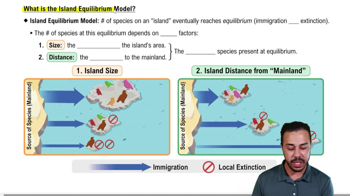
What is the Island Equilibrium Model?

Poikilothermy

Poikilothermy is a biological term describing organisms whose internal temperature varies considerably. Unlike homeotherms, poikilotherms do not maintain a constant body temperature and are influenced by external environmental conditions. This trait is common in reptiles, where body temperature can fluctuate based on ambient temperature, affecting metabolic rates and activity levels.
Recommended video:
Guided course
09:51
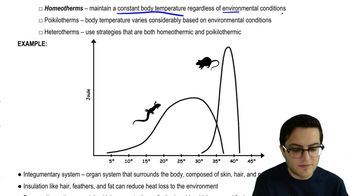
Thermoregulation

Thermal Regulation in Tortoises

Thermal regulation in tortoises involves balancing body temperature with environmental conditions. Larger tortoises, due to their size, have a greater thermal inertia, meaning they change temperature more slowly than smaller tortoises. This can make larger tortoises less poikilothermic, as their size helps buffer against rapid temperature changes, allowing them to maintain a more stable internal temperature.
Recommended video:
Guided course
04:07
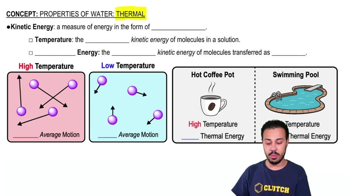
Properties of Water- Thermal
Related Practice
Textbook Question

Many species of animals on islands are larger than related species on the mainland. Scientists hypothesize that this phenomenon, called island gigantism, evolved in response to the scarcity of competitors and predators on islands. Reduced competition and predation allow species to exploit more resources and free them from the need to hide in small refuges.

Which tortoises, mainland or island, need to eat more food per gram of their body mass?

573
views
Textbook Question

Many species of animals on islands are larger than related species on the mainland. Scientists hypothesize that this phenomenon, called island gigantism, evolved in response to the scarcity of competitors and predators on islands. Reduced competition and predation allow species to exploit more resources and free them from the need to hide in small refuges. Which of the following might be a trade-off of gigantism experienced by giant island tortoises?

a. They cool very rapidly during cold weather.

b. It would be difficult to sustain their high mass-specific metabolic rates on a diet of plants alone.

c. It could be more difficult to avoid thermally unfavorable conditions.

d. They could hide from nonnative predators more easily.

533
views
Textbook Question

Many species of animals on islands are larger than related species on the mainland. Scientists hypothesize that this phenomenon, called island gigantism, evolved in response to the scarcity of competitors and predators on islands. Reduced competition and predation allow species to exploit more resources and free them from the need to hide in small refuges.

True or false: The body temperatures of island tortoises always closely match the temperatures in their environments.

599
views
Textbook Question

Many species of animals on islands are larger than related species on the mainland. Scientists hypothesize that this phenomenon, called island gigantism, evolved in response to the scarcity of competitors and predators on islands. Reduced competition and predation allow species to exploit more resources and free them from the need to hide in small refuges. On a trip to the Galápagos Islands, you overhear a group of tourists refer to tortoises as 'cold blooded.'

Explain why this word is not accurate to describe a giant tortoise.

959
views