Pearson+ LogoPearson+ Logo
Ch. 42 - Gas Exchange and Circulation
Freeman - Biological Science 7th Edition
Freeman7th EditionBiological ScienceISBN: 9783584863285Not the one you use?Change textbook
Chapter 42, Problem 7

Carp are fishes that thrive in stagnant-water habitats with low oxygen partial pressure. Compared with the hemoglobin of many other fish species, carp hemoglobin has an extremely high affinity for O₂.
Draw an oxygen–hemoglobin equilibrium curve showing separate lines for carp and a fish that lives in water with a higher oxygen partial pressure.
Explain why they differ.

Verified step by step guidance
1
Begin by understanding the concept of oxygen–hemoglobin equilibrium curves. These curves represent the relationship between the partial pressure of oxygen (pO2) and the saturation of hemoglobin with oxygen. The curve typically has a sigmoidal shape due to cooperative binding of oxygen to hemoglobin.
Consider the environmental conditions: Carp live in stagnant water with low oxygen partial pressure, while other fish may live in environments with higher oxygen levels. This difference in habitat influences the hemoglobin's affinity for oxygen.
Draw two separate curves on a graph with pO2 on the x-axis and hemoglobin saturation on the y-axis. The curve for carp should be positioned to the left, indicating higher affinity for oxygen at lower pO2 levels. This means carp hemoglobin becomes saturated with oxygen even when oxygen levels are low.
Draw the curve for a fish living in higher oxygen partial pressure environments to the right of the carp's curve. This curve will show lower affinity for oxygen, meaning the hemoglobin requires higher pO2 to become saturated.
Explain the difference: Carp hemoglobin has evolved to have a higher affinity for oxygen to efficiently bind oxygen in low pO2 environments, ensuring survival in stagnant waters. In contrast, fish in higher oxygen environments have hemoglobin with lower affinity, as oxygen is more readily available.

Verified video answer for a similar problem:

This video solution was recommended by our tutors as helpful for the problem above.
Video duration:
2m
Was this helpful?

Key Concepts

Here are the essential concepts you must grasp in order to answer the question correctly.

Oxygen-Hemoglobin Equilibrium Curve

The oxygen-hemoglobin equilibrium curve illustrates the relationship between the partial pressure of oxygen and the saturation of hemoglobin with oxygen. It is typically sigmoidal, reflecting cooperative binding. The position and shape of the curve can vary among species, indicating differences in hemoglobin's affinity for oxygen, which is crucial for understanding how different fish adapt to varying oxygen levels in their environments.
Recommended video:
Guided course
10:50
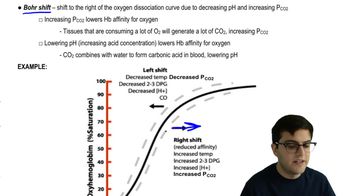
Oxygen Dissociation Curve and the Bohr Shift

Hemoglobin Affinity for Oxygen

Hemoglobin affinity for oxygen refers to how readily hemoglobin binds to oxygen molecules. High affinity means hemoglobin binds oxygen easily, even at low partial pressures, which is advantageous for carp living in low-oxygen environments. Conversely, fish in high-oxygen environments may have hemoglobin with lower affinity, allowing for efficient oxygen release to tissues. This concept explains the differences in the equilibrium curves between carp and other fish.
Recommended video:
Guided course
10:50
Oxygen Dissociation Curve and the Bohr Shift

Adaptation to Oxygen Availability

Adaptation to oxygen availability involves physiological changes that enable organisms to survive in environments with varying oxygen levels. Carp have evolved hemoglobin with high oxygen affinity to thrive in stagnant waters with low oxygen. This adaptation is reflected in their oxygen-hemoglobin equilibrium curve, which shifts left compared to fish in oxygen-rich environments, highlighting evolutionary strategies for survival in diverse habitats.
Recommended video:
01:34
Adaptive Radiation Example 2