
Pearson+ LogoPearson+ Logo
Ch. 44 - Animal Sensory Systems
Freeman - Biological Science 7th Edition
Freeman7th EditionBiological ScienceISBN: 9783584863285Not the one you use?Change textbook
Chapter 44, Problem 4

What type of sensory system do migrating birds use to detect direction?

Verified step by step guidance
1
Migrating birds use a variety of sensory systems to detect direction, one of which is the magnetic sense. They can detect the Earth's magnetic field and use it to orient themselves during migration.
Birds have specialized cells called magnetoreceptors, which contain magnetic particles, that allow them to sense magnetic fields. These cells are often located in the beak or the eye region.
In addition to the magnetic sense, birds also use the position of the sun and stars as a compass for direction during migration. This is known as celestial navigation.
Some species of birds also use their sense of smell to navigate over long distances, detecting odors that are carried by the wind to guide them.
Birds integrate these sensory inputs with their internal circadian clock, which helps them determine the time of day and adjust their navigation accordingly.

Verified video answer for a similar problem:

This video solution was recommended by our tutors as helpful for the problem above.
Video duration:
1m
Was this helpful?

Key Concepts

Here are the essential concepts you must grasp in order to answer the question correctly.

Magnetoreception

Magnetoreception is the ability of certain animals, including migrating birds, to detect the Earth's magnetic field and use it for navigation. This sensory system allows birds to orient themselves and determine direction during long migrations, often over vast distances. It is believed that specialized cells containing magnetite or cryptochrome proteins in their eyes play a crucial role in this process.
Recommended video:
Guided course
02:54
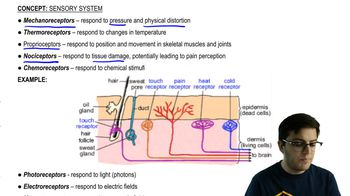
Sensory Receptors

Visual Cues

Visual cues are essential for navigation in birds, especially during migration. Birds use landmarks, the position of the sun, and the stars to guide their flight paths. These visual signals help them to maintain their direction and adjust their course as needed, particularly when flying in unfamiliar territories.
Recommended video:

Circadian Rhythms

Circadian rhythms are internal biological clocks that regulate various physiological processes in organisms, including birds. These rhythms influence migratory behavior by helping birds determine the time of day and season, which is critical for timing their migrations. Understanding these rhythms allows birds to optimize their travel routes and timing for feeding and breeding.
Recommended video:
Guided course
04:34
Photoderiodism
Related Practice
Textbook Question

In the human ear, how do different hair cells respond to different frequencies of sound?

a. Waves of pressure move through the fluid in the cochlea.

b. Hair cells are 'sandwiched' between membranes.

c. Receptor proteins in the stereocilia of each hair cell are different; each protein responds to a certain range of frequencies.

d. Because the basilar membrane varies in stiffness, it vibrates in certain places in response to certain frequencies.

1629
views
Textbook Question

Evaluate the following statements according to the information presented in this chapter. Select True or False for each statement.

T/F Most human eyes have one type of rod and three types of cones.

T/F Rods are more sensitive to dim light than cones are.

T/F Nocturnal animals have fewer rods than diurnal animals.

T/F Both rods and cones use retinal and opsins to detect light.

743
views
Textbook Question

Which of these statements about taste is true?

a. Sweetness is a measure of the concentration of hydrogen ions in food.

b. Sodium ions from foods can directly depolarize certain taste cells.

c. All bitter-tasting compounds have a similar chemical structure.

d. Sourness is detected when hydrogen ions bind to membrane receptors.

766
views
Textbook Question

Considering that sounds and odors both trigger changes in the patterns of action potentials in sensory neurons, how does the brain perceive which sense is which when the action potentials reach the brain?

a. The action potentials stimulated by sounds are different in size and shape from those stimulated by odors.

b. The axons from different sensory neurons go to different areas of the brain.

c. Mechanoreception is not consciously perceived by the brain, whereas chemoreception is.

d. Chemoreception is not consciously perceived by the brain, whereas mechanoreception is.

882
views
Textbook Question

Give three examples of how the sensory abilities of an animal correlate with its habitat or method of finding food and mates.

727
views
Textbook Question

Compare and contrast the lateral line system of fishes with electroreception in sharks.

1093
views