Pearson+ LogoPearson+ Logo
Ch. 44 - Animal Sensory Systems
Freeman - Biological Science 7th Edition
Freeman7th EditionBiological ScienceISBN: 9783584863285Not the one you use?Change textbook
Chapter 44, Problem 7

Compare and contrast the lateral line system of fishes with electroreception in sharks.

Verified step by step guidance
1
Step 1: Understand the concepts: The lateral line system in fishes is a sensory system that allows them to detect movement and vibration in the surrounding water. It consists of a series of sensory organs known as neuromasts, located in a line along the sides of the fish. Electroreception, on the other hand, is a sensory system found in sharks (and some other aquatic animals) that allows them to detect electric fields produced by other organisms. This is achieved through specialized sensory organs known as ampullae of Lorenzini.
Step 2: Compare the two systems: Both the lateral line system and electroreception are sensory systems that provide aquatic animals with information about their environment. They both involve specialized sensory organs (neuromasts in the lateral line system, ampullae of Lorenzini in electroreception) that detect specific types of stimuli (movement and vibration for the lateral line system, electric fields for electroreception).
Step 3: Contrast the two systems: While both systems provide sensory information, they differ in the type of information they provide. The lateral line system is primarily used for detecting movement and vibration, which can help a fish avoid predators, locate prey, and navigate its environment. Electroreception, on the other hand, is used to detect the electric fields produced by other organisms, which can help a shark locate prey, even when it is hidden in sand or mud.
Step 4: Understand the evolutionary significance: The lateral line system is found in most fishes, suggesting that it is a fundamental part of fish sensory perception. Electroreception, on the other hand, is found in a smaller number of aquatic animals, including sharks, rays, and some species of fish. This suggests that electroreception may have evolved later and in response to specific environmental pressures.
Step 5: Summarize the comparison: In summary, while both the lateral line system and electroreception provide important sensory information to aquatic animals, they differ in the type of information they provide and the organisms in which they are found.

Verified video answer for a similar problem:

This video solution was recommended by our tutors as helpful for the problem above.
Video duration:
2m
Was this helpful?

Key Concepts

Here are the essential concepts you must grasp in order to answer the question correctly.

Lateral Line System

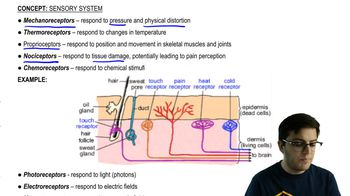
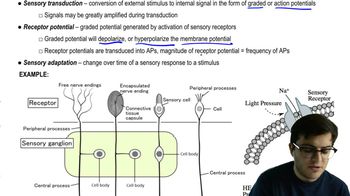
The lateral line system is a sensory organ found in aquatic vertebrates, including fishes, that detects water movements and vibrations. It consists of a series of mechanoreceptors called neuromasts, which are arranged in lines along the sides of the fish's body. This system allows fish to sense their environment, navigate, and detect predators or prey, enhancing their survival in aquatic habitats.
Recommended video:
Guided course
09:19
Immune System

Electroreception

Electroreception is the ability of certain aquatic animals, such as sharks, to detect electric fields generated by other organisms. This sensory capability is facilitated by specialized organs called ampullae of Lorenzini, which are sensitive to minute electrical signals in the water. Electroreception is crucial for locating prey, especially in murky waters where visibility is low, allowing sharks to hunt effectively.
Recommended video:
Guided course
02:54
Sensory Receptors

Comparative Sensory Systems

Comparative sensory systems involve analyzing how different organisms perceive their environment through various sensory modalities. In the case of fishes and sharks, both the lateral line system and electroreception serve to enhance their ability to detect stimuli in aquatic environments, but they operate through different mechanisms. Understanding these systems highlights the evolutionary adaptations that enable these species to thrive in their respective ecological niches.
Recommended video:
Guided course
06:25
Sensory Systems
Related Practice
Textbook Question

What type of sensory system do migrating birds use to detect direction?

804
views
Textbook Question

Considering that sounds and odors both trigger changes in the patterns of action potentials in sensory neurons, how does the brain perceive which sense is which when the action potentials reach the brain?

a. The action potentials stimulated by sounds are different in size and shape from those stimulated by odors.

b. The axons from different sensory neurons go to different areas of the brain.

c. Mechanoreception is not consciously perceived by the brain, whereas chemoreception is.

d. Chemoreception is not consciously perceived by the brain, whereas mechanoreception is.

882
views
Textbook Question

Give three examples of how the sensory abilities of an animal correlate with its habitat or method of finding food and mates.

727
views
Textbook Question

Scientists generally think that a 'good hypothesis' is one that is reasonable and testable and inspires further research into a phenomenon. Using these criteria, explain whether Dalton's hypothesis about color vision was a good hypothesis. Was it correct?

803
views
Textbook Question

Scientists collected data on the date of onset of the menstrual cycles in a group of women who moved into a college dormitory together in the fall. The y-axis of the graph shows the mean difference (in days) between the onset of a woman's cycle and the average onset date of the rest of the women. Evaluate whether these data provide evidence for the existence of a human pheromone.

603
views
Textbook Question

Design experiments to test the hypothesis that electric eels are both electrogenic and electroreceptive.

796
views