Pearson+ LogoPearson+ Logo
Ch. 47 - Animal Reproduction and Development
Freeman - Biological Science 7th Edition
Freeman7th EditionBiological ScienceISBN: 9783584863285Not the one you use?Change textbook
Chapter 47, Problem 7

How do spermatogenesis and oogenesis in humans differ with respect to numbers of cells produced, gamete size, and timing of the second meiotic division?

Verified step by step guidance
1
Step 1: Understand the terms. Spermatogenesis is the process of formation of sperm cells in males, while oogenesis is the process of formation of egg cells or ova in females. Both processes involve meiosis, a type of cell division that results in four daughter cells each with half the number of chromosomes of the parent cell.
Step 2: Compare the number of cells produced. In spermatogenesis, one primary spermatocyte (the cell that undergoes meiosis) produces four sperm cells. In contrast, one primary oocyte in oogenesis produces only one mature egg cell or ovum. The other three cells, known as polar bodies, are much smaller and usually degenerate.
Step 3: Compare the size of the gametes. Sperm cells are much smaller than egg cells. This is because the cytoplasm of the primary oocyte is unequally divided during oogenesis, with most of the cytoplasm going to the egg cell. The polar bodies receive very little cytoplasm and are much smaller.
Step 4: Compare the timing of the second meiotic division. In spermatogenesis, the second meiotic division is completed before the sperm cells are fully mature. In oogenesis, the second meiotic division is not completed unless the egg is fertilized. If fertilization occurs, the second meiotic division is completed just before the sperm nucleus merges with the egg nucleus.
Step 5: Summarize the differences. Spermatogenesis produces four sperm cells from each primary spermatocyte, while oogenesis produces one egg cell and three polar bodies from each primary oocyte. Sperm cells are much smaller than egg cells. The second meiotic division is completed before sperm cells are fully mature, but in oogenesis, it is not completed unless the egg is fertilized.

Verified video answer for a similar problem:

This video solution was recommended by our tutors as helpful for the problem above.
Video duration:
1m
Was this helpful?

Key Concepts

Here are the essential concepts you must grasp in order to answer the question correctly.

Spermatogenesis

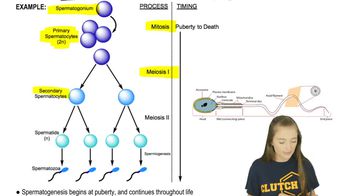
Spermatogenesis is the process of sperm cell development in males, occurring in the testes. It results in the production of four viable sperm cells from each precursor cell through two rounds of meiosis. This process is continuous and begins at puberty, with sperm being produced throughout a male's life.
Recommended video:
Guided course
12:51
Spermatogenesis

Oogenesis

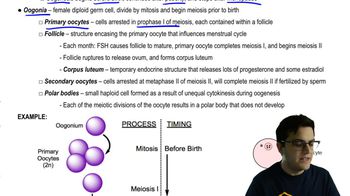
Oogenesis is the process of egg cell development in females, taking place in the ovaries. Unlike spermatogenesis, oogenesis produces only one viable ovum from each precursor cell, with the other three cells forming polar bodies that typically degenerate. This process begins before birth and is completed only upon fertilization, leading to a significant difference in timing compared to spermatogenesis.
Recommended video:

Meiotic Division Timing

In spermatogenesis, the second meiotic division occurs continuously, producing mature sperm ready for fertilization. In contrast, oogenesis involves a prolonged pause in the second meiotic division, which resumes only upon fertilization. This difference in timing affects the availability of gametes and the overall reproductive strategy in humans.
Recommended video:
Guided course
09:40
Introduction to Cell Division