Pearson+ LogoPearson+ Logo
Ch. 47 - Animal Reproduction and Development
Freeman - Biological Science 7th Edition
Freeman7th EditionBiological ScienceISBN: 9783584863285Not the one you use?Change textbook
Chapter 47, Problem 7

What is the connection between genetic regulatory cascades and the observation that differentiation is a step-by-step process?

Verified step by step guidance
1
Understand the concept of genetic regulatory cascades: Genetic regulatory cascades involve a series of gene activations where one gene product regulates the next, creating a chain reaction. This is crucial in controlling the expression of genes that are responsible for various biological processes.
Recognize the role of transcription factors: In genetic regulatory cascades, transcription factors play a key role. These proteins bind to specific DNA sequences and regulate the transcription of downstream genes, which can lead to the production of other transcription factors or functional proteins.
Link to cellular differentiation: During differentiation, a cell transforms from one type to another and acquires specific functions. This process is controlled by the sequential activation and repression of genes, which is orchestrated by the genetic regulatory cascades.
Examine the step-by-step nature of differentiation: Differentiation is a step-by-step process because each step in the genetic regulatory cascade prepares the cell for the next phase of differentiation. The precise timing and order of gene expression are critical for the proper development and function of the differentiated cell.
Explore the implications for developmental biology: Understanding genetic regulatory cascades helps explain how complex organisms develop from a single cell (zygote) through a series of orderly and tightly regulated steps. This knowledge is fundamental in fields like developmental biology and has implications for medical science, particularly in understanding developmental disorders and potential regenerative therapies.

Verified video answer for a similar problem:

This video solution was recommended by our tutors as helpful for the problem above.
Video duration:
2m
Was this helpful?

Key Concepts

Here are the essential concepts you must grasp in order to answer the question correctly.

Genetic Regulatory Cascades

Genetic regulatory cascades refer to a series of molecular events where the expression of genes is controlled in a hierarchical manner. These cascades involve transcription factors and signaling pathways that activate or repress target genes, leading to specific cellular outcomes. They are crucial in developmental biology as they dictate the timing and sequence of gene expression necessary for proper cell differentiation.
Recommended video:
Guided course
02:35
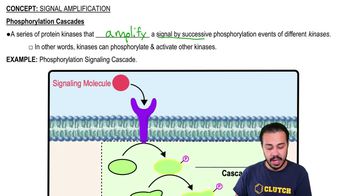
Phosphorylation Cascades

Cell Differentiation

Cell differentiation is the process by which a less specialized cell becomes a more specialized cell type. This process is essential for the development of multicellular organisms, allowing for the formation of various tissues and organs. Differentiation occurs in a step-by-step manner, often influenced by genetic regulatory cascades, which ensure that cells acquire specific identities and functions at the right time.
Recommended video:
Guided course
05:28
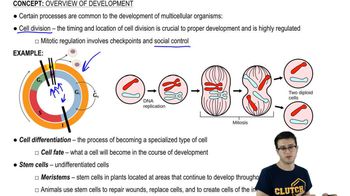
Cell Division and Differentiation

Step-by-Step Process

The step-by-step process in differentiation refers to the sequential activation of genes that leads to the gradual change in cell identity. This process is tightly regulated and often involves feedback mechanisms that ensure cells respond appropriately to internal and external signals. Understanding this sequential nature helps explain how complex organisms develop from a single fertilized egg into diverse cell types.
Recommended video:
Guided course
04:39
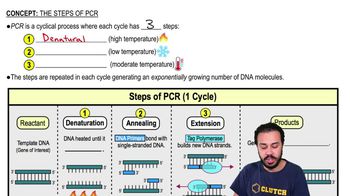
The Steps of PCR
Related Practice
Textbook Question
A friend is interested in isolating genes that are expressed solely in liver cells but only has access to skin cells. She asks you for advice on whether to start her studies. What will you say?
737
views
Textbook Question

Many frogs and mice are similar in size, yet a frog egg is vastly larger than a mouse egg. Propose a plausible explanation for this difference in the egg size.

792
views
Textbook Question

How do spermatogenesis and oogenesis in humans differ with respect to numbers of cells produced, gamete size, and timing of the second meiotic division?

1228
views
Textbook Question

Give examples of negative and positive feedback in hormonal control of the human menstrual cycle. Why can a high estradiol level be considered a 'readiness' signal from a follicle?

1398
views
Textbook Question

Propose an experiment to test the hypothesis that cells from only one region of a frog blastula form the ectoderm. What results from this experiment would support this hypothesis?

597
views
Textbook Question

The BMI z-score is a relative measure of body mass index (BMI) that takes into account age. Higher values represent heavier individuals for a given height. The table here shows the BMI z-score of pre- and post-pubertal girls at three ages.

Which of the following conclusions can you draw from the data?

a. At a given age, there are more girls with low BMI z-scores than with high BMI z-scores.

b. At a given age, girls with high BMI z-scores are more likely to have begun puberty than girls with low BMI z-scores.

c. Girls 11, 12, and 13 years of age are equally likely to have begun puberty.

d. There is no relationship between BMI z-score and age of beginning puberty.

1628
views