
Pearson+ LogoPearson+ Logo
Ch. 54 - Biodiversity and Conservation Ecology
Freeman - Biological Science 7th Edition
Freeman7th EditionBiological ScienceISBN: 9783584863285Not the one you use?Change textbook
Chapter 54, Problem 2

What community property does the red arrow in the model represent?
a. Low resilience
b. High resilience
c. Low resistance
d. High resistance
Graph showing biomass over time with arrows indicating disturbance effects and resilience levels.

Verified step by step guidance
1
Observe the graph which shows biomass on the y-axis and time on the x-axis. The graph depicts a disturbance event followed by a decline and then a recovery in biomass.
Identify the red arrow in the graph. It is pointing upwards, indicating a phase of recovery in biomass after a disturbance.
Understand the concept of resilience in ecology, which refers to the ability of a community to recover after a disturbance.
Consider the options provided: low resilience, high resilience, low resistance, and high resistance. Resilience is related to recovery, while resistance is related to the ability to withstand disturbance.
Conclude that the red arrow represents the recovery phase, which is indicative of resilience. The speed and extent of recovery can suggest whether it is high or low resilience.

Verified video answer for a similar problem:

This video solution was recommended by our tutors as helpful for the problem above.
Video duration:
1m
Was this helpful?

Key Concepts

Here are the essential concepts you must grasp in order to answer the question correctly.

Resilience

Resilience refers to the ability of an ecosystem to recover from disturbances and return to its original state. A highly resilient ecosystem can quickly bounce back after a disturbance, maintaining its structure and function. In the context of the graph, resilience is indicated by how quickly the biomass returns to its pre-disturbance level after a disturbance event.
Recommended video:

Resistance

Resistance is the capacity of an ecosystem to withstand disturbances without significant changes to its structure or function. An ecosystem with high resistance will show little to no change in biomass when faced with disturbances, while low resistance ecosystems may experience substantial shifts. The distinction between resilience and resistance is crucial for understanding how ecosystems respond to environmental changes.
Recommended video:

Disturbance

A disturbance is any event that disrupts the structure or function of an ecosystem, such as natural disasters, human activities, or disease outbreaks. Disturbances can lead to changes in biomass, species composition, and overall ecosystem dynamics. The graph illustrates how disturbances impact biomass over time, highlighting the importance of understanding both the immediate and long-term effects on ecosystem health.
Recommended video:
Guided course
03:37
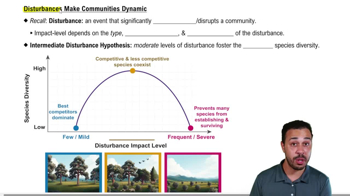
Disturbances Make Communities Dynamic