Pearson+ LogoPearson+ Logo
Ch. 8 - Energy and Enzymes: An Introduction to Metabolism
Freeman - Biological Science 7th Edition
Freeman7th EditionBiological ScienceISBN: 9783584863285Not the one you use?Change textbook
Chapter 8, Problem 4

Explain how feedback inhibition regulates metabolic pathways.

Verified step by step guidance
1
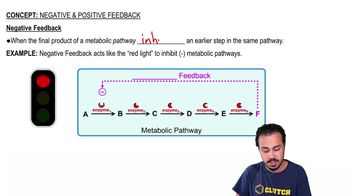
Feedback inhibition is a regulatory mechanism where the end product of a metabolic pathway acts as an inhibitor to an enzyme involved earlier in the pathway, preventing overproduction of the product.
Identify the key enzyme in the pathway, often referred to as the 'rate-limiting enzyme,' which is typically the target of feedback inhibition.
The end product binds to the allosteric site (a site other than the active site) of the enzyme, causing a conformational change in the enzyme's structure.
This conformational change reduces the enzyme's activity, either by decreasing its ability to bind to the substrate or by reducing the catalytic efficiency of the enzyme.
As the concentration of the end product decreases, the inhibition is lifted, allowing the pathway to resume activity, thus maintaining homeostasis in the cell.

Verified video answer for a similar problem:

This video solution was recommended by our tutors as helpful for the problem above.
Video duration:
2m
Was this helpful?

Key Concepts

Here are the essential concepts you must grasp in order to answer the question correctly.

Feedback Inhibition

Feedback inhibition is a regulatory mechanism in metabolic pathways where the end product of a reaction inhibits an earlier step in the pathway. This process helps maintain homeostasis by preventing the overproduction of substances, ensuring that resources are used efficiently. For example, in the synthesis of isoleucine from threonine, isoleucine acts as an inhibitor of the enzyme threonine deaminase, thus regulating its own production.
Recommended video:
Guided course
02:41
Negative Feedback

Metabolic Pathways

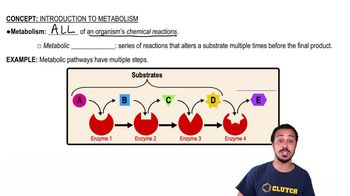
Metabolic pathways are series of chemical reactions occurring within a cell, where the product of one reaction serves as the substrate for the next. These pathways can be catabolic, breaking down molecules for energy, or anabolic, building complex molecules from simpler ones. Understanding these pathways is crucial for comprehending how cells convert nutrients into energy and maintain cellular functions.
Recommended video:
Guided course
02:17
Introduction to Metabolism

Enzyme Regulation

Enzyme regulation refers to the various mechanisms that control enzyme activity and, consequently, the rate of metabolic reactions. This includes feedback inhibition, allosteric regulation, and covalent modification. By regulating enzyme activity, cells can respond to changes in their environment and metabolic needs, ensuring that biochemical processes are finely tuned and efficient.
Recommended video:
Related Practice
Textbook Question

Which of the following correctly describe an exergonic reaction? Select True or False for each statement.

T/F The products have lower Gibbs free energy than the reactants.

T/F Activation energy is required for the reaction to proceed.

T/F The products always have lower entropy than the reactants.

T/F The reaction always occurs quickly.

1955
views
Textbook Question

What is a transition state?

a. The shape adopted by an enzyme that has an inhibitory molecule bound at its active site

b. The amount of kinetic energy required for a reaction to proceed

c. The intermediate complex formed as covalent bonds in the reactants are being broken and re-formed during a reaction

d. The enzyme shape after binding an allosteric regulatory molecule

1776
views
Textbook Question

How does pH affect enzyme-catalyzed reactions?

a. Protons serve as substrates for most reactions.

b. Energy stored in protons is used to drive endergonic reactions.

c. Proton concentration increases the kinetic energy of the reactants, enabling them to reach their transition state.

d. The concentration of protons affects an enzyme's folded structure and reactivity.

1771
views
Textbook Question

Explain the lock-and-key model of enzyme activity. What is incorrect about this model?

2111
views
Textbook Question

If you were to expose glucose to oxygen on your lab bench, why would you not expect to see it burn as described by the reaction in Figure 8.6?

a. The reaction is endergonic and requires an input of energy.

b. The reaction is not spontaneous unless an enzyme is added.

c. The sugar must first be phosphorylated to increase its potential energy.

d. Activation energy is required for the sugar and oxygen to reach their transition state.

1372
views
Textbook Question

In Figure 8.10, the energetic coupling of substrate phosphorylation and an endergonic reaction are shown. If the hydrolysis of ATP releases 7.3 kcal of free energy, use the graph in this figure to estimate what you would expect the ∆G values to be for the uncoupled reaction and the two steps in the coupled reaction.


1739
views