Skip to main content
Calculus
My Course
Learn
Exam Prep
AI Tutor
Study Guides
Textbook Solutions
Flashcards
Explore
Try the app
My Course
Learn
Exam Prep
AI Tutor
Study Guides
Textbook Solutions
Flashcards
Explore
Try the app
Back
Calculus in Polar Coordinates quiz
You can tap to flip the card.
What is the general form for expressing a point in polar coordinates?
You can tap to flip the card.
👆
What is the general form for expressing a point in polar coordinates?
A point in polar coordinates is given as (r, θ), where r is the radial distance from the origin and θ is the angle from the positive x-axis.
Track progress
Control buttons has been changed to "navigation" mode.
1/15
Related flashcards
Related practice
Recommended videos
Calculus in Polar Coordinates definitions
Calculus in Polar Coordinates
15 Terms
Calculus in Polar Coordinates
16. Parametric Equations & Polar Coordinates
5 problems
Topic
Ernest
Conic Sections
16. Parametric Equations & Polar Coordinates
5 problems
Topic
Ernest
16. Parametric Equations & Polar Coordinates
5 topics
14 problems
Chapter
Justin
Guided course
12:18
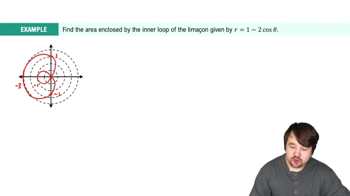
Area of Polar Regions Example 2
222
views
3
rank
1
comments
Guided course
09:04
Slope of Polar Curves
274
views
4
rank
Guided course
05:58
Slope of Polar Curves Example 1
250
views
4
rank
Terms in this set (15)
Hide definitions
What is the general form for expressing a point in polar coordinates?
A point in polar coordinates is given as (r, θ), where r is the radial distance from the origin and θ is the angle from the positive x-axis.
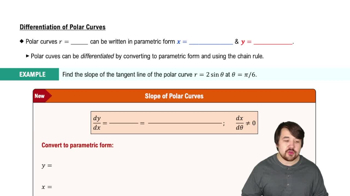
How do you convert a polar curve r = f(θ) into parametric equations for x and y?
Set x = f(θ) cos(θ) and y = f(θ) sin(θ).
What formula is used to find the slope of the tangent line to a polar curve?
The slope is given by dy/dx = (dy/dθ) / (dx/dθ).
When differentiating y = f(θ) sin(θ), what rule do you use?
Use the product rule: derivative of the first times the second plus the first times the derivative of the second.
What is the derivative of y = 2 sin²(θ) with respect to θ?
The derivative is 4 sin(θ) cos(θ), which can also be written as 2 sin(2θ).
How do you find dx/dθ if x = 2 sin(θ) cos(θ)?
dx/dθ = 2 cos(2θ), using the double angle identity for sine.
What trigonometric identity allows you to simplify 2 sin(θ) cos(θ)?
2 sin(θ) cos(θ) = sin(2θ).
If dy/dθ = 2 sin(2θ) and dx/dθ = 2 cos(2θ), what is dy/dx?
dy/dx = tan(2θ).
What is the slope of the tangent line to r = 2 sin(θ) at θ = π/6?
The slope is tan(π/3), which equals √3.
What is the formula for the area of a region bounded by a polar curve r = f(θ) from θ = α to θ = β?
A = (1/2) ∫[α to β] r² dθ.
How do you set up the integral to find the area of one petal of the rose r = 4 sin(2θ)?
Set up the integral as (1/2) ∫[0 to π/2] (4 sin(2θ))² dθ.
What is the value of (4 sin(2θ))²?
It is 16 sin²(2θ).
What trigonometric identity is used to integrate sin²(2θ)?
sin²(2θ) = (1 - cos(4θ))/2.
After applying the identity and simplifying, what does the area integral for one petal of r = 4 sin(2θ) become?
It becomes 4 ∫[0 to π/2] (1 - cos(4θ)) dθ.
What is the area of one petal of the rose curve r = 4 sin(2θ)?
The area is 2π.
 BackBack
 12:18
12:18