Skip to main content
Calculus
My Course
Learn
Exam Prep
AI Tutor
Study Guides
Textbook Solutions
Flashcards
Explore
Try the app
My Course
Learn
Exam Prep
AI Tutor
Study Guides
Textbook Solutions
Flashcards
Explore
Try the app
Back
Continuity definitions
You can tap to flip the card.
Continuity
You can tap to flip the card.
👆
Continuity
Occurs when approaching a point from both sides yields the same value as the function at that point.
Track progress
Control buttons has been changed to "navigation" mode.
1/15
Related flashcards
Related practice
Recommended videos
Continuity quiz #1
Continuity
10 Terms
Continuity
1. Limits and Continuity
4 problems
Topic
David-Paige
Finding Limits Algebraically
1. Limits and Continuity
4 problems
Topic
Ernest
1. Limits and Continuity
3 topics
7 problems
Chapter
Jonathan
05:34
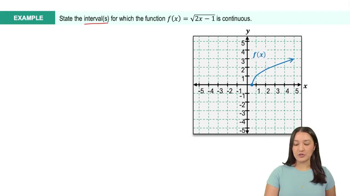
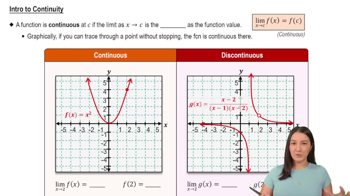
Intro to Continuity
4296
views
123
rank
00:57
Intro to Continuity Example 2
2608
views
65
rank
05:25
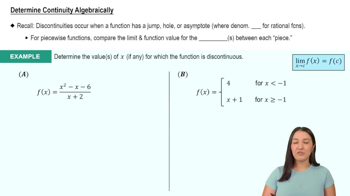
Determine Continuity Algebraically
3064
views
53
rank
Terms in this set (15)
Hide definitions
Continuity
Occurs when approaching a point from both sides yields the same value as the function at that point.
Discontinuity
Arises when a function's limit and value at a point differ, or the limit does not exist.
Limit
Describes the value a function approaches as the input nears a specific point.
Hole
Appears as an undefined point on a graph where the function could be redefined to restore continuity.
Jump Discontinuity
Occurs when the left and right limits at a point differ, causing a sudden change in function value.
Asymptote
Represents a line that a function approaches but never touches, often causing unbounded behavior.
Rational Function
Formed by dividing two polynomials, often exhibiting discontinuities where the denominator is zero.
Piecewise Function
Defined by different expressions over various intervals, possibly causing discontinuities at interval boundaries.
One-Sided Limit
Evaluates the behavior of a function as the input approaches a point from only one direction.
Removable Discontinuity
A type of discontinuity where a hole exists and the function could be redefined to become continuous.
Unbounded Behavior
Describes a function's values increasing or decreasing without limit near a certain point.
Function Value
The output of a function for a specific input, used to compare with the limit for continuity.
Graph Tracing
A visual method for checking continuity by moving a pen along a graph without lifting it.
Denominator Zero
A condition in rational functions that signals potential discontinuities such as holes or asymptotes.
Interval Boundary
A point where different pieces of a piecewise function meet, often requiring special attention for continuity.
 BackBack
 05:34
05:34